The Night the Well Rested
At sundown the well keeper pulled the bucket up as high as the rope would go and tied it off on the crossbar. She wrapped the handle in a dishcloth so it could not clank, because a bucket clanking in the night puts people in mind of water. Then she took the stub of chalk out of her apron and wrote on the side of the bucket, in capitals:
RESTING. Yes, you.
She knew exactly who would try it.
Once a year the meadow well rested. From dusk to first light nobody drew from it, not a bucket and not a cup, and for the rest of the year it ran clear. That was the whole rule. Keeping it was the whole job, and the job took all night, because the rule was simple and people were not.
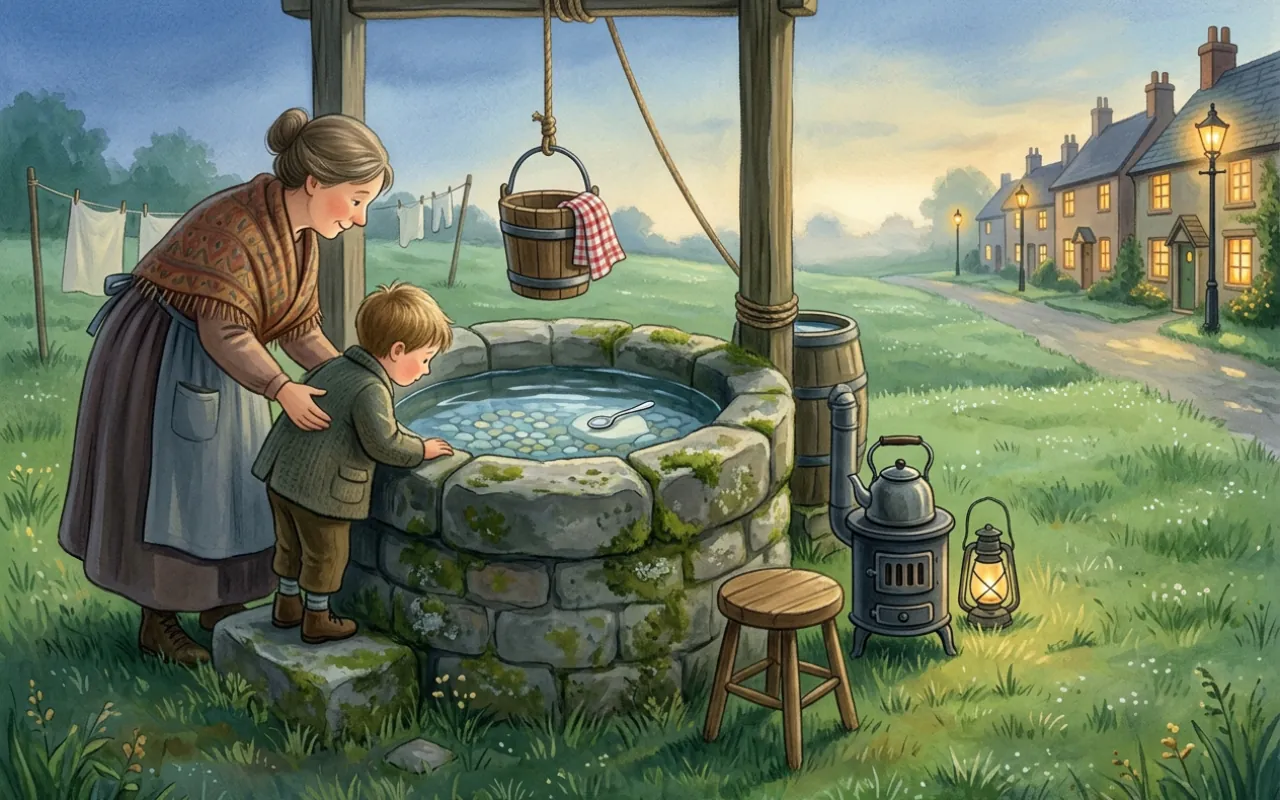
She had a stool, a shawl, a lantern, a tin stove the size of a hatbox, and her kettle, filled the day before. It held four good cups. She did not mean to drink them early. Tea at ten o’clock is wasted on anybody. The cold part of the night comes between two and four, and she was saving the kettle for that.
And at first light, if the well had been let alone, she meant to see the bottom. Nobody sees the bottom of the meadow well on an ordinary day. It is forty feet down. But on the morning after a resting night it is there, as plain as a kitchen floor, with a teaspoon lying on it. The keeper looked in on that teaspoon once a year, the way a person looks in on a neighbour, to see that it was keeping well.
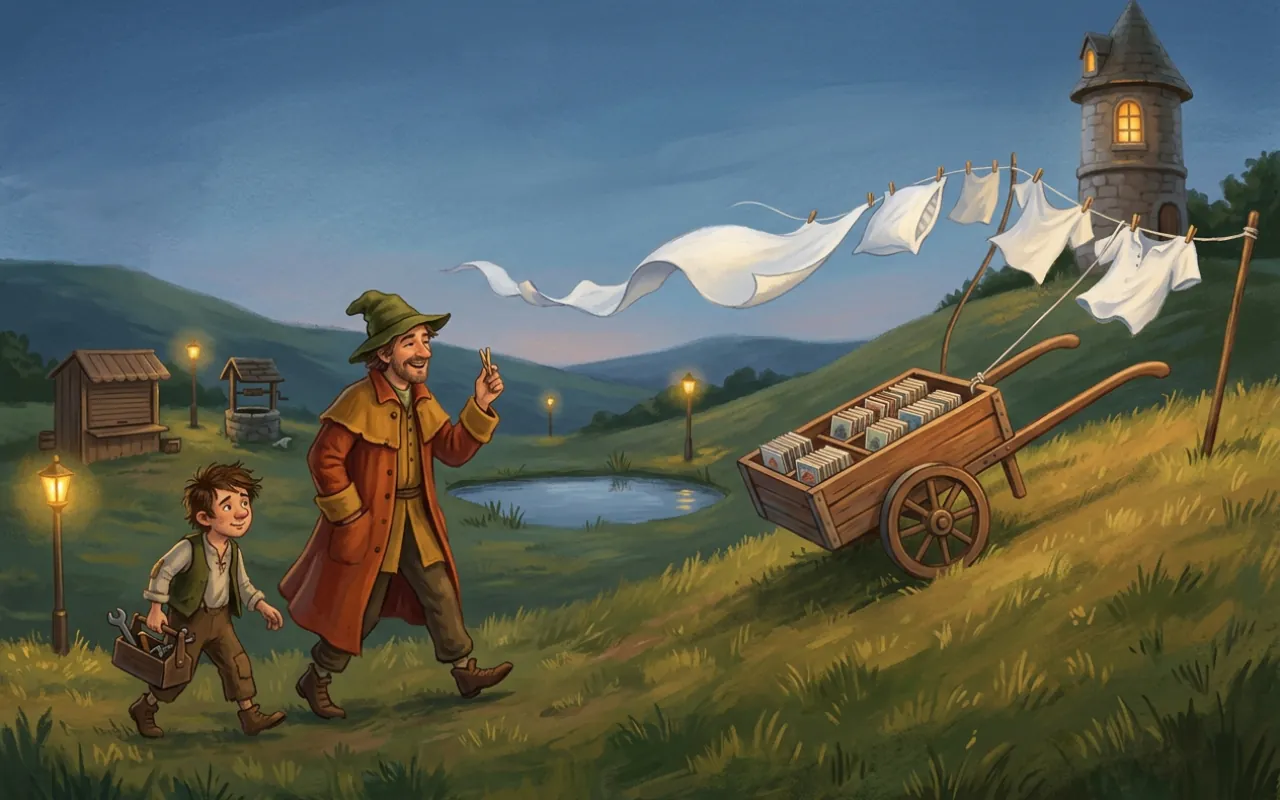
Across the meadow the lamps began to come on, gold in the blue air, one post and then the next. That was Wick. She could tell where he had got to by which lamp was newest. When he reached the lamp by the well he did not go on to the next one. He came over with a cloth in his hand and stood in front of the bucket.
“Resting,” Wick read. “Yes, you.”
People always read it out loud, as if it were news. Wick read it twice, in case it said something different the second time.
“Is that for me?” he said.
“Did you want water?”
“A very little. There’s a thumbprint on number twelve. I think it’s mine. I’ve checked it twice and it’s still there, and people can see it from the lane.” He held up the cloth. “I did know about tonight. I wrote it down. I only wondered whether lamp water counted, because it isn’t really drinking, it’s more…” He looked at her face. “It counts.”
She lifted the kettle and poured onto his cloth.
“Half that,” Wick said. “Thank you. That’s plenty. Thank you.”
He went back to number twelve and wiped it, and checked it twice, and went on with his round. The keeper set the kettle down by the stove. It was lighter than it had been.
At midnight she held the lantern over the well. The water was dark as strong tea, the way it always was, with her own face in it looking unimpressed. But under her face she could just make out the top ring of stones. They were not usually there.
“Good,” she said, and sat back down.
At two o’clock a small boy came up the lane with a jug.
He had a coat on over his nightshirt and his boots on the wrong feet. That was Tam Coldwater, from the third cottage down. His dad stood in their lit doorway with a small girl on his hip, watching Tam all the way up. The keeper raised a hand to the dad, and the dad raised one back.
Tam stopped in front of the bucket and read it with his finger.
“Rest. Ing.”
“Resting,” the keeper said.
“Yes. You.” He looked up at her. “Is it me?”
“What’s the jug for?”
“Bel woke up thirsty. Dad said ask nicely.” He thought about it. “Please.”
He held the jug out in both hands. It was a big jug for a small sister. The keeper filled it to the line from her kettle, and afterwards the kettle came up so light in her hand that she noticed.
Tam watched the bucket while she poured. “Why’s it got a hanky on?”
“So it doesn’t clank.”
“Why?”
“So nobody hears it and thinks about water.”
“I thought about water,” Tam said.
“You came with a jug. That’s different.” She put the lid back on the kettle. “If you’re up at first light, come back. You can see the bottom.”
“The bottom of what?”
“The well.”
Tam looked at the well for some time. “Has it got one?”
“Once a year,” the keeper said.
He went back down the lane holding the jug out in front of him, the way people carry a full thing, and he spilled only a little at the gate. The lit doorway closed. The keeper shook her kettle. One cup, more or less, and she suspected less.
At three she looked again. Her face in the water was fainter now, and under it she could count six rings of stones going down, and a seventh if she squinted.
At four, with the cold part of the night properly begun, she put the last cup on the stove. It had only just begun to hiss when Poppy came up the lane, floury to the elbows, with a pail in one hand and something in a cloth in the other.
“Resting,” Poppy read. “Yes, you.” She sniffed. “That’s for Maren.”
“Is it.”
“She’d draw a bucket just to see what it did. Then she’d write it down and leave the bucket out.” Poppy put the pail at the keeper’s feet. “I need water for the morning dough.”
The keeper took the kettle off the stove and poured. It did not take long. There was a small hot puddle in the bottom of Poppy’s pail, and then there was nothing more.
Poppy looked into the pail. “That’s a cup.”
“It’s what there is.”
“That’s your tea.”
“It was going to be.”
“Well, I can’t start forty loaves on a cup,” Poppy said. “I’ll be late to the stall. Wick will come for his roll and not say a word, and then he’ll write down the time. And I can’t use the pond, pond water’s full of sky, it makes everything rise in a temper. And rain’s no good, everybody knows rain’s—” She stopped. She was looking at the rain barrel by the washing line.
“Rain’s softer,” she said.
The keeper waited.
“Rain makes a better loaf,” Poppy said. “Everybody knows that. I’ve always said so.”
“You’ve never said so.”
“I’ve thought it. Loudly.” She was already at the barrel with both hands on the rim. “Rain bread. I’ll put it on the slate.”
“Which column?”
“A new one. That’s your washing water, isn’t it? Nobody does washing in the dark. Take an end.”
So the keeper took an end. Between them they tipped the barrel onto its rim, and some of the rain went on the keeper’s boots, and they walked it to the top of the lane a quarter turn at a time. Poppy took it the rest of the way by herself. She did not give back the cup of hot water. Rain, she said over her shoulder, wants warming.
She had left the thing in the cloth on the stool. It was a bun, still warm.
“Tell me if it’s too sweet!” Poppy called up the lane. “Not now. Everything’s sweet without tea.”
At five the keeper sat on her stool with an empty kettle and ate the bun dry. It was too sweet. She would tell Poppy so, and Poppy would argue.
Then she got up and stood by the well. The water was right there. A cup of it would boil in ten minutes on the tin stove. She put her hand on the rope, and her eyes went, the way everybody’s had gone all night, to the bucket.
RESTING. Yes, you.
She took her hand off the rope.
She had always known exactly who would try it. Not Wick, who would not touch a rope without asking twice. Not Maren, whatever Poppy thought. Not a small boy with a jug. It was the keeper herself, at five in the morning on every resting night, with an empty kettle and a well full of water an arm’s length away.
She sat down again and put the kettle where she could not see it.
The sky went pale at the edges, and Wick’s lamps began to look less important. Down the lane a door opened, and Tam came up with his boots on the right feet.
“Is it the bottom yet?”
“Come and look.”
She stood him on the step so his chin reached the stone, kept a good hold on the back of his coat, and they looked down together.
The water was gone. That was how it looked. It was all still there, forty feet of it, but it was so clear that the light went straight through to the bottom. Up in the meadow it was still grey, but down there it was already morning. Every round stone was lit, grey and brown and one white one. On the white one, on its back, lay a teaspoon.
“There you are,” the keeper said to it.
“Whose is it?” said Tam.
“Nobody’s. It’s been down there as long as I’ve been up here.”
“Can I get it?”
“No. It lives there.”
Tam stretched his arm out over the water. “It looks like I could reach.”
“Forty feet,” the keeper said, and he took his arm back in.
“Mrs. Hatch held my coat on this step,” the keeper said. “Same spoon.”
“Who’s Mrs. Hatch?”
“Lives down the valley. Writes about hens.”
She lifted him down. She unwound the dishcloth from the bucket handle, put it over her shoulder, and untied the rope.
“You can pull up the first one,” she said.
Tam let the bucket down a long way, and pulled it up with both hands and his tongue out, and she helped only at the very end. The handle clanked on the stone. It was a fine loud clank, and down the lane two doors opened at once.
She dipped the cup and gave the first of it to Tam. He drank it all and looked into the empty cup.
“It tastes of nothing,” he said.
“That’s right.”
The second cup went into her kettle.
By the time it boiled there was a queue. There was a man with two buckets, and a woman with a big blue jug, and Tam’s dad with Bel on one hip and a pail in his free hand. “She went straight back to sleep after that jug,” he said. “Thank you.” The keeper said it was no trouble, which was not quite true, but near enough for the time of day.
She wiped RESTING off the bucket with the dishcloth and left the rest. The man with two buckets read it out loud, “Yes, you,” as if it were news, and got on with it.
Then the keeper sat down on her stool and drank the best cup of tea she would have all year. She told nobody. It is not the kind of thing a queue wants to hear about at six in the morning. At the bottom of the well the teaspoon was keeping well, and at the top, with a hot cup in both hands and a whole year of clear water in front of her, so was the keeper.