Two Miles by Starlight
Ivo the Milestone-Mender kept chisels in a canvas roll, and each pocket of the roll was stitched with the numeral its chisel cut best. On damp evenings Ivo oiled them at the kitchen table, starting with 0 and ending with 9, because that is the order numerals come in. The chisel in the pocket marked 2 was the most worn of the set. Its handle had gone dark and smooth, and it had been sharpened so often that it was a good thumb shorter than the others.
Ivo had just reached the 3 when a cart stopped outside, and something in the back of it went ting, once. It was the sound good glass makes in straw when a cart pulls up.
Ivo opened the door. Hobb the Carter was on the seat, and Hobb’s mule stood in the shafts with her head low and her eyes shut.
“That was the cart’s opinion,” said Hobb, quietly. “It’s against stopping. Keep your voice down. She’s asleep.”
“She’s standing up,” said Ivo.
“She does both. Asleep, she goes where she’s put. Awake, she wants her supper, and her supper’s up at the Hollow, and she’ll go and get it whether we’re on the cart or not.” Hobb leaned down and held something out. “Your stone was standing in the road.”
It was a piece of grey stone about the size of a biscuit. Across its face ran one short groove, straight and clean, with square ends. Ivo knew that groove the way other people know their own handwriting. It was the foot of the 2.
“My stone stands a foot from the road,” said Ivo. “It has always stood a foot from the road. I have measured it.”
“On a bend,” said Hobb, “a foot’s nothing.”
Ivo turned the piece over. “What does it say now?”
“Seven, mostly. Seven miles. If it’s early and you’re tired.”
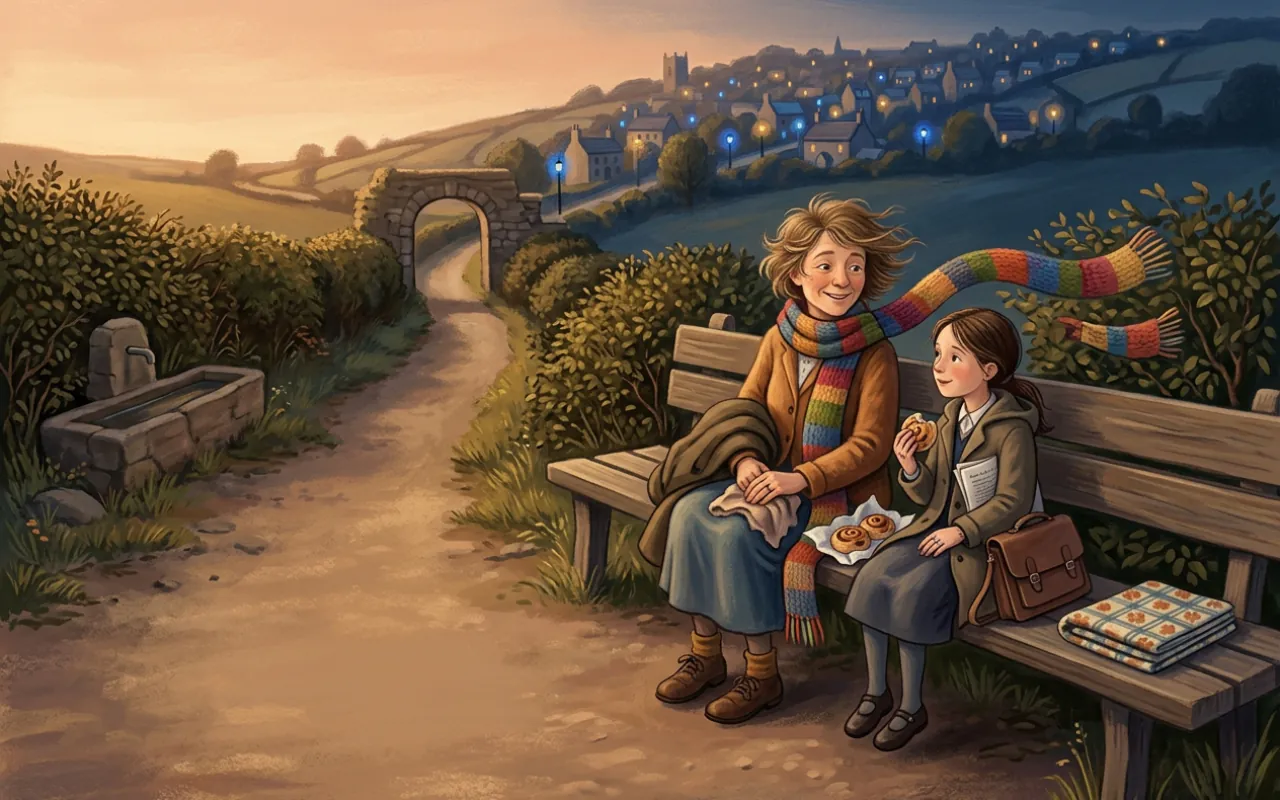
Ivo thought of the people who came up the east road in the morning, before it was properly light. Someone would come up with a basket of eggs and read seven, and sit down on Larkin’s bench, and not want to get up again.
“They’d get to the arch and be pleasantly surprised,” said Hobb.
“Nobody should be surprised by a road,” said Ivo, and began to roll up the chisels.
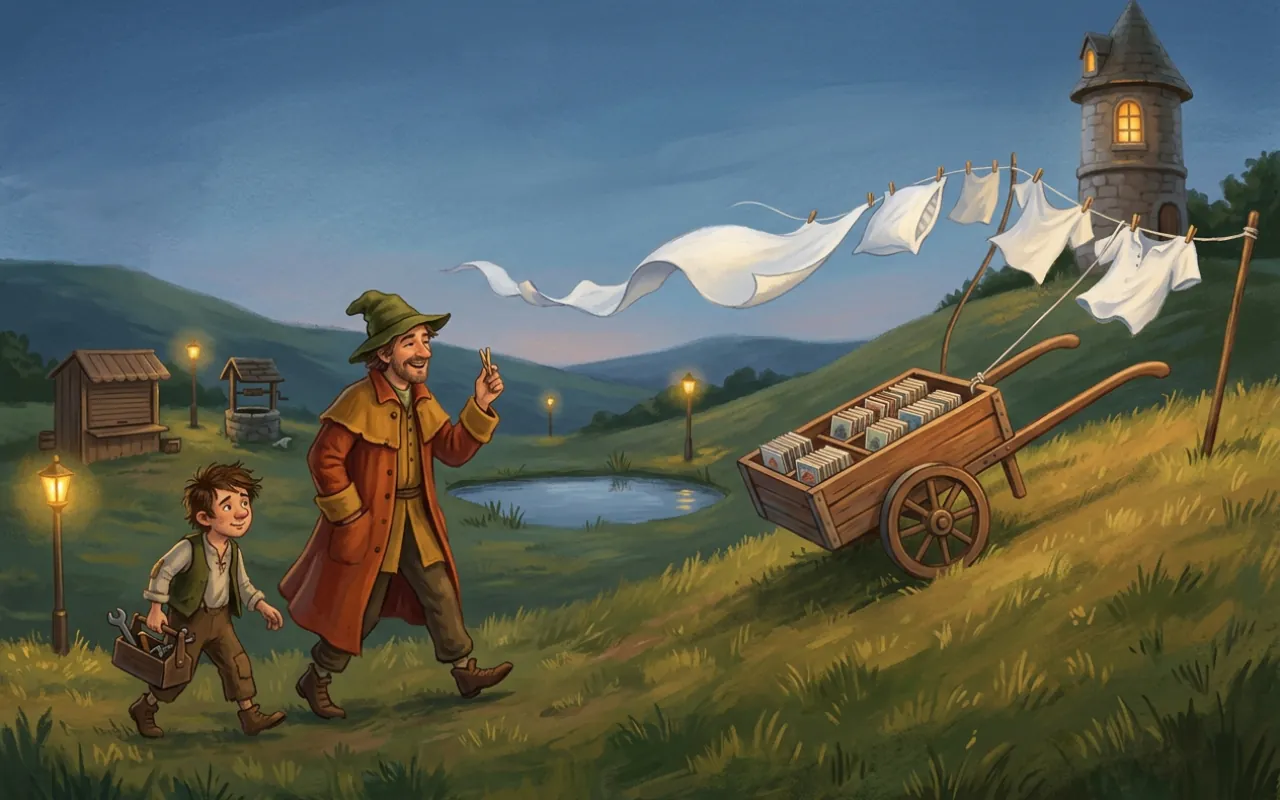
Hobb looked at the roll, and at the lamps of the Hollow just up the hill, and at the twelve panes of window glass lying in the straw behind. “I’ve got glass to deliver,” said Hobb. “And there’s hardly any oil in that lamp. Tansy Nightjar carries enough oil up this road to light the Hollow twice, and I’ve got what was at the bottom of the tin.” Then Hobb moved over on the seat. “Get up, then. I’m not saying it was the wheel.”
Hobb turned the mule round in the road without waking her, which takes a light hand on the reins and a great deal of not saying anything. Then they went back down the east road at a sleeping mule’s pace.
It was a fine blue night. Behind them the Hollow showed its lamps, blue and gold, all over the hillside. Far ahead and below, the meadow lamps were lit, all but the last few, and someone was lighting those slowly, as if checking each one twice. The tall grass hummed along the verge. Ivo sat with the chisel roll on both knees and the piece of stone in one hand, and ran a thumb along the groove.
“You’ll wear it out,” said Hobb.
“I am remembering the width,” said Ivo.
Hobb stopped with the tailboard beside the milestone, out of long habit with deliveries, and in the back the glass went ting.
“It doesn’t think much of your stone either,” said Hobb.
The milestone came up to Ivo’s hip. It had a 2 cut in its face, and under that the word MILES, and nothing else, which was how Ivo liked a stone. Now the 2 had lost its foot. All that was left was the curve at the top and the long slant coming down, and by lamplight it made a seven, and not even a bad one. But where the chip had come away, the stone underneath was pale and sound. There was something to cut into.
Hobb unhooked the cart lamp and held it up. Ivo took out a pair of dividers, a brass rule and a stick of chalk.
First Ivo measured the groove on the broken piece, to have the width of the old foot. Then Ivo measured up from the bottom of the M, because the foot of the 2 had always sat on the same line as the feet of the letters. Then Ivo drew that line in chalk, very lightly, and measured it once, and twice, and three times. It was right each time.
Ivo set the dividers to it a fourth time, and the cart lamp gave a small cough and went out.
“That one was for pleasure,” said Ivo.
“Then you’ve lost nothing,” said Hobb.
“I have lost the pleasure.”
Hobb made a small noise into a sleeve.
“I wasn’t being funny,” said Ivo.
“I know you weren’t,” said Hobb.
It did not go dark, exactly. Nights on the east road are blue, the Hollow was still showing its lamps up the hill, and there were more stars out than anyone has a use for. There was light enough to see the stone. There was not light enough to cut a numeral by, and a numeral cut wrong is worse than one knocked off, because people believe it.
Ivo thought about waiting for first light. That is the trouble with first light: it is exactly when people start walking.
Then, in the tall grass behind the milestone, something brightened.
It was a fleck of star, a grain of light no bigger than a seed, low among the grass stems. As they watched, it grew brighter and stayed bright, the way flecks do when they would like a game of cards before they go.
Hobb looked at it the way Hobb looked at a customer who had come to the cart wanting something particular and would not say what. “That one wants a game,” said Hobb.
“How long does a game last?” said Ivo.
“As long as I like,” said Hobb, “if I’m careful.”
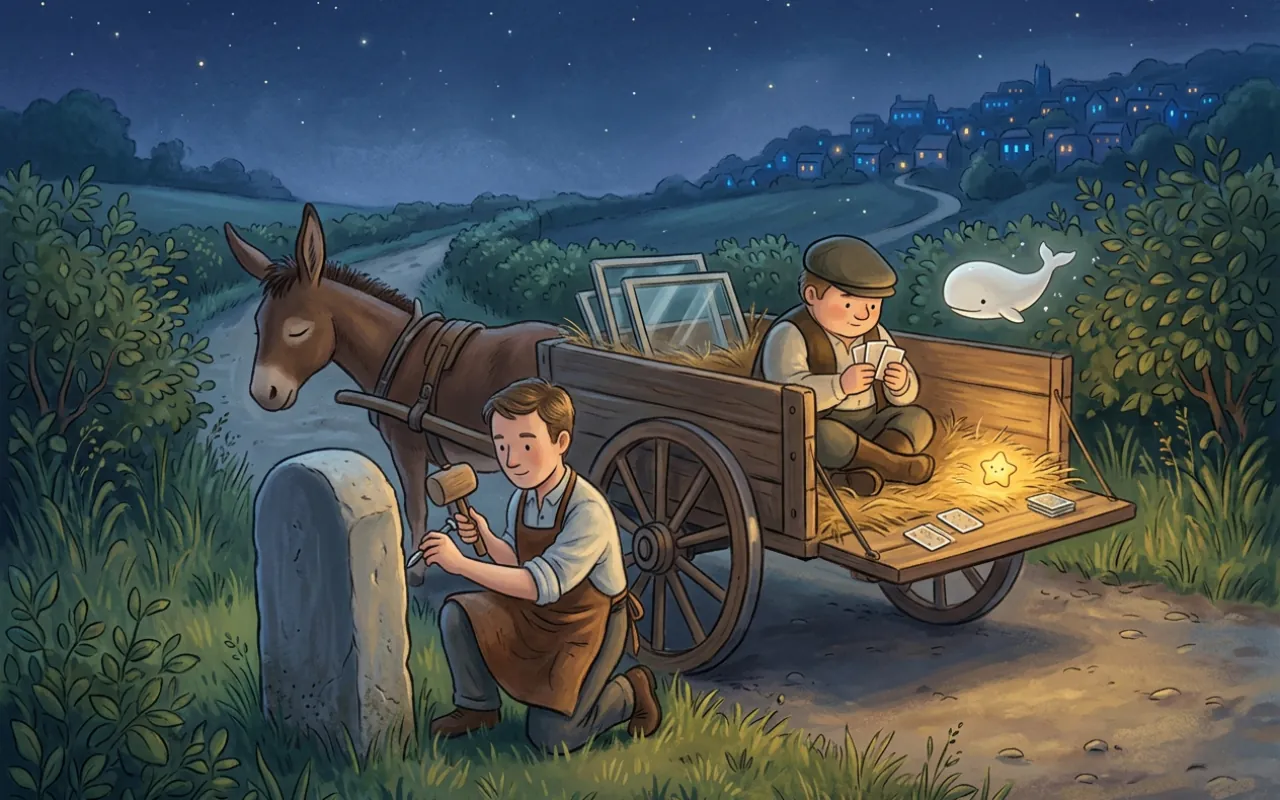
Under the seat Hobb kept a deck for the hand of cards that Bramble the Hedge-Layer insisted on, by custom, whenever the cart wanted the lane. Hobb cleared a space in the straw at the end of the tailboard and dealt two hands, one facing the grass. The fleck came up out of the grass the way a bubble comes up through water and settled behind its cards. Then it brightened, and kept brightening, until there was light to read the small print on a flour sack.
Ivo could see the chalk line again.
“Go on, then,” said Hobb. “I’ll keep it busy.”
Ivo took the 2 out of its pocket.
Hobb glanced over. “That one’s seen some use.”
“The road has a great many twos in it,” said Ivo.
“More sevens, I’d have said.”
“There are no sevens on this road,” said Ivo, and set the edge to the chalk.
Ivo held the mallet short, close to the head, so that each tap was small. The mule was four feet away with her eyes shut, and every tap went out into the night like a spoon on a saucer. Ivo cut the foot along the chalk in one long, low pass, then went back along it to bring it down to the depth of the curve above. Then came a tap at each end, to square it, so the new foot would look as if it had always been there.
At the third tap the mule moved one ear.
Ivo stopped. Hobb stopped with a card halfway down. The ear went slowly back to where it had been, the mule went on being asleep, and they both went on with their work.
On the tailboard the game was going very slowly indeed. Hobb took as long over each card as Hobb usually took over lunch, and talked to the fleck the whole time in a low voice, as if it were a stubborn customer.
“You’ll want to keep that one back,” Hobb told it. “I’m only saying. It’s your hand.”
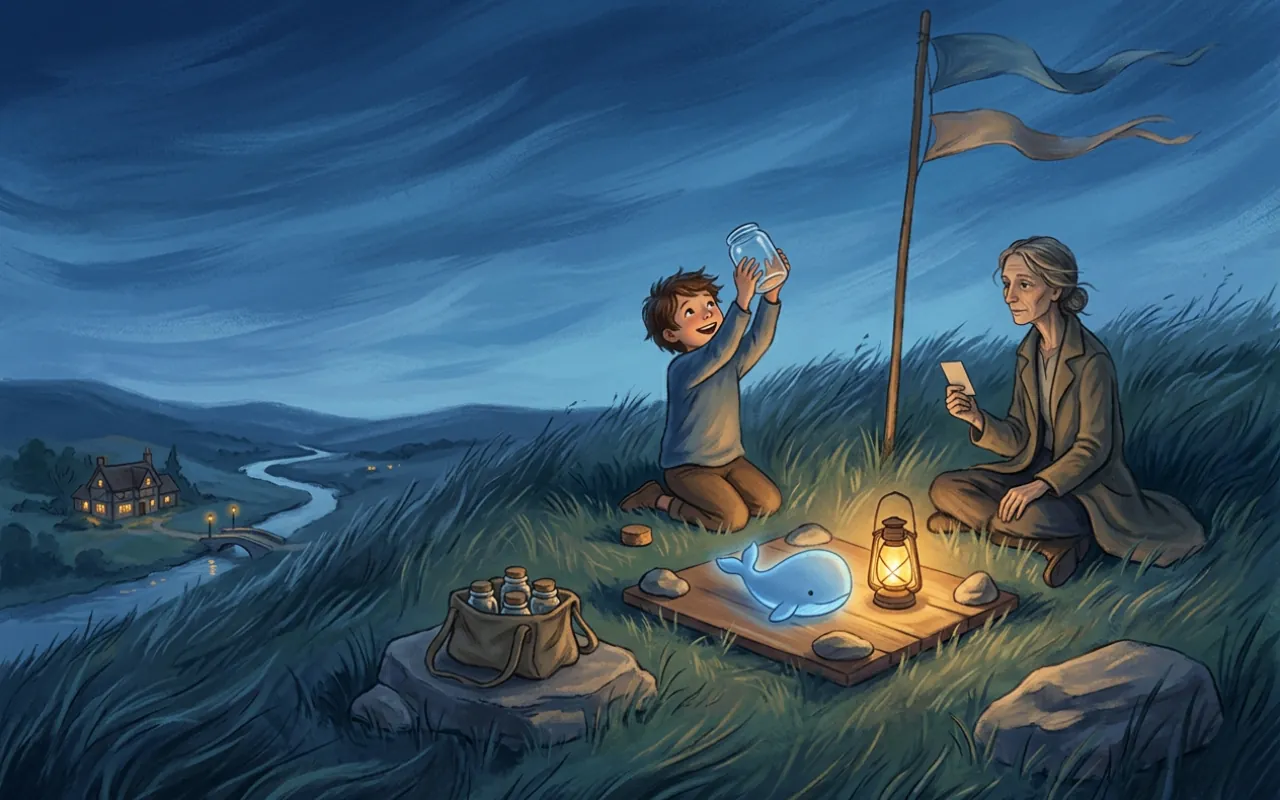
One of the fleck’s cards turned itself over. It was a Moonlit Whale.
“Nobody plays the Whale in the Morning,” said Hobb. “Well. That’s your lookout.”
The Whale came up off the card no bigger than a loaf and swam slowly in the air above the tailboard, pale as milk, and its light fell on the stone along with the fleck’s. Hobb sighed and put down a Sunbeam Squire. The Whale nudged it gently off the edge of the straw, and the Squire lay down on the tailboard and went to sleep.
“That makes two of them,” said Hobb, looking at the mule.
Losing slowly is harder than it sounds. Hobb could not win, because then the game would be over, and could not lose quickly, for the same reason. So Hobb let one lantern go in the Afternoon and held the other on purpose. Hobb played cards that were nearly good enough, and kept back the ones that were exactly good enough, and told the fleck at every turn what it ought to do. The fleck did as it liked.
“Not the Rain Cloud,” said Hobb. “Not near my glass.”
The fleck kept the Rain Cloud back. Hobb said that was the first sensible thing it had done all night.
Ivo blew the dust out of the new cut and stood back.
The 2 had its foot again, cut clean. It sat on the line with the M and the I and the L and the E and the S, as it always had. Ivo measured it once, twice, three times, and it was right each time. Then Ivo measured it a fourth time, in good light, and that one was for pleasure, and it was a pleasure.
After that Ivo crouched by the near wheel of the cart, measured something low down by the verge, wrote it in a small notebook and put the notebook away without a word.
“Done?” said Hobb.
“Done,” said Ivo.
“Thank goodness,” said Hobb. “I was running out of ways to lose.”
Hobb put down a Kind Gust. It came off the card as a soft breath that lifted Ivo’s collar, crossed the tailboard and blew out the fleck’s last lantern like a birthday candle. The Moonlit Whale rose up past the milestone, turned into a small star, and was gone.
The fleck stayed where it was for a moment, as if going over the hand to make sure it had been played fairly. It seemed to decide that it had. Then it cooled to a dull grey speck and lay still in the straw.
Ivo picked it up and put it in the chisel roll, in the pocket marked 2, beside the chisel.
“What do you want that for?” said Hobb.
“It was here when the stone was cut,” said Ivo. “I like a record.”
They went back up the east road at the same sleeping pace, with no lamp of their own, only the blue night and the Hollow’s lamps ahead. For a long while neither of them said anything. The grass hummed. The mule walked on in her sleep.
About halfway up, without anyone asking, Hobb said, “It was probably the wheel.”
“I know,” said Ivo. “On that bend the rut comes within three inches of the stone. I measured it while you were losing.”
Hobb thought about that for a good hundred yards. Then Hobb said it was a fine stone, as stones go, and Ivo said it was, and that was the end of it.
They passed Ivo’s door and did not stop, because twelve panes of glass want two people to carry them. Under the blue lamp at the East Gate, Hobb drew the cart up, and in the back the glass went ting.
“There,” said Hobb. “Now it’s pleased.”
“It sounded exactly the same as the other two times,” said Ivo.
“It always does,” said Hobb. “You have to know the cart.”
They carried the panes in two at a time, saying nothing louder than “mind the step”. The mule had been turned round twice in the road, had walked down to the stone and all the way back up, and had stood through a whole game of cards and the cutting of a numeral, and she never once woke up.
And in the morning, when the first person came up the east road with a basket of eggs, the stone said two miles, and it was two miles, and nobody was surprised at all.