The Comet’s Cart Goes Uphill
The Wandering Comet always came down to the Meadow Pond an hour before the usual hour. The Comet does not hurry, and the surest way never to hurry is to be early.
The cart came too. It was a handcart with long handles and a wide tray on top, and on the tray the card packs sat in tidy rows. The cart leaned a little to the left, and had done for ten years. Twice in those ten years, while nobody was looking, it had rolled down the last bit of bank and put the whole tray into the pond. Both times the Comet had waded in, fished out every pack, dried them on the grass, and sold them the next night as “slightly pond”, at a small extra charge.
Two in ten years, the Comet said, was an acceptable rate.
That evening Corvin the Tinker came across the grass with a tool bag clanking. The sky was still pale and none of the lamps were lit. The Comet was setting the upturned basket down by the water.
“I know you’re not open,” Corvin said. “I’m after a pack. I don’t mind waiting.”
Corvin did mind, as it turned out, for nearly a minute. Then Corvin crouched down by the cart.
“That wheel pulls,” Corvin said.
“It does that.”
“Toward the water.”
“Twice in ten years,” said the Comet. “An acceptable rate.”
But Corvin was already flat in the grass with head and shoulders under the cart, and a tinker lying under a cart is past listening. Corvin came out holding an old card, soft at the corners, with somebody’s mark under the last stroke.
“Off the big kettle at Nessa’s,” Corvin said. “It used to walk off the hob every time it boiled. This kept it on for six years. The kettle’s gone for scrap, but the card’s perfectly good.” Out came a little tin with no label. “I don’t like doing a job twice. So I do it once, properly.”
The Comet considered this, and then stated terms, as the Comet always does. “Payment for a cart that does not go into the pond. Nothing for anything else it does.”
“It won’t do anything else,” said Corvin.
Corvin glued the card to the axle, pressed it flat with a thumb, and counted to twenty. Then Corvin crawled out, took hold of the handles, and gave the cart a little rock to test it.
“There,” said Corvin, and let go.
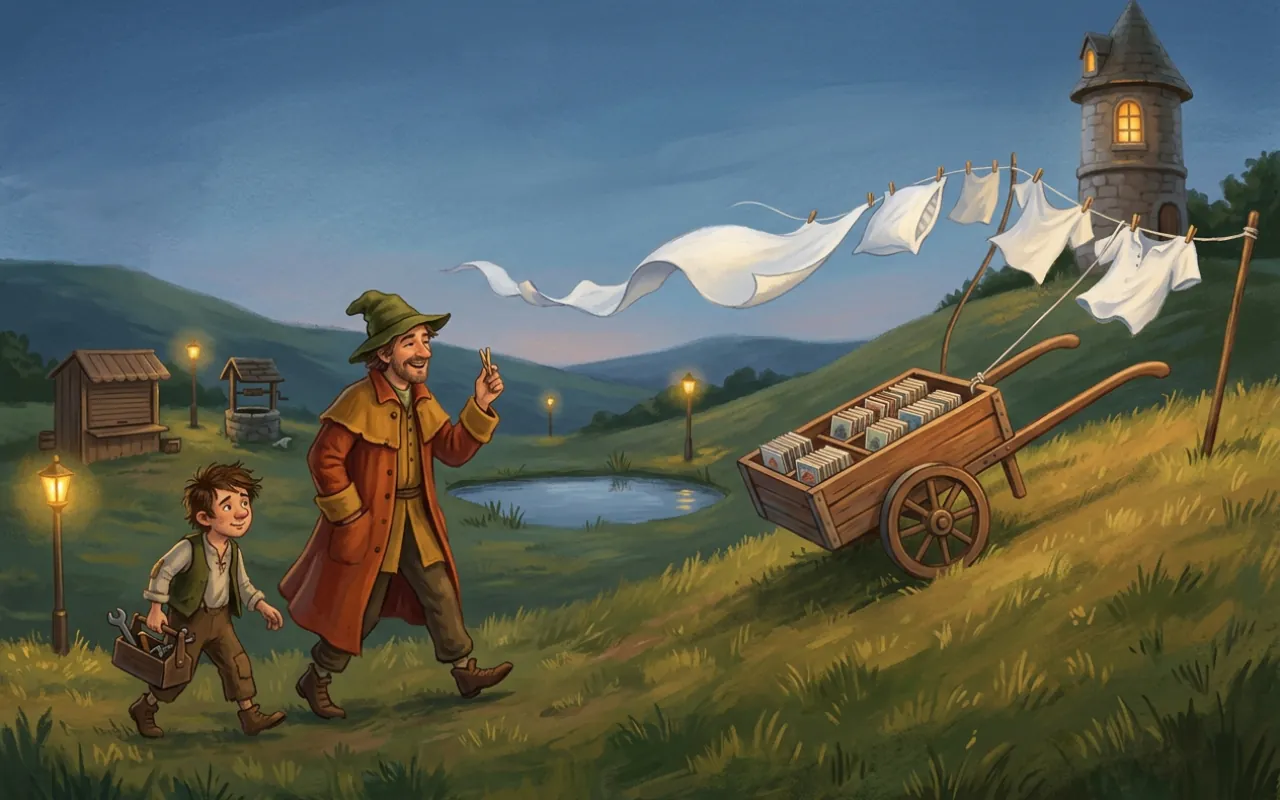
The cart began to roll. It did not roll toward the pond. It rolled away from the pond, up the meadow, at a steady trundle, tray and packs and all, like a cart that had just remembered an appointment.
“Ah,” said Corvin.
Nobody has ever seen the Wandering Comet run, and that evening was no different. But the Comet went up the meadow after the cart at the briskest walk anyone in the valley had ever seen the Comet attempt, with the long coat swinging.
“The Comet does not hurry,” said the Comet.
Anyone wondering why the Comet did not simply catch up and take hold of the handles has not understood about the Comet and running. The cart stayed exactly one brisk walk ahead.
Corvin trotted alongside with the bag banging along. “It’s not going downhill,” Corvin said. “Nobody can say it’s going downhill.”
“It is going uphill.”
“That’s a separate matter.” Corvin thought about it for a few steps. “All right. It works both ways now. I’d have been happy with the one.”
The well came first. The well keeper had hung her washing out between the well post and a pole: two sheets, a pillowcase and four shirts. The cart went under the line. The line caught on the corner of the tray and came off both its hooks, and the cart carried on up the meadow with the whole washing line trailing behind it like the tail of a kite.
A peg fell in the grass. The Comet picked it up without slowing, and then another, and then a third.
“The Comet does not hurry,” said the Comet, and put the pegs in a coat pocket.
Next came Poppy’s stall, shut for the night, with the shutters down. The cart went straight at the stall, and at the last moment went round it on the left.
“Uphill’s on the left,” said Corvin, out of breath and sounding rather proud. “I wish I’d had this on a kettle.”
“You did,” said the Comet.
Then came the knoll, which is the steepest part of the meadow. A cart is supposed to slow down on a hill. This one did not slow down at all. It went up the knoll as steadily as it had crossed the flat, with the sheets flapping and the pillowcase bouncing, and the Comet went up after it with the pegs rattling.
“You’re hurrying,” said Corvin.
“The Comet,” said the Comet, a little short of breath, “does not hurry.”
At the very top of the knoll is Maren’s Observatory. There was a lit window high in the tower and a smell of soup coming from under the door. It is the kind of door that needs a shoulder. The cart went up to it and stopped with its nose against the boards, and stayed there, pushing gently, going nowhere. The door needed a shoulder, and the cart, as it happened, had none.
Corvin lifted a hand to knock.
“No,” said the Comet.
“Somebody’s in. They’ll open it.”
“Somebody will put a shoulder to that door,” said the Comet. “Then the cart will be in the observatory. Then it will be up the stairs. Then it will be on the apprentice’s bed.”
Corvin put the hand down.
The Comet unpegged the washing first. It was the first thing all evening done at the proper speed: each sheet shaken out and folded corner to corner, the shirts with their arms tucked in, the pillowcase on top. There were fourteen pegs. The Comet counted them twice.
Meanwhile Corvin was under the cart again.
“It’ll come off,” Corvin said from underneath. “The glue’s good, though. Better than I remembered. If the card comes off, the axle comes with it. I’d fit you a new axle. A straight one. Fix that lean while I’m at it.”
“No,” said the Comet.
Corvin looked out from under the tray. “It leans.”
“It has ten years of hedge in it.”
Corvin started to answer, and stopped. There are some things a tinker can mend and some things a tinker cannot argue with. “And I’d be doing the same job twice,” Corvin said. “Backward. I don’t like that.”
“Then the card stays,” said the Comet. “And the cart comes down.”
That was the hard part. A cart that climbs by itself does not care to be taken downhill. Every step down the knoll, it pulled back toward the observatory door. If the Comet’s hands had loosened for a moment, it would have been back up there with its nose on the boards. So they tied one end of the washing line to the front of the cart, and Corvin went down ahead with the other end tied round Corvin’s middle. The Comet held the handles. They went down three steps at a time, and then rested. Each time they rested, the cart leaned back uphill, and Corvin sat down hard in the grass and held it.
“Usually,” said Corvin from the grass, “whoever’s on the rope at the bottom of the hill is the one doing the pulling.”
“Tonight,” said the Comet, “you are the brake.”
Three steps, and rest. Three steps, and rest. Below them the meadow lamps came on one post at a time as Wick went round with his taper, and the air turned deep blue. It was the slowest anybody had ever brought anything down that knoll.
“This,” said the Comet, “is a reasonable speed.”
They passed Poppy’s stall, on the right this time. They passed the well and its bare post. At last they came down the last bit of bank to the edge of the pond, and Corvin unwound the rope, and the Comet, very carefully, let go of the handles.
They both stood ready to give chase.
The cart did not move.
It did not roll toward the water. It did not trundle off up the meadow. It stood exactly where it had been put, more still than any cart has ever stood. Corvin balanced a card on its edge on the tray, and the card stayed up. A frog went into the pond with a plop, and the pond rippled. The cart did not.
Corvin turned all the way round, slowly, looking at the meadow. The well was up from here. The stall was up. The road was up, and the knoll was a great deal up.
“The pond’s the bottom,” Corvin said. “It only ever runs away from downhill. Down here there isn’t any downhill to run from.”
“Then the rate stays at two,” said the Comet.
Just then Wick came down the path and lit the lamp by the pond. He checked the cover, and checked it again. Then he looked at the cart for a long moment, because Wick notices when a thing is standing stiller than it ought to, and went on to the next post.
When that lamp is lit, it is the usual hour. The Comet set out the tray, and sat down on the upturned basket.
“The Comet does not hurry,” said the Comet. “That is why the Comet comes early.”
Then the Comet counted stardust into Corvin’s hand. “For one direction, as agreed. The second at no charge.”
Corvin looked at the stardust, and at the cart, and gave the stardust straight back. “I came for a pack,” Corvin said.
The Comet held one up. It was a little wrinkled, with a faint green tidemark across one corner. “Slightly pond. A small extra charge.”
“That one,” said Corvin.
The well keeper came down soon after with a lamp in one hand and an empty peg bag in the other. She did not ask where her line had gone. She had seen it go past the window.
The Comet gave it back coiled, with the washing folded on top and fourteen pegs in a row. “Your line was taken up the knoll without asking, and then used to bring a cart down. We are sorry for both.”
“Mostly me,” said Corvin.
The well keeper looked at the washing. “Somebody’s folded this.”
“Corners to corners,” said the Comet.
“Hm.” She tucked it under her arm. “Next time it goes up the hill, knock first. I’ll bring the washing in.” She went back up the meadow, and a little later she called down that the kettle was on if anybody was cold. Corvin was not cold at all, and went anyway.
The rest of the night went the way the Comet’s nights go. Wick came back after his round and compared two packs for twenty minutes, which the Comet considered exactly the right length of time.
At first light the Comet packed the tray, set the basket on top, took hold of the handles, and gave them the smallest nudge toward the rise.
The cart climbed the meadow by itself. It went past the pond lamp, past the well with its line back up, past Poppy, who stopped with a shutter in her hands to watch it go. The Comet walked behind with one hand resting on the handles, not pushing and not pulling, just keeping the cart to a stroll. It was a very slow stroll. It was exactly as slow as the Comet liked.
For ten years the Comet had pushed that cart up every hill on every road. Now the cart did the climbing, and the Comet did the strolling, and the lean was still in it, ten years of hedge and all.
They went over the rise together, the cart a step ahead and the Comet a step behind. The Comet did not hurry, and this time that was perfectly true. It was the best bargain the Comet ever made, and half of it had been free.