The Jar Marked Sable Losing
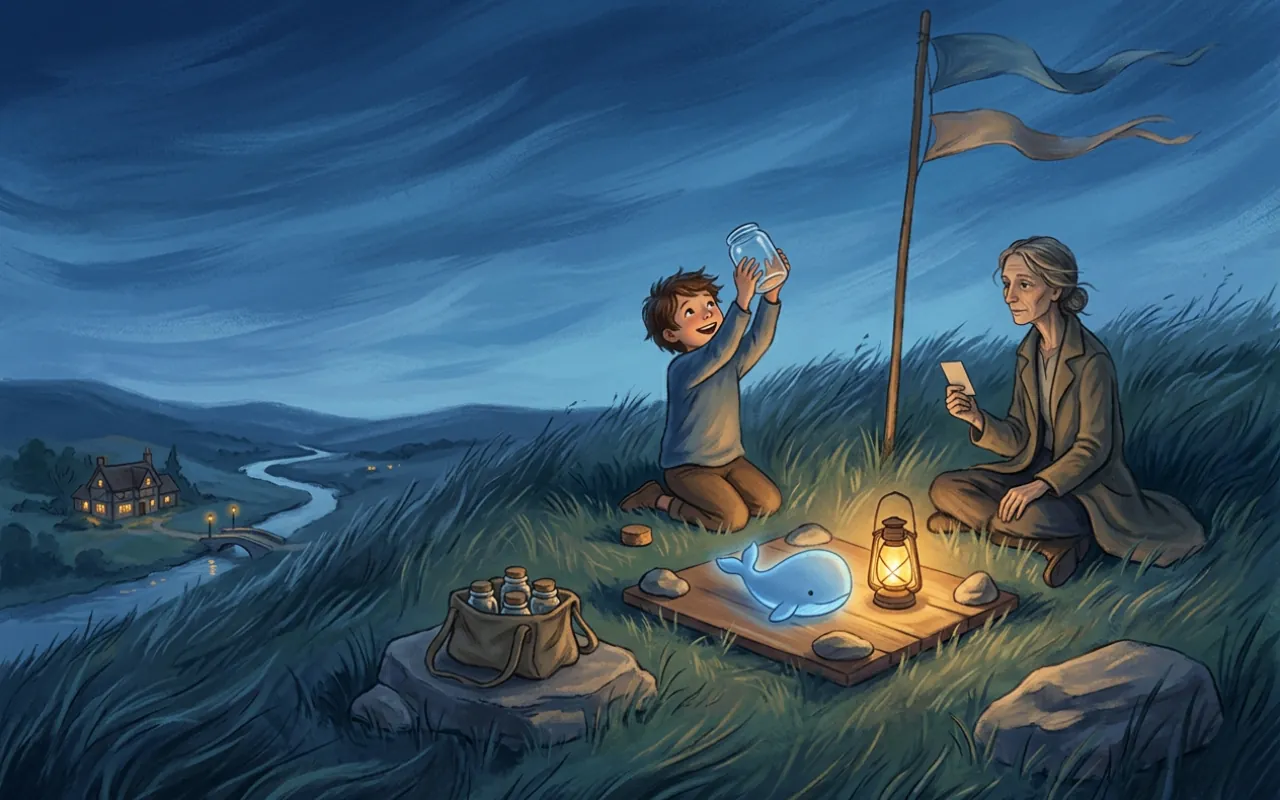
Pip Underweather came up Whistling Ridge on the last evening of the season with a satchel that clinked. Every jar in the satchel had a sound in it. There was a good hinge from Kettlebridge, a kettle just before it boils, Nessa saying “Oh, honestly,” and Rook laughing, which Rook would rather nobody had kept.
One jar had nothing in it at all. It had a cork and a label, and the label said SABLE LOSING in Pip’s best capitals. Pip had carried it up the ridge for three autumns. The ridge wind wears the ink off anything left out in it, so the label had been gone over twice, very carefully. It was the neatest thing on the hill, and the jar was still empty.
Sable was kneeling by the low board, putting a stone on each corner. She set the first one down with a small, flat clack.
Pip had a jar out before the stone stopped rocking. “Was that the stone? Do it again. No, the other corner.”
“No,” said Sable.
Pip put the jar away without minding. Most of the best sounds in the satchel had been collected without asking anybody first, and Pip had found that people minded much less afterwards.
Tonight Pip set the SABLE LOSING jar on the flat rock beside the board, ready, and beside it a second jar, a new one. Its label said THE LAST NOTE. Once a year, when the ridge wind went round for the last time before winter, the whole ridge gave one long note, like someone blowing across the top of a very large bottle. Everyone below the ridge had heard it. Pip had heard it three times and never once caught it. The first autumn Pip had missed it by losing quickly and going home early to sulk. The second autumn Pip had missed it by losing slowly. The third autumn Pip had missed it by arguing about a lantern with the cork still in.
So Pip wanted two things from this last evening, which is one more than most people get. Pip wanted to win a game against Sable on the low board, just one, before she packed it away for the winter. And Pip wanted the note.
“This is the year,” said Pip, sitting down cross-legged and shuffling.
“You said that last autumn.”
“Last autumn I said nearly. And this deck has never lost to you. Not once.”
“It’s new,” said Sable.
“That’s why.”
Pip went to deal. Sable put two fingers on the deck and kept them there.
“Not yet. Wind’s coming round.” She nodded down the slope. “See the grass on that ledge? When it lies flat, the wind’s gone round. I’ll tell you when.”
Pip waited, which Pip was not good at, and it showed in the knees. The plain pennant swung east and hung there. The other pennant, the one with light in its threads, swung after it. On the ledge below, the long grass went flat all at once, and then stood up again.
“Now,” said Sable.
Pip dealt, low and quick, each card flat to the board before the wind could get a corner under it.
Sable had not lost a game on that board in three years. She played cards the way the ridge wind blew. She was patient for a long time, and then she was not.
In the Morning round Pip’s Sunbeam Squire marched out bright and brave. Sable let it stand there being brave until it was tired, and then she put it down for a nap. It rose into Pip’s sky as a little star, and one of Pip’s lanterns went out behind it.
In the Afternoon Pip reached for the Moonlit Whale. It was the best card in the new deck, and the one that might save everything. Pip had the corner of it between two fingers when something in the satchel went off. It was a pan lid hitting a stone floor, exactly as loud as the night it happened.
Pip jumped. The Whale jumped too. The wind got under it and sent it skating toward the edge of the board, and Sable put her hand down flat on it without looking up.
“That was last Tuesday’s supper,” she said.
“It’s a very good lid,” said Pip.
“It’s my lid.” She slid the Whale back across the board. “Play it or don’t.”
Pip played it. The Whale came up out of the board like a hill of blue evening. It settled over one of Pip’s lanterns and stayed there, and the lantern stayed lit.
All this while, Sable had kept one card back. She kept it through Morning. She kept it through Afternoon. She kept it into Night, face down under her thumb, and the rest of Pip’s lanterns went out one at a time around it, until there was only the one under the Whale.
But Pip’s sky was crowded by then. There was a little star up there for every creature that had gone, and Pip had counted them twice. If that last lantern lasted the night, Pip would win by one.
Pip knew it. Sable knew it. And Pip kept looking at the ledge.
“Watch the board,” said Sable.
“I am. Mostly.” Pip had the new jar in one hand with the cork half out. “It’s tonight, isn’t it? The note.”
“It’s tonight.”
“Will you—”
“I’ll tell you when.”
Pip nodded and did not entirely believe her. After three autumns of missing it, Pip did not believe anything about that note. So Pip watched the board with one eye and the ledge with the other, which is harder than it sounds and works for neither.
Then it was Sable’s turn, and the last turn of the Night.
She turned the held card over in her fingers. Pip saw the corner of it, and the little curl of wind drawn there, and knew it was the Kind Gust. A Kind Gust would lift the Whale off the board as gently as anything. The last lantern would go out underneath it, and that would be that.
Sable did not lay it down.
She was looking past Pip’s shoulder, down the slope. The plain pennant lifted. The bright pennant lifted after it. Both of them swung slowly round to the east, and on the ledge below, all the long grass lay flat.
“Now,” said Sable.
Pip pulled the cork.
The note came up out of the whole ridge at once. It was low and long and round, and it went on longer than seemed possible. The stones on the corners of the board hummed with it. Pip’s teeth hummed with it. Pip held the jar up in both hands, as high as it would go. Sable sat quite still with the Kind Gust between her fingers and watched the grass.
Sable had spent her last turn watching the grass for Pip instead of playing the Kind Gust, and a turn spent is a turn gone. Somewhere in the middle of the note, Night on the board ran out. The Whale went to sleep where it sat. The last lantern was still lit. Over Pip’s side of the board there was one more star than over Sable’s.
When the note had finished, Pip pushed the cork in hard. Then Sable laid the Kind Gust down anyway. There was nothing left on the board for it to do, so it went across the board and lifted Pip’s fringe and went off down the ridge on its own.
“Well,” said Sable.
That was all. That was the sound of Sable losing, after three years of waiting for it, and Pip was holding the wrong jar. The jar marked SABLE LOSING sat on the flat rock with its cork in, as empty as ever.
“Say that again,” said Pip.
“No,” said Sable.
Pip counted the stars once more with one finger, to be sure. “I won.”
“You did.”
“By one.”
“One’s plenty.”
“You were watching the ledge,” said Pip.
“I read the wind,” said Sable. “I’m always watching the ledge.”
She took the stones off the corners and packed them into the board box one by one. Then she folded the low board in on top of them.
“I expect I’ll lose again some time next spring,” she said. “After the thaw.”
“When, though?”
“I’ll tell you when.” She latched the box. “So you’ve got the right jar out.”
She took down the plain pennant and rolled it under her arm. The bright one she left where it was. Then she handed Pip the box.
“Winner carries it,” she said.
They went down the path in the blue evening. Below them the lamps along Kettlebridge were coming on post by post, and Nessa’s windows were lit on the near bank.
Pip talked the whole way down, because that is what winning does to a person. “I’ll tell Nessa first. Then Rook, if Rook’s eating, because then Rook can’t get away. I’ll say it was close, which it was. I’ll say you played very well, which you did. And then I’ll say by how much—”
The satchel began to sing.
It was the new jar, corked tight, giving back the note. It chose the steepest part of the path, where Pip had both arms full of board box and could do nothing about it at all. Sable, coming down behind, had to stop or walk straight into the box.
So they both stopped. The note was just as long the second time, and just as low and round. The two of them stood on the path and heard the season out, and neither of them said a word until it was done.
“Good,” said Sable. “You got it.”
“I got it,” said Pip. “And you lost.”
“Once,” said Sable.
Then they went on down to supper, the winner in front with the box. The season on Whistling Ridge was over, and Pip had the last of it corked in a jar. The other jar was still empty, and that was all right. It would keep till spring, and Sable had promised to say when.