The Snow That Would Not Settle
There was once a steep little town where the snow came sideways. The houses went up the hill one above another, leaning a little, like books on a shelf that has slipped. Most winters the snow blew straight past their windows and on to somewhere else, and hardly any of it stayed.
Tess lived in the third house from the bottom, with her mom and an old dog called Biscuit. What Tess wanted, more than anything, was real lying-down snow. Deep snow. Snow you could sledge on from the top of the hill to the bottom without stopping.
She had waxed her sledge in October. She had coiled its rope as neat as a cinnamon bun and parked it by the front door, where everybody tripped over it. You may think that a girl who waxes her sledge in October is an impatient sort of girl. You would be right, and Tess would tell you so herself.
Every evening she opened the door and looked at the hill. And every evening Mom said, in the voice she used for bedtime, “Snow has to settle before it’s any good.”
“I know,” Tess said. She did know. She only wished it would hurry up.
Then one night, just after supper, the first snow of winter came down. It did not come sideways. It came down straight and soft and thick, and Tess pressed her nose to the window and watched it land on the path.
Then she watched it bounce.
Every flake that touched the ground sprang straight back up, as if it had landed on a drum. It went up to the gutters and came down and went up again. It would not lie down anywhere. So it gathered underneath things instead. It piled up under the eaves and under the benches and under the porch roofs, upside down, the wrong way round. Under the little bridge at the bottom of the hill it hung in a soft white beard. And on the rain barrel by the gate an icicle was growing, but it was growing up, pointing at the moon.
“It’s too excited,” Mom said, behind her. “It’s the first snow. It’s been waiting all year too.”
“It has to settle tonight,” said Tess. “Or there won’t be a hill in the morning.” She was already putting on her coat.
Mom looked at the clock. She looked at Tess. Then she put her own coat on over her nightgown, because she was that kind of mom.
Biscuit was out on the front step already. She had been lying there since supper with her nose on her paws, because Biscuit liked the cold, and she liked lying down even more.
Tess marched into the middle of the street and put her mittens on her hips.
“Lie down,” she said to the snow. “Right now. It’s late, and I mean it.”
That was exactly what Mom said to her on the nights she was bouncing. The snow bounced higher. A whole cloud of it went up past the bedroom windows and stuck under the roof of the house above. Mom made a small noise that might have been a cough.
So Tess knelt and patted the snow flat with her mittens, firmly, the way you pat a pillow. Each time she lifted her hands, it sprang off the path in a puff, like flour off a table when somebody claps. It went up her sleeves. It went on her eyelashes. It did not lie down.
That was when Mr. Pocket came up the hill with the last of the evening post.
Mr. Pocket was the postman. He had carried the post up that hill for forty winters, in wind and rain and sideways snow, and he had never once lain down in the snow. “A postman stays on his feet,” he always said. “On principle.” He carried a shovel as well as his bag, because a postman on that hill had to.
“Won’t settle?” he said.
“It won’t,” said Tess.
“Then we’ll heap it,” said Mr. Pocket. “Snow’s like letters. Put it in a pile and it stays put.”
So Tess fetched the coal shovel, and the two of them shoveled the snow into a heap as big as a wheelbarrow, and patted the sides, and stood back. The heap went up. It rose all in one piece, slowly, floated over the gate and lodged under the porch roof next door, like a pudding on a plate held the wrong way round.
Mr. Pocket took off his cap and put it back on again.
Tess sat down on the step beside Biscuit. She was cold and she was cross and she was very close to crying. Then she saw Biscuit’s back.
Biscuit had been lying there all evening, fast asleep, and her back was white. On Biscuit, the snow had lain down. It lay along her fur like a little blanket, and it did not bounce at all.
And Tess remembered something. On the nights she was bouncing, “Lie down” never worked. Tucking her in tight never worked either. What worked was Mom lying down on top of the covers beside her, not saying anything, breathing slow, until Tess was breathing slow too. Nobody ever got Tess to sleep by telling her to.
“Oh,” said Tess.
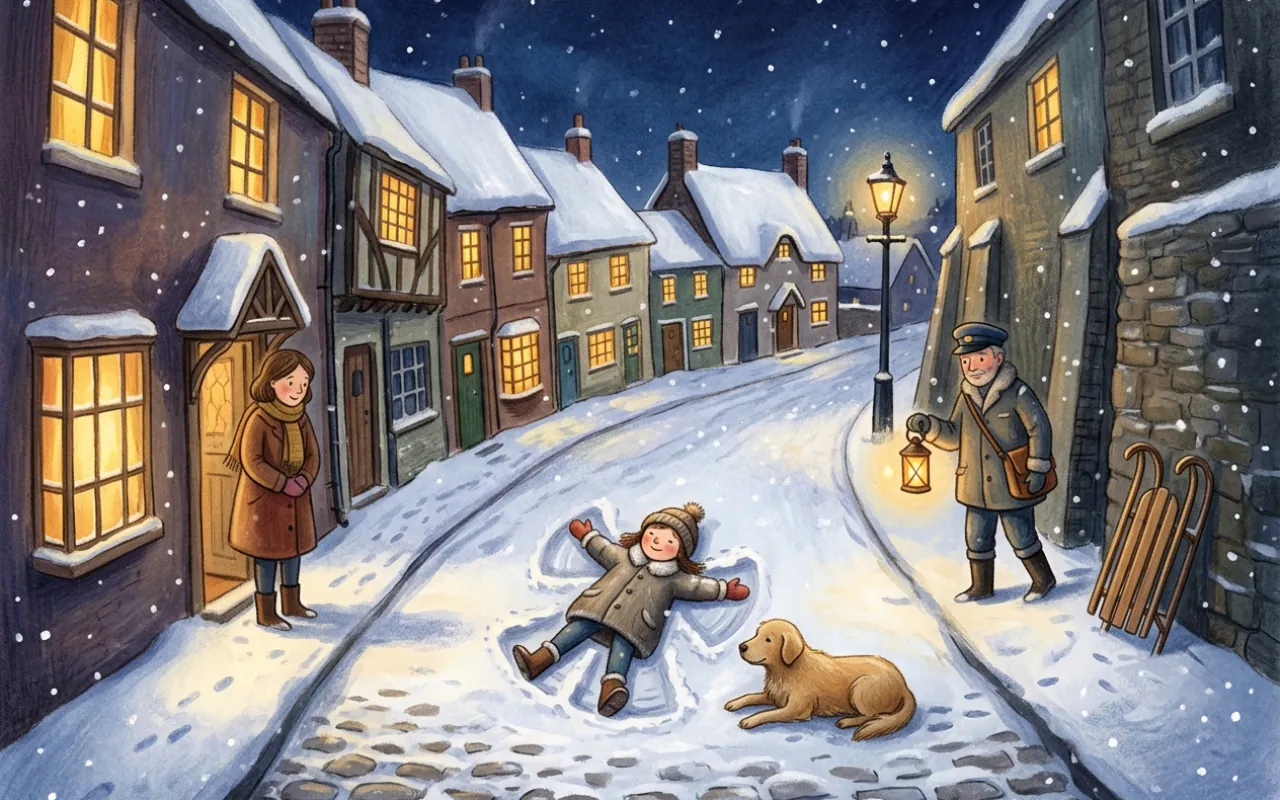
She walked into the middle of the street and lay down on her back in her coat. The snow bounced all around her. She moved her arms and legs out and in, very slowly, making an angel, to show it how. She yawned, on purpose. Then she yawned again, not on purpose.
A flake came down on her sleeve and stayed. Another one lay down beside her ear. Then a dozen, then a hundred. The snow came out from under the eaves and the benches, lazily, and drifted down and lay beside her, flake by flake, quiet as anything.
“Mom,” said Tess, in the voice you use in a room where someone is nearly asleep. “Come and lie down.”
So Mom lay down in her coat and her nightgown and made an angel too.
Then the doors opened all up the hill. The neighbors came out in their slippers and their pajamas: the baker, the twins, and the old man with his hot-water bottle. One by one they lay down in the street, each a little higher than the last, like the houses. They all moved their arms slowly. The snow came down to lie with them. Under the bridge the white beard let go and settled on the banks of the stream.
Only Mr. Pocket was still standing.
“Forty winters,” he said, but not very loudly.
“You don’t have to make an angel,” said Tess. “You can just be a postman lying down.”
Mr. Pocket thought about it. Then he lay down very carefully, with his post bag on his chest, held in both hands so nothing would get wet. He looked up at the sky for a long time. After a while his elbows began to go out and in, just a little.
“Huh,” he said. “Nobody told me it was this nice down here.”
And the whole hill settled, white and deep and still.
Everyone went in pink-cheeked. Mom pulled Tess’s boots off for her, one, two, and carried her up the stairs, although Tess was really too big for carrying. She tucked her in and lay down beside her on top of the covers, the way she always did.
“Will it stay?” Tess said.
“It’s settled,” said Mom. “Snow has to settle before it’s any good.” She smoothed Tess’s hair. “So does Tess.”
Tess was asleep before she heard the end of it.
In the morning the town was buried. Every roof up the hill had a thick white cushion on it, and the snow that had slept the whole night through lay deep in the street. The icicle on the rain barrel had turned over in the night and was hanging down the proper way. Tess had slept the whole night through as well, and woke later than she had ever woken in her life.
Up the hill were the angels, one above another. Near the top was one with very small wings, made by the elbows only, and in the middle of its chest was the neat square shape of a post bag. Mr. Pocket was standing beside it with the morning post, on his feet, looking extremely pleased.
Tess pulled her sledge to the top of the hill and uncoiled the rope at last. Biscuit lay down in the snow to watch, and the snow stayed on her.
And down went Tess, past the angels and over the bridge, all the way to the bottom without stopping. It was exactly what she had waxed her sledge for, back in October.