Hattie and the Hundred and Twelve Steps
Once there was a lighthouse on a rock in the sea, striped red and white like a good sock, with a hundred and twelve steps inside it going round and round to the top.
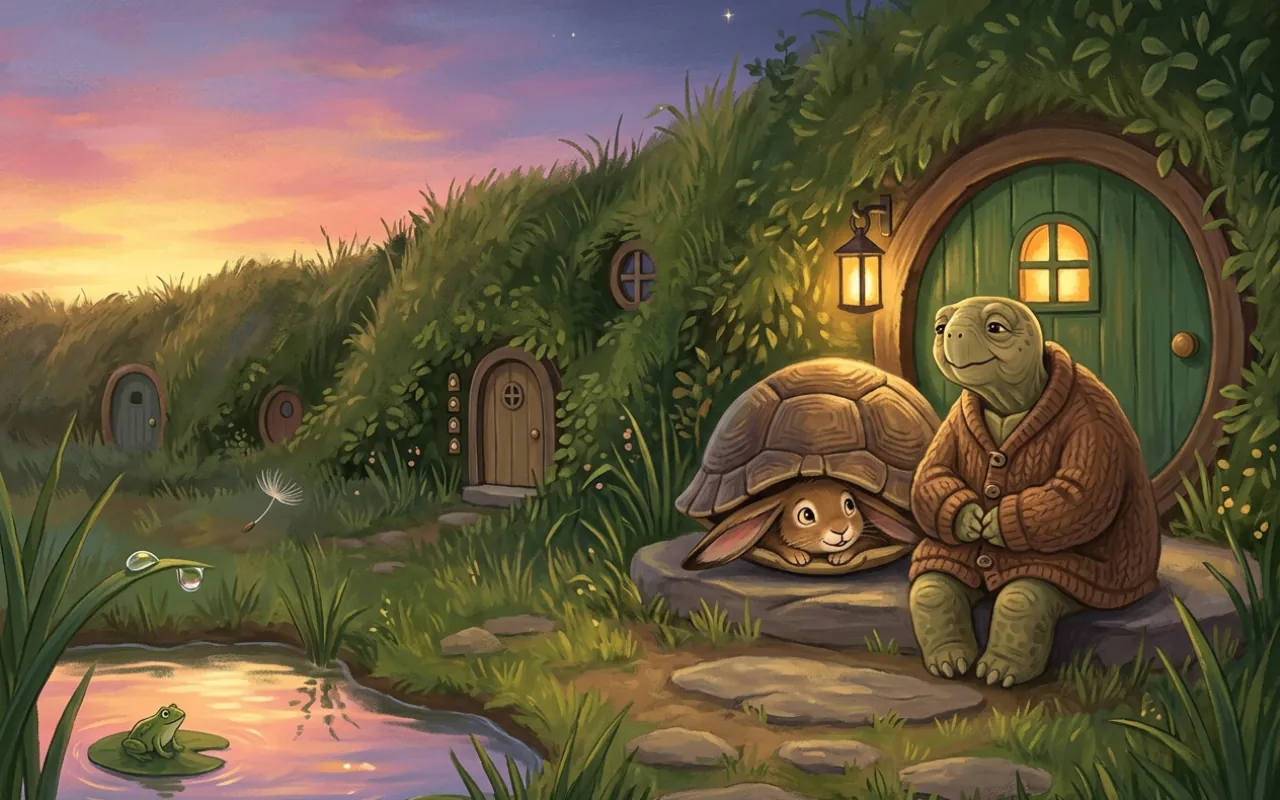
At the bottom of the steps lived Hattie. Hattie was a tortoise, and she was old. She had lived at the bottom of the lighthouse longer than Grandpa had been keeper, and longer than his grandpa before him. Nobody could remember a time when she was not there, setting off across the kitchen after breakfast and arriving at the stove in time for lunch.
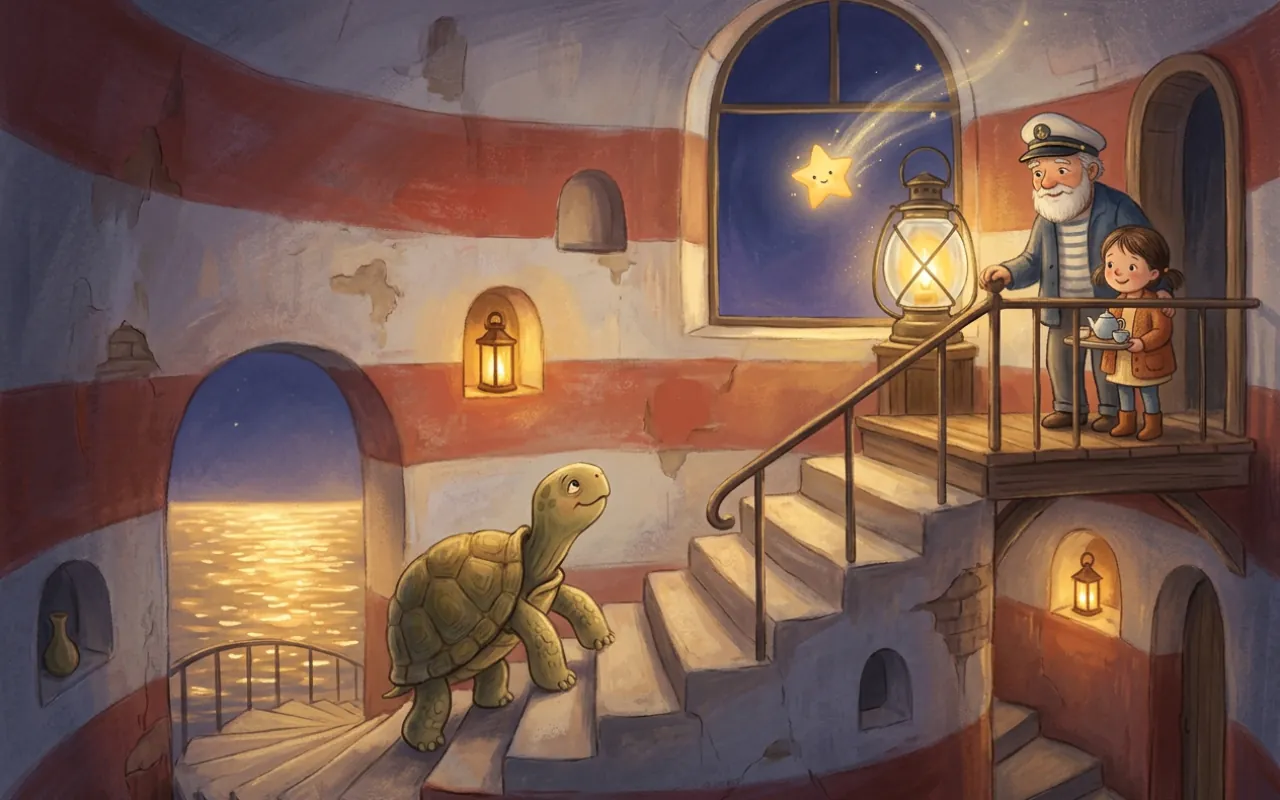
This lighthouse was not lit with oil. Every evening, as the sun went down, a small kind star came down out of the sky, in at the lamp-room window, and settled into the great glass lamp like a hen onto a nest. Then the light went out across the water and the whole sea turned gold.
Hattie had seen the gold every evening of her life. She watched it from the doorstep, where the light went over her head and out to the boats. But she had never once seen the star arrive. That was the thing she wanted. She wanted to be at the top, just once, at sunset, and see the star come down.
There were two difficulties with this. There were a hundred and twelve steps, and Hattie was a tortoise.
Every spring, on the first warm day, Hattie set off up the stairs at dawn. Grandpa called it Hattie’s Day, and on Hattie’s Day there was one rule: nobody carries Hattie. She climbed until she could not climb any more, and sometime in the night Grandpa would find her asleep on a step. Then he took the chalk from his pocket and drew a little H on that step, and carried her down to her box by the stove.
So the staircase was a record of her tries, going back years and years. There was an H on step nineteen and two on step thirty-three. There was a faded one on twenty-six from the spring Nell was born. And the highest H of all, from long ago, when Hattie was only very old instead of very, very old, was on step forty-one.
“Forty-one, Hattie,” Grandpa said every spring. “You’ll beat it yet.”
Now, you and I know what she was climbing for. Grandpa did not. Grandpa thought she liked stairs.
Nell was Grandpa’s granddaughter, and she lived at the lighthouse too. Every day at noon she carried the lunch tray up to the watch room at step eighty-two, and every day she said good morning to each step as she passed it. “Good morning, One. Good morning, Two.” It was noon, but she said the steps had been waiting since breakfast and had not had theirs yet. So Hattie, who heard her every single day, knew the numbers as well as anyone.
Most tortoises sleep through the winter. Hattie slept through this one in her box by the stove with one eye open, because she was watching the stairs. By midwinter she had noticed three things.
The first thing was that on washing day, after breakfast, Grandpa carried the laundry basket up to the first landing at step thirty. He packed it the way he did everything, generously, so there was always a bath towel trailing over the side and down to the floor.
The second thing was that at noon Nell carried the lunch tray up, and it was a tray with two shelves, like a little bookcase with handles. The plates went on top and the pudding went underneath. On the first landing Nell always put the tray down so she could wave at the ferry through the round window, and she waved until it was all the way round the point.
The third thing was that at sundown Grandpa climbed all the way to the top with the oilcan. The star did not like a squeak, so every evening he oiled the hinge of the lamp-room window before he opened it.
Hattie thought about these three things all winter. She thought slowly, but she thought them all the way through.
The first warm day of spring was a washing day. Hattie had been hoping it would be.
She set off at dawn, but not up the stairs. She set off across the kitchen. By breakfast she had reached the laundry basket. By the end of breakfast she had climbed the bath towel and was lying at the bottom of the basket, under Grandpa’s shirts.
“Heavy wash,” Grandpa said, and carried it up to the first landing. When he lifted out the last shirt, there was Hattie.
Grandpa laughed so much he had to sit down on step thirty-one. “Well,” he said. “Nobody carries Hattie. I didn’t carry her. The basket did.” He hung up the shirts and patted her shell and said, “Forty-one, Hattie,” and went on up to the watch room.
Hattie did not climb a single step. She sat on the landing by the round window and waited.
At noon she heard Nell coming. “Good morning, Twenty-eight. Good morning, Twenty-nine. Good morning, Thirty.” Nell put the tray down and waved through the round window. “Hello, ferry!” she said. The man in the red hat on the ferry waved back. And while Nell was waving, which took a good while, Hattie stepped onto the bottom shelf of the tray, which was very nearly on the floor, and tucked herself in behind the rice pudding.
“Gracious,” Nell said, picking up the tray. “That pudding’s heavy.”
Up she went. “Good morning, Thirty-one. Good morning, Thirty-two.” Round and round. “Good morning, Forty. Good morning, Forty-one, and your H.” And Hattie went past step forty-one and its little chalk H sitting down, next to a rice pudding, which is the best way to go past anything.
In the watch room, where Grandpa was waiting, Nell set the tray on the floor to shut the door. Grandpa looked at it and said, “That pudding has a head.”
“Hattie!” Nell said. Then she looked worried. “Nobody carries Hattie,” she said. “But I didn’t carry her. The pudding did.”
“Then it counts,” Grandpa said. It was the highest Hattie had ever been, and he was very proud of her. They gave her the lettuce out of their sandwiches. After lunch they set her on the top of step eighty-two, just outside the door, facing up, and went down to mend the boat.
Hattie had thirty steps left, and all afternoon to do them in.
She put her front feet up on eighty-three. Then she had a long think. Then she brought her back feet up after them. Then she rested. Then eighty-four.
The light in the little windows went from white to yellow. It went from yellow to orange. Her legs ached. Twice she nearly fell asleep, and both times she heard Nell in her head saying the next number, and went up to see it. Ninety. Ninety-nine. One hundred and five. One hundred and eleven.
At sundown Grandpa came up with the oilcan. He thought Hattie would be asleep somewhere about ninety, and he meant to chalk her H on his way back down.
He found her on step one hundred and twelve, the very top step, wide awake, facing the lamp-room window with the pink sky in it.
Grandpa looked at Hattie, and then at the sky.
“Oh, Hattie,” he said. “It was never the stairs, was it.”
Nobody carries Hattie on her day. But the day was nearly over, and the sill was only a very little way up. Grandpa oiled the hinge, and opened the window, and lifted her onto the sill beside the great glass lamp.
Then the star came down out of the sky. Hattie watched the whole way. The star was small and slow and bright, and came in at the window right past Hattie’s nose, and stopped there a moment, and shone a little brighter, which is how a star says hello. Then the star settled into the lamp like a hen onto a nest, with a small shuffle to get comfortable. The light went out over the water, and the whole sea turned gold.
The gold went out past the ferry and past the boats, all the way to where the sea stopped and the sky began. She had seen it every evening of her life from the bottom. It was better from the top.
And because she had come thirty steps with the shirts, and fifty-two with the pudding, and thirty all by herself, and because the sill was warm from the star, Hattie fell asleep right there.
Grandpa took the chalk from his pocket. He bent down and drew a little H on step one hundred and twelve.
From then on, Grandpa carried Hattie up to the top every evening at teatime. It was not her day, he said, so it was allowed. He kept a biscuit tin by the lamp, and he put her in it, and she never missed the star again.
Nell came up at teatime too. She said good evening to every step on the way, and good evening to the H at the very top, and good evening to Hattie in her tin. Then the star came down, and the whole sea turned gold, and Hattie watched it from the top of the lighthouse, as glad as a tortoise can be. Which is very glad indeed, only slowly.
The end.