The Breeze That Wouldn’t Be Folded
Molly could fold anything. She could fold a map back the way it came. She could fold a fitted sheet, which is more than most grown-ups can say. While she did it she hummed, a small busy hum that meant she was thinking about corners.
So when Grandpa said that this year she could put the summer away by herself, she was pleased, but she was not surprised.
Grandpa was the weather-keeper. He lived in the weather house on top of the tallest hill in the valley, and he knew every breeze by its name and its day. All summer the breezes came and went over the hill. When summer was over, they came in to rest. They lay about the house in soft, slippery heaps, like sheets fresh off the line. They were cool to the touch and always fidgeting a little at the edges.
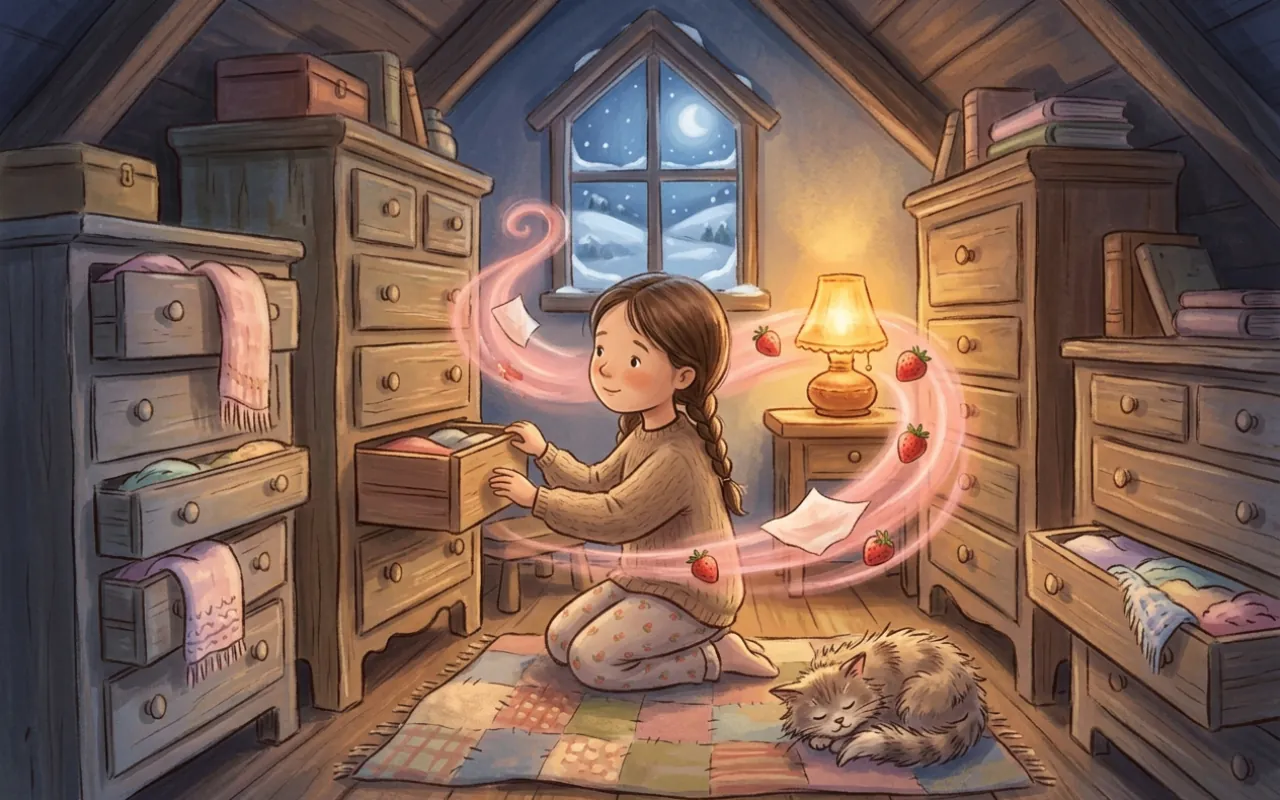
In the attic there was a great chest of drawers, taller than a door. Every drawer had a label in Grandpa’s writing, and every label said the day its breeze had blown.
“Here is the rule,” Grandpa said, after supper on the longest night. He was settling into his armchair with his book. “The winter wind comes over the hill at midnight. It’s a big old wind and a tidy one. If it finds summer lying about, it gets in a muddle. Then the snow falls sideways all winter and lands in the wrong valley. So: every breeze in its drawer by twelve.”
“By twelve,” Molly said.
“Fold them in three,” Grandpa said. “They like that. And say goodnight. They like that too.”
Then the clock began to strike seven, and Grandpa was asleep before it got to the end.
Molly went up to the attic with two candles and her sleeves rolled up.
The haymaking breeze came first, because it was the biggest. It was warm and wide and smelled of dry grass. When she picked it up, it lifted her hair off her neck, the way it had done to everyone in the hayfield in July. Molly found its corners. She folded it once, and again, and once more the other way.
“In three, and in three, and goodnight to you,” she said.
The haymaking breeze lay down flat in her arms and went quiet. She put it in the drawer marked The Tuesday the Hay Came In.
Next came the washing-day breeze, which kept flapping like a shirt on a line and had to be held by both ends. “In three, and in three, and goodnight to you.” Then the breeze off the river, and the evening breeze, and the breeze from the day the kites went up. Molly hummed and folded, and the drawers filled up one by one.
The drawer marked Windy Thursday, August rattled, the way it always did. Molly gave it a pat, which is all anyone can do with a windy Thursday in August.
Then there was only one breeze left.
Little June was the smallest breeze of the summer. It had come over the hill on a hot afternoon, in the middle of a picnic, and it still smelled of strawberries. It also had a paper napkin caught in it, with a strawberry printed in one corner. Molly had tried to take the napkin out. Little June would not give it up.
It was so small it fitted in her two hands. She folded it in three, and in three. “Goodnight to you,” she said, and she put it in the drawer marked Saturday in June, Picnic, Afternoon, and shut it.
She was very pleased with herself for nearly a minute.
Then both candles went out.
It was not dark, because the moon was round and bright in the attic window. It was only inconvenient. From downstairs came a small, offended noise. Molly went down and found Pudding the cat by the stove with every bit of fur blown the wrong way. Grandpa was snoring in his armchair, and the pages of his book were flapping.
Above the book, napkin and all, was Little June.
“Right,” Molly said.
The first thing she tried was a firmer drawer. The bottom drawer stuck so badly that Molly needed both hands and a knee to open it. She folded Little June in three, and in three, and said goodnight to it. Then she shut the bottom drawer with her knee. Nothing could get out of that.
She went down to light the candles at the stove. When she came back, Little June was coming out through the keyhole, as thin as a piece of string. The napkin got stuck. Little June tugged until the napkin came free with a small pop. Then it blew the candles out again.
The second thing Molly tried was a shoebox. It was the box her winter boots had come in, and it had a good tight lid. She folded Little June, and said the words, and put it in the box. She tied a ribbon round the box twice and made a bow with a double knot. Then, to be sure, she sat on it.
She sat and hummed for quite a while. Then Pudding came up the attic stairs with fur pointing every which way. When Molly untied the bow, the box was empty, and the ribbon had not been touched. Molly felt this was cheating. But there is no box made that a breeze cannot get out of if it wants to, and Little June wanted to.
The third thing she tried was singing. If you can’t make a thing lie still, Molly thought, you can sometimes sing it to sleep. She sang the slow song Grandpa used to sing to her, the one about the boat on the long river.
Little June danced.
It went round the attic in loops with the napkin flying out behind. It went round Pudding, so that every bit of fur stood up the wrong way again. It danced the way a very small person dances at a wedding, long after everyone else has sat down. Molly stopped singing. Little June danced a little longer, just to be sure the song was over.
Downstairs, the clock struck eleven.
Molly sat down on the floor. Her sleeves had come unrolled, and she was tired. Little June had gone to the window and lay on the sill against the cold glass.
The window was shut tight. There was no draught anywhere. But the napkin was trembling.
Molly looked at it. Then she put out her hand. Little June was cold. It was shivering all over, a little at a time, the way you shiver when you get out of the bath and can’t find the towel.
Of course it was. It was the smallest breeze of the summer. It had been born on a hot afternoon with strawberries in it, and it had never been cold in its life. The haymaking breeze was big enough to keep itself warm. Little June was not, and a drawer in an attic on the longest night is a cold place to be small.
“Oh,” Molly said. “You’re cold.”
She stopped trying to fold it. She gathered it up into the front of her cardigan, napkin and all.
“You’d better come to bed with me,” she said.
For the first time all night, Little June held still.
Molly shut the empty June drawer and checked every drawer in the chest. The windy Thursday rattled. She patted it.
On her way to bed she stopped by Grandpa’s chair. She tucked his rug up under his chin. She found his page and marked it with the ribbon from the shoebox. Grandpa did not open his eyes.
“June,” he said. “Saturday. Picnic, afternoon. Strawberries.”
“Yes,” Molly said. “It wouldn’t go in.”
“Small ones never do,” said Grandpa, and went on sleeping.
Molly thought he might have mentioned that at seven o’clock. She tucked his rug in a little tighter anyway.
In bed, she put Little June down at her feet. It turned round three times and curled up there like a cat. After a minute it stopped shivering. After another minute Molly’s toes were warmer than they had been since September. Little June kept its napkin, and Molly let it.
She did not say “in three, and in three,” because there was nothing to fold. She only said the last part.
“Goodnight to you.”
At midnight the winter wind came over the hill.
It was a big wind, clean and cold, and it smelled of snow that had not fallen yet. It went once round the weather house, the way a careful person goes round a house at night to check the doors. It looked in at the attic window and saw every drawer shut. The windy Thursday rattled once, as if to say hello, and was quiet. The winter wind went by Molly’s window and found nothing lying about, only a girl asleep and a breeze tucked in, and it knew the difference.
So it went on down the valley, humming. That winter the snow came down straight and landed in all the right places.
And Molly slept the whole of the longest night, which is a great deal of sleeping, with a small summer breeze curled at her feet. All winter long, however deep the snow, the foot of her bed smelled faintly of strawberries, and she was warm, and so was Little June.