Peg Takes the Hen Back Up
Once there was a girl called Peg who could not see a high thing without climbing it. She had climbed the apple tree, the garden wall and the coal shed, and once, before anybody could stop her, the wardrobe. Wherever she climbed, she took a sandwich in her pocket, just in case there was somebody hungry at the top. There never had been. But you never know.
Peg lived with her mom in a cottage with a vegetable patch. In the spring a man at the market sold Mom a paper twist of beans. “Good climbers,” he said, and winked. Mom planted them in a row beside the cabbages.
The next morning there was a beanstalk in the garden.
It was as thick as a lamppost and as green as a pea. It went up past the chimney, past the rooks, and straight into the clouds. Mom stood at the back door in her dressing gown with her mouth open.
“He did say they were good climbers,” she said. “I feel a bit responsible.”
Peg was already putting her boots on.
But before she could start, she heard a small, surprised “Bwuk.”
There in the middle of Mom’s best cabbage, like a tea cosy on a teapot, sat a plump speckled hen. She had a leaf on her head. She did not look as if she had meant to be there.
Then, from far above the clouds, a voice called down. It was a big voice, as big as a barn, but it was not cross at all. It sounded like someone looking under every chair in the house.
“Here, chook chook,” said the voice. “Here, chook chook.”
The clouds shook, and a little rain fell out of them, pat, pat, pat, onto the cabbages.
“That’s hers,” said Peg. “Somebody up there is missing her.”
“Then she ought to go home,” said Mom.
Now, you may have heard a story about a boy who went up a beanstalk and came down with a hen that was not his. This is that story the other way round.
When Peg lifted the hen out of the cabbage, there was an egg underneath. Mom picked it up and nearly dropped it.
“It’s warm,” she said. “It’s as warm as a hot-water bottle.”
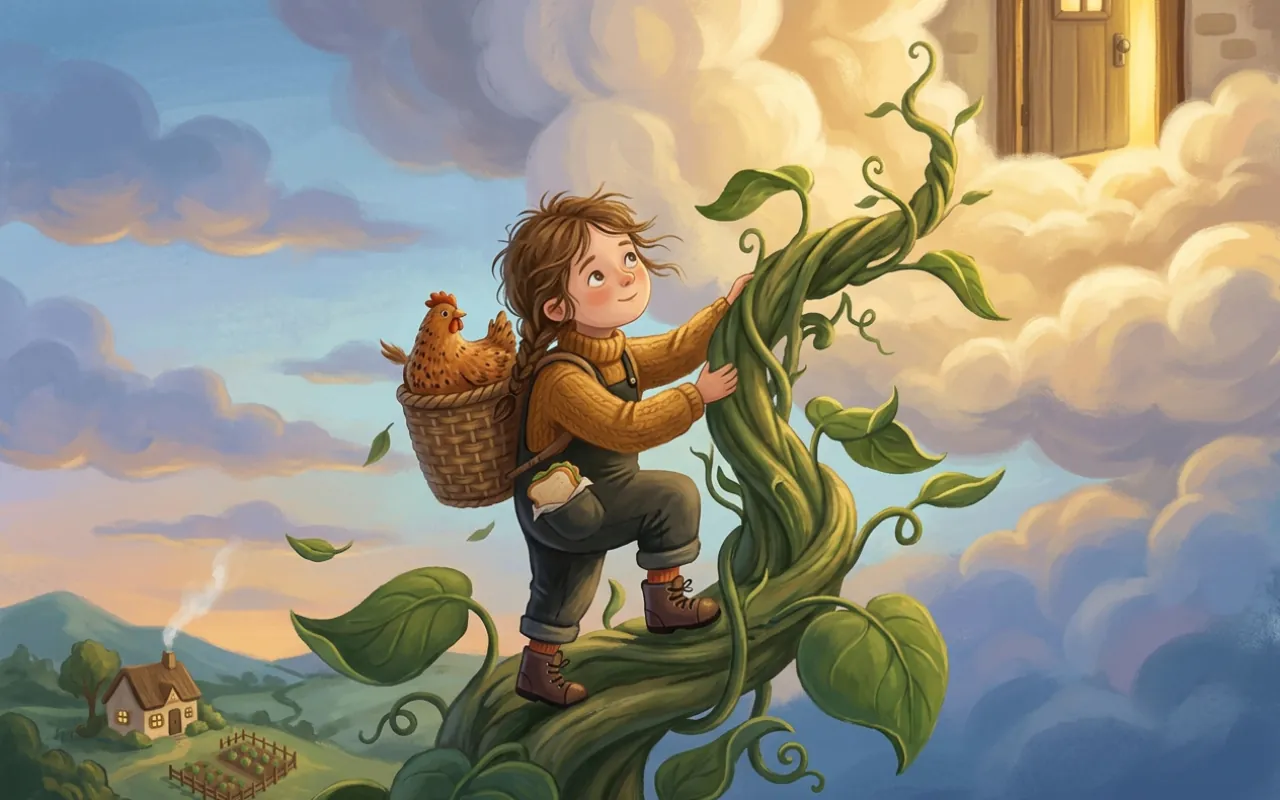
Mom fetched the big apple basket with the two straps. Peg put a tea towel in the bottom, the warm egg on the tea towel, and the hen on the egg. The hen settled down at once, as hens do when they are sitting on something warm. Then Mom made the sandwich.
“Not egg,” said Peg, looking at the hen.
“Cheese and pickle,” said Mom. She wrapped it in paper and put it in Peg’s coat pocket. She did up Peg’s top button. “Hold on with both hands,” she said.
“I always do,” said Peg, which was nearly true.
Then Peg put the basket on her back and began to climb.
The beanstalk had knobbles for her feet and leaves to sit on, and it was the best thing Peg had ever climbed, and she had climbed the wardrobe. She went past the chimney. She went past the rooks, who were surprised. The cottage got as small as a matchbox, and Mom in the garden got as small as a clothes peg. Peg waved to her, carefully, with one hand.
Halfway up, the wind came.
It pushed across the sky in one long push, and the whole beanstalk leaned over and swung back, like a boat on a rope. In the basket the hen said, “Bwark!” and put out all her feathers at once.
Peg knew what to do in a wind. Stop. Hold on with both hands. Wait for it to finish. So she stopped, and held on, and while she waited she hummed, because a hen in a basket does not know what waiting is. She hummed the song Mom hummed when she did the ironing, which has no words and goes on for a long time.
The hen pulled her feathers in. The beanstalk swung back and stood still. And the egg in the basket was so warm against Peg’s back that she hardly felt the cold at all.
Inside the clouds it was damp, and Peg’s arms were tired. She sat down on a leaf as wide as a kitchen table and took out her sandwich.
She ate half and gave the hen a crumb of crust. Then she wrapped up the other half and put it back in her pocket.
“Just in case,” she said to the hen.
She climbed the last bit, and her head came up out of the clouds into the sunshine.
On top of the clouds, as white as a pillow, stood a farmhouse. The top of the beanstalk was poking up through a row of onions. Everything was enormous. The front door was so high that the knocker was up where a bedroom window ought to be.
Peg knocked with her fist. It sounded like a mouse knocking on a wardrobe. She shouted, “Hello!” That sounded like a smaller mouse.
The keyhole was lower down, and there was a boot scraper under it, and Peg could not see a boot scraper without climbing it. So up she went, hen and all, and there was the keyhole, as big as a cat flap.
She held the hen up to it.
“Now,” said Peg. “As loud as you can.”
The hen put her head right into the keyhole and said, “BWUK-BWUK-BWUK-BWAAARK!” This is the loudest thing a hen can say, and it goes on for a while.
Slippers went flump, flump, flump across a floor. Then the voice said, very close now, and all of a wobble, “Here, chook chook?”
The door opened, and there stood Big Albert.
He was as tall as a church and as wide as a haystack, with a big brown coat and a kind, worried face. He looked down and saw the hen in Peg’s arms.
He sat down so hard, from pure relief, that the whole farmhouse bounced, and Peg bounced, and the hen bounced, and the kettle on the stove went ping.
“Hilda,” he said. “Oh, Hilda. There you are.”
He held out one enormous hand, and Peg put Hilda into it. Hilda walked up his arm and sat on his shoulder as if she had never been anywhere at all.
“She came down our beanstalk,” said Peg. “She was in Mom’s cabbages.” Then she took the warm egg out of the basket and held it up. “This is hers too.”
“I’d have come down after her,” said Big Albert, “but I’d only have snapped it. So I called. I’ve been calling all night.”
“We heard,” said Peg. “It rained on the cabbages.”
“Oh dear,” said Big Albert. “I’d better make you some tea.”
Big Albert put the egg in his coat pocket, where he always kept two of Hilda’s eggs to warm his hands. He made the tea in a pot the size of a water butt, and he poured Peg’s into a thimble, which was exactly right. His own teacup was as big as a bath. When he had finished his tea, he filled the cup with warm water, and Peg took off her boots, sat on the saucer and put her tired feet in.
“Oh,” said Peg. “Oh, that’s good.”
Then Big Albert’s tummy rumbled. It sounded like a cart going over a bridge.
“I haven’t had my breakfast,” he said. “Or my dinner. I was busy calling.”
So Peg took the other half of her sandwich out of her pocket and held it up.
“Just in case,” she said. “I always bring one.”
Big Albert ate it in one very careful bite, so as not to waste a crumb.
“That,” said Big Albert, “is the best thing I’ve had all week.”
And that was the first time there had ever been somebody hungry at the top.
When it was time to go, Big Albert took two warm eggs out of his coat pocket. He put one in each of Peg’s pockets.
“One for you,” he said, “and one for your mom, to say sorry about her best cabbage.”
“But they’re your hand-warmers,” said Peg.
“I’ve still got the one you brought me,” said Big Albert. “And I’ve got Hilda back. My hands will be warm enough.”
Going down is quicker than going up, as everybody who climbs things knows. Mom was waiting at the bottom with her arms out, just in case, and Peg climbed down into them.
That winter, the two eggs never once went cold. Every night Mom put them at the bottom of the bed, one for Peg and one for herself. Each one went in a sock so it would not roll. They both had warm feet all winter long.
On Sundays Peg climbed up for tea. She took two sandwiches now: one just in case, and one for Big Albert.
And at bedtime, with her feet on her egg, Peg would hear a big kind voice far above the clouds, calling Hilda in for the night.
“Here, chook chook,” it called, and it did not sound sad at all, only like someone saying goodnight. A little rain shook out of the clouds, just enough for Mom’s cabbages, and Peg went to sleep with warm feet.