That’ll Do Nicely, Thank You
Once there was a boy called Leo who lived with his mom in a narrow house on a sloping lane. The house had a blue front door, and a back door with a cat flap in it, and no cat. At the bottom of the hill stood a red postbox, and every morning at seven Mr. Abbott the postman came to empty it.
Leo was seven, and he liked things to be organized. For a whole month he had been planning his mom’s birthday breakfast, and he had drawn a map of it. The map showed the kitchen table, with a B where the bowl would go and an S for the spoon. It showed the stairs, with a big red X on the fourth one, because the fourth stair creaked. It showed Mom’s bedroom door, and beside it Leo had written KNOCK TWICE, SOFTLY. Across the top, in his best capitals, it said ALL BY MYSELF, and underneath that, DO NOT WAKE HER UP.
Here is why it mattered so much. Every day of Leo’s life, Mom had made the breakfast. And every day, when she sat down to her own plate at last, she said, “That’ll do nicely, thank you,” to nobody in particular. Leo wanted, just once, to be the person she said it to.
There was one difficulty. Leo was not allowed to use the stove. So Grandma had lent him her porridge pot.
It was a black iron pot the size of a bucket, and it did not need a stove at all. You set it on the table and said, “Cook, little pot,” and it cooked porridge: warm, already sugared, with raisins in. Grandma had written all this on a card, with IT MUST BE LITTLE in capitals. The pot would not answer to “pot”. It would not answer to “big pot”, however true that was. It answered only to “little”.
Leo read the card once, at bedtime, sitting on the stairs in his pajamas. The front of the card was so exciting that he never thought to turn it over. Then Mom called him up to bed, and the card stayed on the stairs. Even organized people leave things on stairs. In the morning the card was gone. Leo looked under the pot, inside the pot, behind the bread bin and in the bread bin. It was nowhere.
“Never mind,” Leo said to himself. “I only need the starting words.”
You and I know better. But Leo was seven, and it was six o’clock in the morning, and he had a map.
He set the bowl on the table at B. He set the spoon at S. Then he leaned close to the pot and said, in his smallest whisper, “Cook, little pot.”
The pot gave a small warm bubble. When Leo lifted the lid, the pot was full to the brim with porridge. He ladled out one bowl. It was perfect. He put the lid back on.
The porridge lifted the lid and came out over the rim.
“Stop, little pot,” Leo said, very quietly.
The pot, which was a very polite pot, went on cooking.
The porridge ran down the sides of the pot and across the table. It went round the perfect bowl on both sides, like a moat round a castle, and dropped onto the floor. Leo thought perhaps the pot wanted manners.
“Enough, please,” he said, as firmly as anyone can say anything in a whisper.
The pot, which was a very polite pot, went on cooking.
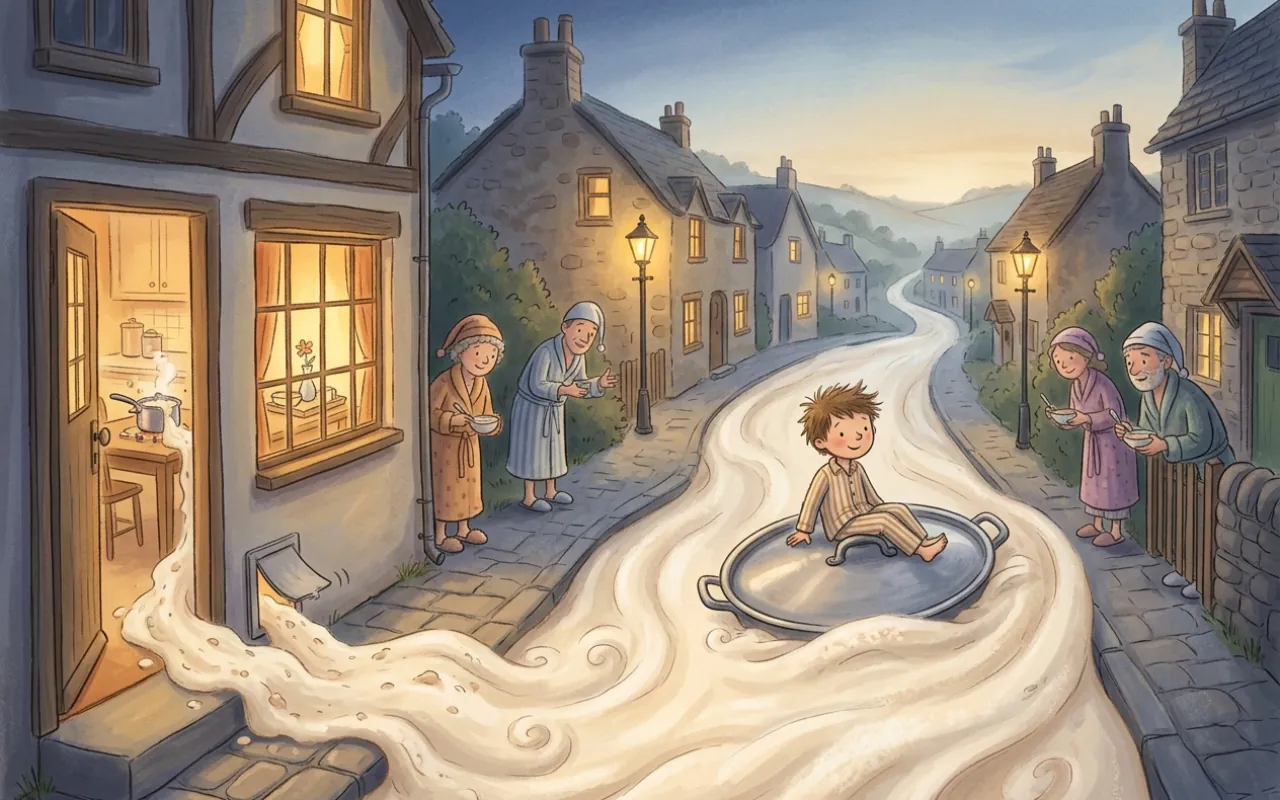
So Leo climbed onto a chair and sat on the lid. That, he thought, would settle it. The pot considered this. It lifted him slowly and kindly, the way a waiter lifts a tray. Up he went on a fat soft column of porridge, until his slippers were level with the kitchen clock. He was not very high. But he was not on the map.
The pot, which was a very polite pot, went on cooking.
Meanwhile the porridge had found the cat flap. It went out through the cat flap as if that was what the cat flap had been for all along. It went down the back step, out of the gate, and rolled very gently down the lane, wide and warm and slow, toward the postbox.
Doors opened all along the lane, because porridge with raisins in it does not go past the front door every day. The family at number four came out in their slippers. The old man at number nine came out with his biggest mixing bowl. Then everybody went back inside for spoons.
A few came round to the back door to see where it was coming from. Leo leaned down from his lid.
“Shh!” he said. “She’s asleep. It’s her birthday.”
So the word went down the lane from door to door, in a whisper. It’s her birthday. She’s asleep. And the whole street ate breakfast standing in the lane, as quietly as it possibly could.
At seven o’clock, Mr. Abbott came up the hill with three birthday cards for Mom. Mr. Abbott had never refused a second breakfast in his life, and he had already had his first. So he had a bowl, standing up. Then he opened his bag and took out a small tin of golden syrup, which he carried every day, in case.
“You never know,” he said, keeping his voice down.
He went along the lane putting a thread of syrup into every bowl. Then he came in at the back door and looked up at Leo by the clock.
“You’ve not had any yourself,” he said, and he handed up a bowl with syrup on it. Mr. Abbott was tall, and it only just reached.
A whole street whispering is louder than you would think. Upstairs, Mom woke up. She came down in her dressing gown with her hair flat on one side. She trod on the fourth stair, which creaked, but by then it hardly mattered.
From the kitchen doorway she saw the porridge on the table and the floor. She saw it going out through the cat flap. And she saw her son, up by the clock, sitting on a pot lid with his breakfast in his lap.
Mr. Abbott was a postman, and handing people things was his job. So he handed Mom a bowl. And Mom, without thinking at all, said what she always said.
“Oh. That’ll do nicely, thank you.”
The pot stopped at once.
The lid came down, slowly and kindly, until Leo was sitting on a pot on a table again. Out in the lane, the last of the porridge rolled down the last bit of the hill. It came to rest in a neat round puddle at the foot of the postbox, exactly as if it had been posted.
Leo looked at his mom. Then he looked at the map, which had porridge on one corner.
“You were supposed to be asleep,” he said. “I was supposed to do it all by myself.”
Mom looked round the kitchen. She looked out at the lane, where the family at number four were waving their spoons at her. Then she looked at Leo.
“This is the best birthday breakfast I have ever had,” she said. “The whole street came.”
“But you haven’t had yours,” said Leo. “The one on the map.”
Mom thought about that. “Then I had better go back to bed,” she said, and she did. She stepped over the fourth stair on the way up.
So Leo did it all by the map. The perfect bowl was still at B, with its moat all round it. He wiped the edge and set the bowl on the tray with the spoon. Mr. Abbott added one thread of golden syrup, which was not on the map, but Leo felt the map would allow it. He added the three birthday cards too. Leo carried the tray up the stairs and stepped over the fourth one. He knocked twice, softly.
Mom was fast asleep, or very nearly. Leo said, “Happy birthday,” and she opened her eyes and was more surprised than he had ever seen anybody be.
She moved her book to make room for the tray, and something slid out of it onto the quilt. It was a card.
“I found that on the stairs last night,” Mom said. “I needed a bookmark.”
People who need a bookmark never turn it over. Mom turned it over now. It was in Grandma’s capitals.
TO START: COOK, LITTLE POT. IT MUST BE LITTLE. TO STOP: THAT’LL DO NICELY, THANK YOU.
Mom laughed so much she had to hold the tray still. “Grandma said that at every breakfast when I was small,” she said. “And I never once saw her light the stove. I thought it was just manners.”
“It is manners,” said Leo. “It’s also the stopping words.”
Mom ate every spoonful. She ate the raisins and the syrup and the last bit round the edge. Then she put down her spoon and looked at Leo and said it, and this time she said it to him.
“That’ll do nicely, thank you.”
Down in the kitchen, the pot did nothing at all, because there was nothing left to stop.
And that is why, on that lane, to this day, everybody says “That’ll do nicely, thank you” at the end of breakfast, whether there is a pot in the house or not. Mr. Abbott says it twice.