Post for the Middle of the Bay
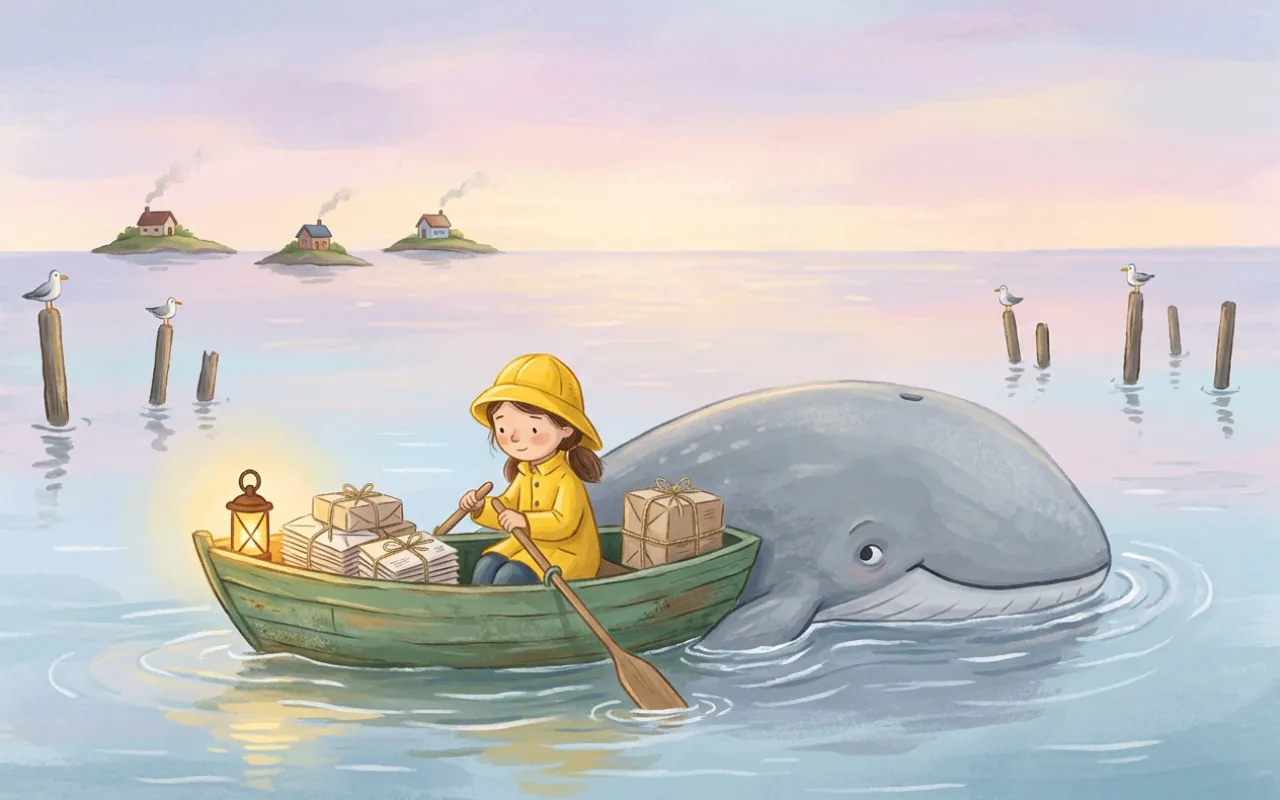
Bea rowed the island post. Out across the wide grey bay there were three islands, and none of them had a bridge or a ferry. So every morning Bea loaded the letters into a little green rowing boat and took them over herself.
She had a habit, and it is worth remembering. Bea read every address out loud as she rowed. She read them in a grand voice, to the open sea, the way a footman at a palace announces a duchess.
“Letters like to know where they’re going,” she said. “It settles them.”
So every morning the gulls on the harbour wall heard “Mr. Penny, The Boathouse, Gull Rock!” and “The Misses Fry, Top House, Little Lump!” and, grandest of all, “Mrs. Hobb, Lantern Cottage, Far Island!”
Most weeks there was a letter for Mrs. Hobb’s goat as well. It came from Mrs. Hobb’s nephew, who was six and thought it very unfair that a goat should never get post. Bea read that one out exactly as grandly as the rest. “Duchess the Goat, Lantern Cottage, Far Island!”
“A letter is a letter,” she said.
Before she set off, Bea always stopped at the bakery on the harbour. Mr. Rudd the baker was a large, floury man with arms like two good loaves. Every morning he had her bun ready in a paper bag, and every morning Bea rolled up her sleeve, bent her arm and said, “Feel that.”
Mr. Rudd felt it with one floury thumb.
“Hm,” he said.
That was all. He was not impressed. He was never impressed.
Now, for some weeks the island post had been getting faster.
It used to take Bea all morning to row to Far Island and back. Lately she was home in time for a second bun. The middle of the bay was the widest, greyest, most tiring part of the trip, and now it went by in no time at all. Stranger still, sometimes she dipped her oars and they found nothing but air. It was as if the sea had stepped down an inch to let her pass.
“A new current,” said Mr. Rudd. “Currents change.”
“Or,” said Bea, and rolled up her sleeve.
“Hm,” said Mr. Rudd.
Bea would quite have liked it to be her arms. But she was a fair sort of person, and if somebody was helping her across the bay, she wanted to know who, so that she could thank them properly. So she decided to find out.
On the first morning she rowed as hard as she could. She rowed until her face went pink and her hat slid down over one eye. The boat went fast, but in the middle of the bay it went no faster than it had the day before, and twice her oars came up dry.
“Well?” said Mr. Rudd, when she came in.
“It isn’t my arms,” said Bea sadly. “Or not only my arms.”
“Hm,” said Mr. Rudd, and gave her the second bun for nothing.
On the second morning she tried the opposite. In the middle of the bay she pulled in her oars, folded her arms, and sat. The boat slowed. It began to drift. Bea sat there feeling rather silly, and to pass the time she picked up the next letter and read it out.
“Mr. Penny, The Boathouse, Gull Rock!”
At once the water all around the boat went smooth. It went as smooth as a sheet that has just been ironed, and the boat lifted, only an inch, and slid forward.
Bea stopped reading. The boat slowed.
She read the next one. “The Misses Fry, Top House, Little Lump!” The boat slid on.
“It’s the addresses,” she told Mr. Rudd that afternoon. “When I read them out, the boat goes.”
Mr. Rudd stopped kneading. “Currents don’t listen,” he said.
“No,” said Bea. “They don’t, do they?”
On the third morning Bea rowed out to the middle of the bay and put her oars in the bottom of the boat. She sat up very straight and took the whole bundle of letters on her knee. Then she read the top one louder than she had ever read anything in her life.
“MRS. HOBB, LANTERN COTTAGE, FAR ISLAND!”
The sea went smooth as far as she could see. The boat lifted, not an inch this time but a whole hand’s width. And from right under the boards, under her boots, came a sound.
It was low and long and warm. It was like the bottom note of a cello when someone draws the bow across it very slowly, and it went on so long that the oars hummed along with it.
Bea leaned over the side and looked down.
The water was as clear as a window. Under it were lights, hundreds of them, small and green and silver, like a town seen from a hill at night. For a moment Bea thought it really was a town. Then all the lights moved together, and she saw that they were on a back. It was a back as broad as a field, and her little green boat was sitting right in the middle of it.
At the edge of the back the water rose in a slow round hump, and up came an eye. It was dark and kind and as big as a cartwheel, and it blinked at her.
“Oh,” said Bea. “Hello.”
The whale hummed. The boat shook pleasantly.
“It’s been you,” said Bea. “All this time. Carrying the post.”
The whale hummed again, so warmly that her hat slid down over one eye.
“I’m glad it was you,” said Bea, pushing it back. “I’d much rather a whale than a current.”
Hum.
“And you come up to hear the addresses.”
Hum.
Bea looked down at the bundle on her knee. Mrs. Hobb. Mr. Penny. The Misses Fry. Duchess the Goat. All those letters, going off to every house on every island. And the whale lying here in the middle of the bay, where it had always been, listening to where they were all going.
“Has anybody ever written to you?” said Bea.
The whale did not hum. It sank, just a little.
“Well,” said Bea. “We shall see about that.”
She read out every address in the bundle, and the whale carried her across the middle of the bay faster than the post had ever gone. That evening she sat at her kitchen table with her best pen and wrote a letter. It took her four tries, because she wanted it to be right.
The next morning she showed Mr. Rudd the envelope. It said: The Whale, The Middle of the Bay.
Mr. Rudd read it twice. Then he wiped his hands on his apron, which he only did for important things.
“Read it nicely,” he said.
In the middle of the bay Bea pulled in her oars. The sea went smooth. The boat rose. She held up the envelope and read the address in the grandest voice she had.
“The Whale, The Middle of the Bay!”
Then, since a whale cannot open a letter, she opened it herself and read it out.
“Dear Whale. Thank you for carrying the post. Thank you for carrying me. I am sorry I thought it was my arms. I will read you every address I ever have. Your friend, Bea (the Post).”
For a moment nothing happened. Then the whole whale came up.
It came up slowly and gently, the way good dough rises, until its back was out of the water and the little green boat sat on top of it like a cup on a table. The sea-lights shone all over it, green and silver in the morning. Then the whale blew. A spout went up as tall as a lighthouse and came down again in a warm, fine rain, and a rainbow stood over all three islands at once.
On the harbour, Mr. Rudd saw it and dropped a whole tray of buns. On Far Island, Mrs. Hobb saw it from her doorstep, and so did Duchess the goat.
That is why, if you row out across that wide grey bay today, you will find a post box nailed to the buoy in the middle. It is painted red, and on the front, in big white letters, it says THE WHALE.
Somebody writes every day. Mrs. Hobb writes on Mondays. Her nephew writes on Tuesdays and signs it from the goat as well. The Misses Fry take turns. And on Saturdays there is always a letter from Mr. Rudd, in very small writing, all about bread.
Bea collects them every morning and reads them out in the middle of the bay, the address first, grandly, and then the rest. Then the whale carries her on towards the islands, and she runs the fastest post route in the world.
She still stops at the bakery first, and out of habit she still rolls up her sleeve. Mr. Rudd still feels her arm with one floury thumb.
“Hm,” he says. “Softer.”
“I don’t need muscles,” says Bea. “I’ve got a whale.”
And the whale, who had gone its whole long life without a single letter, now gets more post than anyone on the bay. More, even, than the goat.