Two Hundred and Eleven Stars
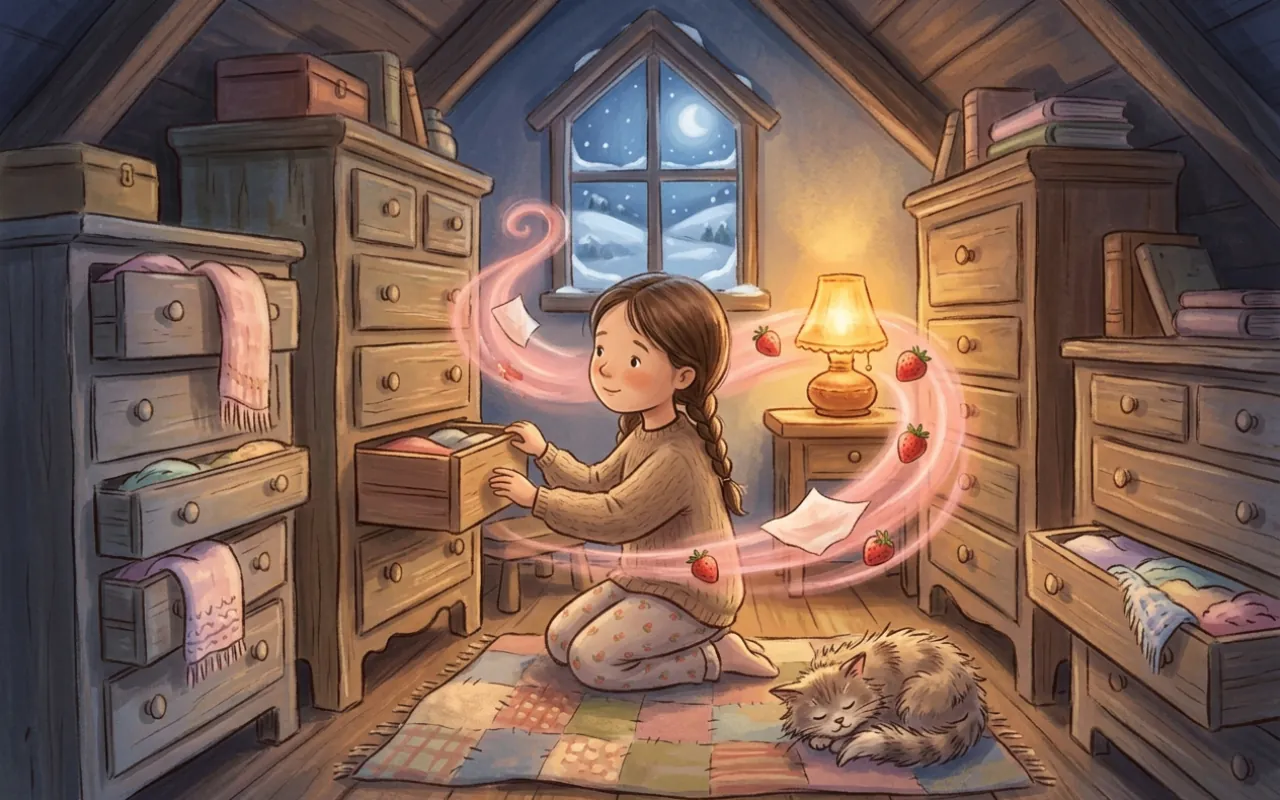
Nell counted the stars over her house every night, through her bedroom window, one pane at a time. She counted out loud so as not to lose her place, and if she did lose it, she started again at one. Her mom had learned to stand in the doorway and wait.
“All there?” her mom would say.
“Two hundred and eleven,” Nell would say. “All there.”
She had been counting since she was six, and it had always come out two hundred and eleven. Below the stars, high on the mountain, was one more light: the window of Big Tam’s house. Big Tam was a giant, and the kindest person in the valley. Nell never counted that one, because it was not a star.
One night in deep winter, with the snow right up to the windowsills, Nell woke late. Her mom had long gone to bed. Nell counted again, and got two hundred and ten.
She counted twice more, very slowly. Two hundred and ten. The gap was in the top left pane, between the big bright star and the little bent row of five.
Then she looked down into the lane.
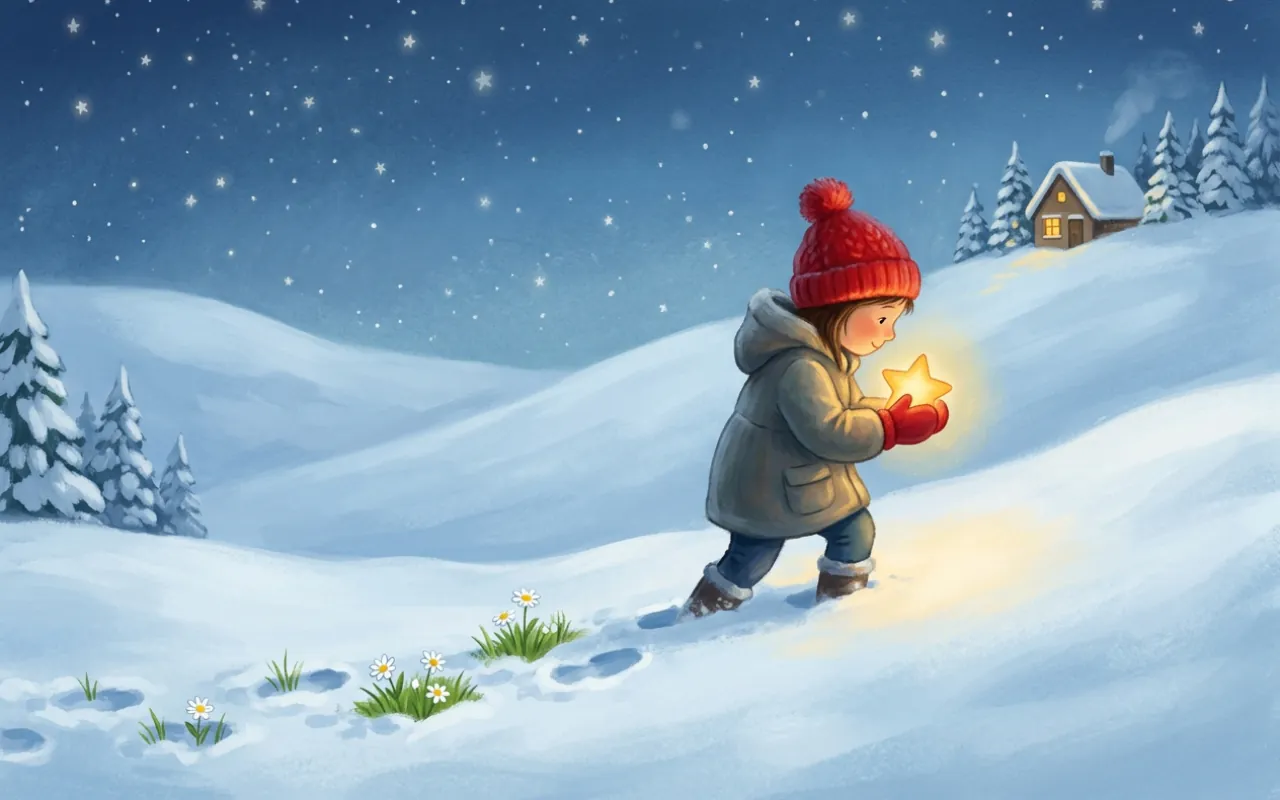
There was a line of green circles in the snow. Each one was as round as a plate, and each one was grass, summer grass, with daisies standing up in it. They came down the lane like something that had fallen at the top and bounced, and they stopped at her gate. In the last one lay the star, humming.
Nell wrote a note and put it on her own pillow, where her mom would look first. It said: GONE TO PUT A STAR BACK. BACK BEFORE MORNING. NELL. Then she put on her boots and her coat and her long red scarf and went out.
The star was the size of a hen’s egg, and it hummed one clear note, like a wet finger going round the rim of a glass. When Nell picked it up, it was as warm as an egg just out of the pan.
Nell did not know much about stars, apart from how many there were. But she knew a star has to be back in the sky before the sky gets light. And everybody knew the sky came lowest over the top meadow. In summer the haymakers up there took their hats off, to be on the safe side.
So she wrapped the star in her scarf and set off.
“Two hundred and ten,” she said, to keep herself company.
After a while she smelled hot wool. The star had burned a little brown ring in her scarf, and then another, and it was starting on a third.
She moved it to her coat pocket, and it went straight through the bottom and into the snow.
“Two hundred and ten,” said Nell, and picked it up again.
At the end of the village, Mrs. Hob sat knitting in her bright window. She was finishing the sleeve of a jumper she had promised the postman by morning.
Nell knocked on the glass. Mrs. Hob opened the window and looked at the star humming in Nell’s hand, with the scarf smoking round it.
“Well,” said Mrs. Hob. “That’s a star.”
“It’s the two hundred and eleventh,” said Nell. “I’m taking it up to the top meadow. But it melts through everything.”
Mrs. Hob put the postman’s sleeve down and took out a ball of wool so white it was nearly blue.
“Snow-wool,” she said. “Spun from the first snow of the year. I keep it for hot pans. Nothing burns it.” She looked at the clock. “Give me eleven minutes.”
It took her eleven minutes flat. Nell watched the clock the whole time and did not say one word, which was very hard. Then Mrs. Hob held up a little mitten with no thumb, just the size of an egg. Nell popped the star in. It went on humming, a little muffled, and the mitten did not smoke at all.
“There,” said Mrs. Hob. “Now wind that scarf round your neck properly. That’s what a scarf is for.”
She was back at the postman’s sleeve before Nell reached the gate.
Past the last house the snow got deeper. By the steep bit it was over Nell’s knees, and she was going much more slowly than the morning was coming. The mitten stopped the star burning things. It did not stop it being summer. Each time she set it down, she left a round of daisies behind her.
“Two hundred and ten,” said Nell, out of breath now.
A shepherd’s boy came down the path towards her, pulling a sledge with a lantern on the front. He had been taking hay up to the ewes.
“What’ve you got?” said the shepherd’s boy.
Nell showed him. The star hummed at him through the mitten.
“Top meadow?” he said.
“Before morning,” said Nell.
He turned the sledge round without another word. Nell sat on it with the mitten on her knee, and he pulled her up the steep bit, puffing clouds.
At the top of the steep bit he stopped. “Worst of it done,” he said. “My mom’s waiting up.”
“Thank you,” said Nell.
“Put it back nice,” said the shepherd’s boy, and went off down the hill with the empty sledge bumping behind him.
The top meadow was wide and white and flat, and the sky came down so low over it that Nell could hear it. Every star was humming its own note, and all together they sounded like a great many glasses ringing very softly.
She held the mitten up as high as she could. She stood on her toes. She jumped. The sky was low, but it was not that low, and Nell was nine, and not tall even for nine. Over the far ridge, the black had begun to go the dark blue that comes before grey.
“Two hundred and ten,” said Nell, and for the first time it came out small.
Then the snow on the ridge shook, and Big Tam came stepping over it. He had a coat with very deep pockets, and in winter he kept his sheep in them, with their sleepy white heads poking out of the tops. Because his pockets were full of sheep, he had nowhere to put his hands, and so his hands were always cold.
“I saw your green circles coming up the mountain,” said Big Tam. “I thought somebody might want a hand.” He laid one on the snow, palm up. “I’m very sorry. It’s a cold one.”
Nell climbed onto it. It was like sitting on a frosty doorstep. She took the star out of the mitten and set it down while she got her balance. At once there was a round of summer grass in the middle of Big Tam’s palm, with daisies in it.
Big Tam looked at it for a long time.
“Well, now,” he said. “That’s the first time that hand’s been warm since October.”
Then he lifted her. Up past his coat buttons and the sleeping sheep, up past his beard, up and up, until the stars were all round Nell like snow that had stopped falling halfway down. And there was the gap, between the big bright star and the little bent row of five.
Nell held up the star and opened her hand.
It rose out of her fingers as slowly as a bubble going up through honey, and settled into its place, and its note joined all the others.
“Two hundred and eleven,” said Nell.
Big Tam put her in his left-hand pocket, between two warm sleeping sheep, and it was the warmest place Nell had ever been. She felt the sheep breathing on either side of her, and Big Tam walking, one long soft step at a time, all the way down the mountain.
At her house he opened her bedroom window with two fingers and lifted her in. He pulled her blanket up for her with one fingertip, very carefully.
“Goodnight, Nell,” said Big Tam. “Thank you for my warm hand.”
Nell counted once more, pane by pane, and got to two hundred and eleven, and she was asleep before she could start again.
In the morning her mom found the note under Nell’s sleeping head, and a little white mitten with no thumb. Out of the window she saw the green circles going up the lane, past Mrs. Hob’s, and all the way to the top meadow.
That night her mom stood in the doorway, the same as always.
“All there?” she said.
“Two hundred and eleven,” said Nell.
“I know,” said her mom. “I counted.”
And to this day, when Nell counts to two hundred and eleven and says goodnight, one star in the top left pane blinks twice. That is the star Nell carried up the mountain, saying goodnight back.