Bun Says Goodnight to the Mountain
In a high green valley, where the grass kept going up and up until it turned into a mountain, there lived a dormouse called Bun. She was the smallest animal in the valley. She was also the sleepiest, and the most determined, all three at once.
Bun had entered every contest the valley had ever held, and she had fallen asleep in every one. In the Hill Race she fell asleep at the halfway stone. In the Long Jump she fell asleep in the air, or very nearly. In the Who Can Stand On One Leg Longest she stood on one leg for a remarkably long time. Then she lay down and slept until it was over.
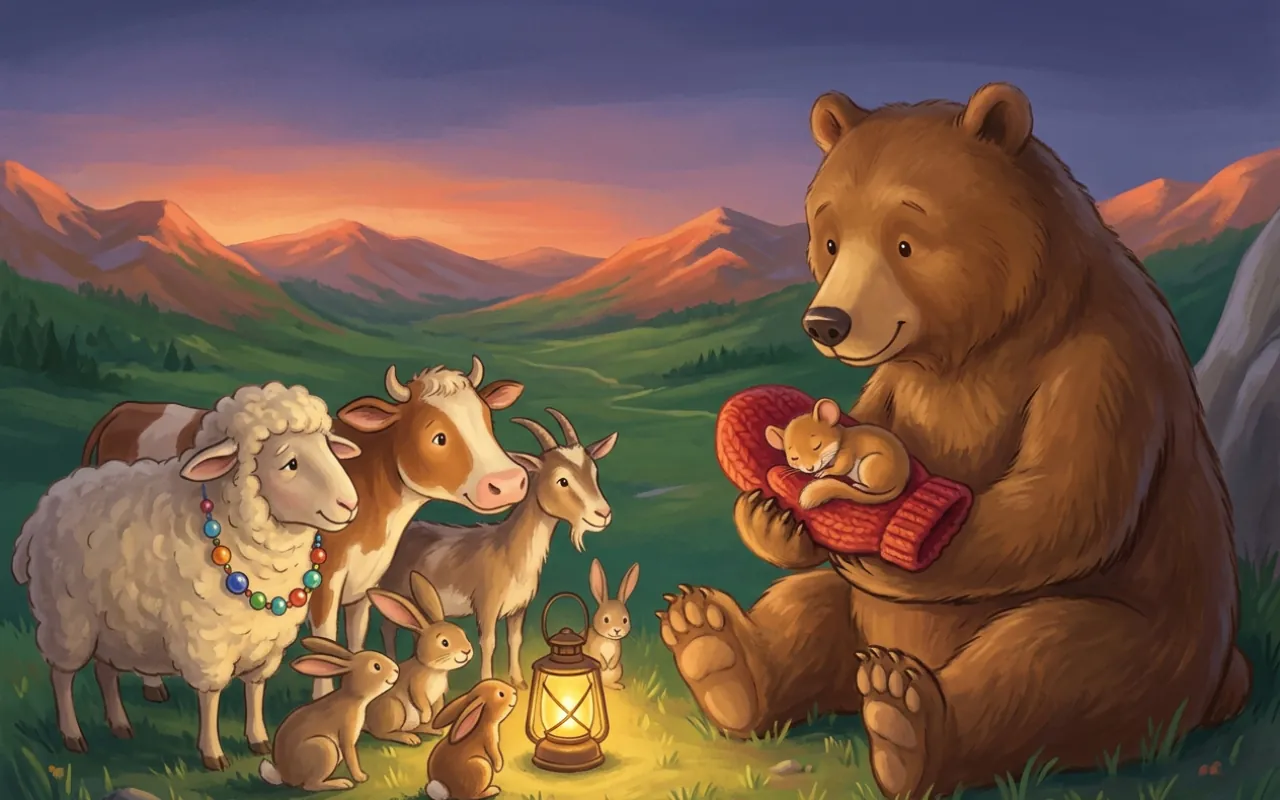
So Bun had learned to bring a mitten. It was a red wool mitten, and it made a perfect pillow for a dormouse. She carried it rolled up under one arm.
“What’s the mitten for?” the others asked.
“Just in case,” said Bun.
And every night, last thing, Bun said goodnight to whatever was nearest: the mitten, the moon, the hill outside her door.
At the end of every summer, the animals climbed up to the Echo Gap, high in the mountain, for the Echo Contest. On contest night, if you shouted into the Gap, it sent your voice back as a bead of coloured glass. The bigger the call, the bigger the bead. And if you held the bead to your ear, it said what you had said.
The judge was Granny Tuft, an old goat with a beard like a paintbrush. Round her neck she wore a string of every winning bead since her grandmother’s day. The oldest bead was small and brown, and when Granny Tuft trotted, it said “Oi!” very faintly. Nobody remembered who had won with “Oi!” It must have been a very good one.
The winner got a blue ribbon, which was nice. But what Bun wanted, just once, was her bead on Granny Tuft’s string, so the whole valley would know she had been there, and awake for it.
The trouble was really three troubles. Bun’s voice was a squeak. The contest went in order of size, biggest first, so Bun always went last. And by the time last came round, Bun was always asleep on her mitten. Every year somebody found her curled up with her tail over her nose, and every year somebody said, “It seems a shame to wake her.” So they let her sleep.
This year Bun climbed to the Gap with her mitten under her arm and her mind made up.
“I am going to stay awake,” she told Barnaby, who was walking beside her very carefully so as not to tread on anyone. “And I’m going to shout so loud the mountain falls over.”
“Oh dear,” said Barnaby. “I hope it doesn’t. Sorry. I mean, good luck.”
Barnaby was a large, kind bear, the biggest in the valley, so Barnaby went first, took a deep breath and roared. It was a very polite roar, as roars go. Then came the “Sorry” to the mountain, the way it always did.
The air in the Gap went bright, and a dark red bead as big as a plum dropped into Barnaby’s paws. Barnaby held it up to one ear. Out came a small round roar, and then, very faintly, “Sorry.”
“Sorry,” said Barnaby to the bead.
Next came the cows, whose beads were as big as apples, and then the sheep, whose beads were all exactly the same size, because sheep do everything together. Then came Mabel.
Mabel was a goose who had won three years running, and had practised all summer by honking into an upturned bucket. The bucket had come along for luck. Down it went, out stretched a long neck, and Mabel honked.
Down dropped a yellow bead as big as an egg. When Granny Tuft held it to her ear, it honked back so loudly that her ears went flat.
“That,” said Granny Tuft, “is the one to beat.”
Bun looked at the egg. Then she looked at Barnaby’s head, which was very high up.
“If I were higher,” said Bun, “my shout would go further.”
Practice shouts were allowed, off to one side. So Barnaby lay down, and Bun climbed up between Barnaby’s ears and shouted, “HELLO, MOUNTAIN!” as hard as she could.
A bead the size of a pea dropped onto Barnaby’s nose. Bun held it to her ear. “Hello, mountain,” it squeaked.
“Sorry,” said Barnaby, though it was not Barnaby’s fault.
“If I were louder,” said Bun, “that would do it.”
So Mabel lent her the bucket, and Bun shouted from underneath it. The bucket rang like a bell, and out rolled a second pea. “Hello, mountain,” it squeaked, with a little clang at the end.
Bun put both peas into her mitten. They were very pretty. They were not going to win anything.
Then she waited through the badgers and the foxes and the hares, the hedgehogs and the field mice, until the first star came out. Bun unrolled her mitten, just in case, and sat down on it, just to rest her legs.
I expect you can guess what happened next. Bun could have guessed it too, if she had been awake.
“And last of all,” said Granny Tuft, “Bun.”
Nobody answered. There was Bun on her red mitten, round as a bun, with her tail over her nose.
“It seems a shame to wake her,” said somebody, as somebody said every year.
“No,” said Mabel. “Not this year. She comes every single year. She ought to have her turn.”
So Barnaby slid one paw under the mitten, very slowly, and lifted Bun, mitten and all, like a cake on a plate. The whole valley followed on tiptoe, which is not easy for a cow.
Barnaby held Bun up in front of the Gap.
“Bun,” said Barnaby, as quietly as a bear can say anything. “It’s your turn. Sorry.”
Bun opened one eye. She saw the mountain, very big and very still. She was far too sleepy to shout. So she said what she always said to things last thing at night.
“Goodnight, mountain,” said Bun. “Thank you for all the beads.”
Then she shut her eye again.
For a moment nothing happened. Since Granny Tuft’s grandmother’s day, the valley had roared at the mountain and honked at it and bellowed at it. Nobody had ever once said goodnight.
Then the air in the Gap turned silver. A light came out of it, as slow as snow on a still night, and it grew as it came. It floated down and settled, glowing, in the grass in front of them all. It was a bead as big as the moon looks when the moon is low over a hill.
Bun woke all the way up. She climbed down Barnaby’s arm and laid her ear against the bead.
“Goodnight, Bun,” said the bead. “Goodnight, Barnaby. Goodnight, Mabel. Goodnight, Granny Tuft.”
And it went on. It said goodnight to every cow and every badger by name. It said goodnight to every sheep by name, which pleased the sheep very much, because usually people only count them. It did not leave anybody out.
“That,” said Mabel, “is the best bead I have ever seen, and I have won three.”
Granny Tuft looked at the bead, and then at her string, and then at the bead again.
“Well,” said Granny Tuft. “That is not going on a string.”
So she tied the blue ribbon round Bun’s middle, where it went round twice with a bow at the back. Then she said to the whole valley, “Everybody shouts at a mountain. It took the smallest of us to speak to it kindly.”
Then she bent her old head down. “Have you got anything a little smaller?”
Bun opened her mitten and held out the two peas. Granny Tuft chose the one with the clang and threaded it onto her string, right next to the oldest bead of all. And from that night on, whenever Granny Tuft trotted, two small voices spoke up one after the other: “Oi!” and “Hello, mountain!”
It was much too late to walk home. The whole valley lay down right there, round the glowing bead.
Nobody else had brought a pillow, so they used each other. The hares leaned on the sheep, and the sheep leaned on the cows, and everybody leaned on Barnaby, who lay round the outside of them all like a large brown wall that was also a blanket. And in the very middle, next to the silver bead, Bun lay down on her mitten. Just in case.
The bead went on saying goodnight, quietly, name after name. When it got to the end, it started again at the beginning.
Every year before this, Bun had gone last and fallen asleep first. This year the mountain said her name first. And she fell asleep at the very same moment as everybody else, in one big heap on the hillside, with her ribbon round her middle. She was smiling, and so was the whole valley.
The end.