The Long Way to the Sofa
Bea slept with two pillows. One was for her head and one was for her ideas, and she took both of them very seriously. The head pillow was flat and sensible. The ideas pillow was fat and blue. Every night Bea put her hand on it and thought hard, and every morning there was something good in it. A plan for a tent made out of the kitchen table. A name for the stripe on the cat’s left side. Pancakes on a weekday, which nobody in the house had agreed to yet.
That week Grandpa had come to stay. There was no spare room in the tall, narrow house at the end of the lane, so Grandpa slept on the sofa downstairs. He had a cushion for a pillow. It was a lumpy cushion with a big button in the middle.
“I don’t mind a bit,” Grandpa said at breakfast. Then he turned all of himself round in his chair to look at the toaster, because his neck would not turn on its own.
He said it again at lunch, and again at supper, and each time he said it he rubbed the back of his neck.
That night Bea lay awake and thought about the button. She thought about it with her head on one pillow and her hand on the other. In the end she had an idea, which is what the ideas pillow is for. Her ideas could manage without a pillow for one night. Grandpa’s neck could not.
So she would take the ideas pillow down to him. She waited until Mom’s light went out, because Mom’s light was always the last.
Now, you may not know this about houses. When the last light goes out, a house stretches to its full night-time size, the way a cat stretches when it gets off a warm chair. Most people never see it, because they are asleep, and that is how houses like it.
Bea’s house was tall and narrow, so it had a long way to stretch. When she opened her bedroom door with the pillow in her arms, the landing had become a road. The green carpet ran off ahead of her like a meadow. The doors along it were far apart, like farmhouses in the country. The bathroom night-light was on, and from here it looked like a lit window a long way off. Over her head, the little window in the roof had grown as wide as a sky, and it was full of stars.
The hall clock stood at the side of the road. He was taller than ever, and his face shone like a moon.
“Hello,” said Bea. “What time is it?”
The clock thought about it slowly, the way clocks do. Tick. Tock.
“Upstairs,” he said, “it is ten past two.”
Tick. Tock.
“In the kitchen, it is quarter to three. In the bathroom it is five past two, because the bathroom is always running five minutes late.”
“I need to get to the sofa before morning,” said Bea. “Which way do I go?”
Tick. Tock. Tick.
“Follow,” said the clock, “the cat.”
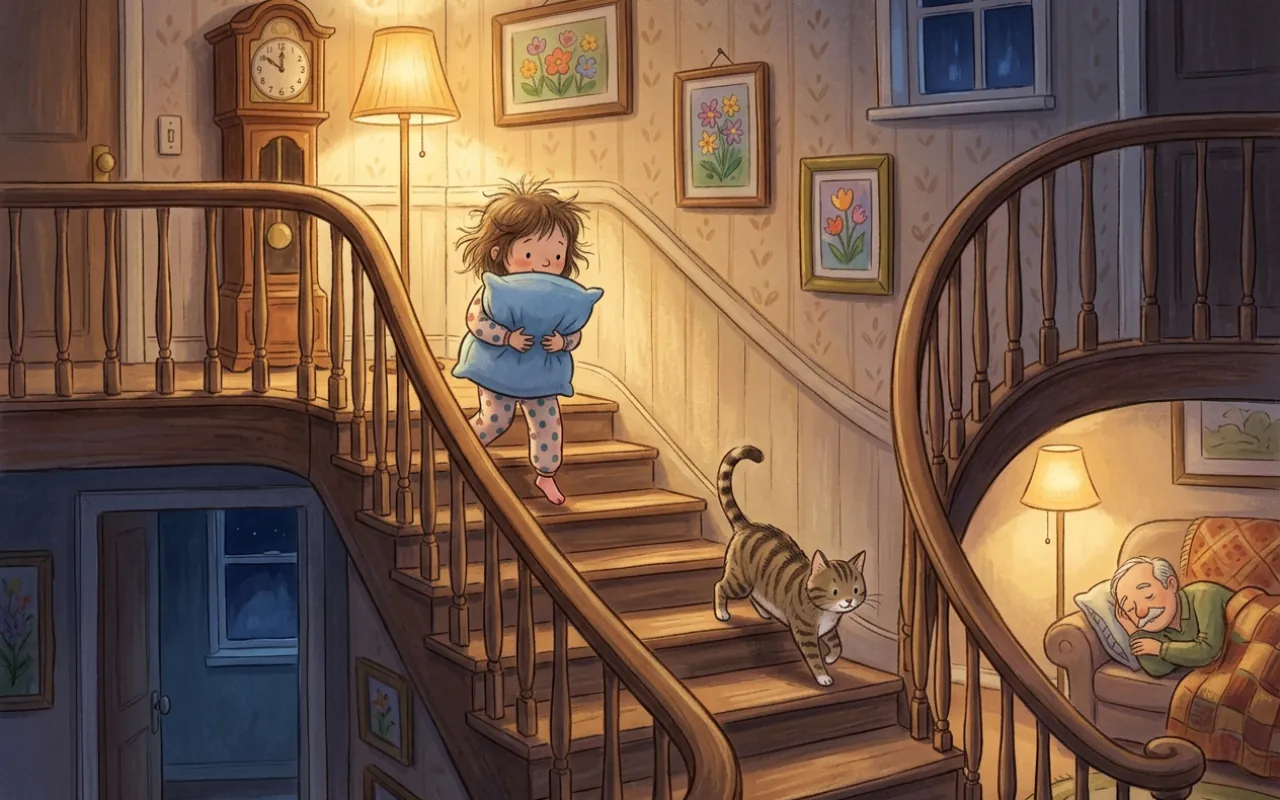
Bea looked down. There was Biscuit, who did not talk and did know the way. She had her tail straight up like a flag, and she was already walking.
Bea followed the flag. The road went on and on. The pillow was big and soft, and it kept climbing up in front of her face, so she carried it like a sleeping puppy, with her chin on top.
Halfway along was the laundry basket. At night it was a hill, a round wicker hill, with a path up the side made of dropped socks. Biscuit went up the path. Bea went up after her, one sock at a time. At the top she stopped to puff, and she could see the whole way ahead. The road ran on to the top of the stairs, and the stairs went down and down for miles. Halfway down a little blue light was burning. Far at the bottom, a tall white light stood in the kitchen.
“Oh,” said Bea. “That’s a lot of stairs.”
Biscuit went down the other side of the hill.
The stairs counted themselves. That is what stairs do at night, quietly, for whoever happens to be on them. Each one said its number in a small wooden voice as Bea stepped down.
“One,” said the first stair. “Two,” said the second.
Bea went carefully, because she could not see her feet over the pillow.
“Ten,” said the stairs. “Eleven. Twelve. Fourteen.”
Then there was a small cough, like someone who has said the wrong name at a party.
The thirteenth stair is always missing at night. There is no hole where it ought to be. The stairs simply go from twelve to fourteen, and every single time they are a little embarrassed about it.
“Bless you,” said Bea.
On they went. “Forty. Forty-one.” Bea’s arms began to ache. “Ninety. Ninety-one.” Her eyes began to close by themselves. “A hundred and eleven, a hundred and twelve,” said the stairs, “a hundred and fourteen.” Cough.
“Bless you,” said Bea.
The little blue light belonged to the boiler cupboard. Its door was open a crack, and the boiler hummed inside, and a small blue flame burned in its window. It was as warm as an inn on a winter road, where someone keeps the stove going all night for travellers. Bea sat down with her back against it and the pillow on her knees.
She thought she would rest for one tick and one tock. Then she thought she might rest for one more. Her head went down on to the pillow.
Biscuit came back up the stairs. “Two hundred and two,” said the stairs, very softly, because Biscuit weighed much less than Bea. Biscuit sat on Bea’s feet. Then she bumped Bea’s chin with the top of her head, hard, the way cats do when they mean up.
“I’m up,” said Bea. She was not up. Biscuit bumped her again. “I’m up,” said Bea, and this time she was.
“Two hundred and twelve,” said the stairs. “Two hundred and fourteen.” Cough.
“Bless you,” said Bea, nearly asleep on her feet.
At the bottom of the stairs was the kitchen, and the kitchen was as wide as a harbour. The fridge had left its door open a crack, on purpose, so that its light could stand out on the floor like a lighthouse. The light was tall and white with a hum in it. It reached right across the kitchen and through the far door, and there at the end of it was the sofa.
“Thank you,” Bea said to the fridge. The fridge hummed.
Grandpa was asleep with the lumpy cushion under his head. His head was tipped over sideways, and the button was pressing a round dent into his cheek. He was snoring a slow snore with a whistle at the end.
Bea lifted Grandpa’s head with both hands, as carefully as a full bowl of soup. It was heavier than it looked. Heads are. She slid the lumpy cushion out and the ideas pillow in, and she let his head down on to it.
Grandpa’s neck went straight, and the snore lost its whistle.
“Oh,” said Grandpa, without waking up. “That’s the stuff.”
Bea looked back at the stairs, going up and up for miles, and she knew she could not do the long road home. Not tonight. Not with legs like these. So she climbed on to the other end of the sofa, where Grandpa’s feet were under the blanket, and curled up on them. Biscuit climbed up and curled up on Bea. Grandpa’s feet were warm, the way grandpas’ feet are.
While they slept, the house shrank quietly back to its ordinary size around them. The kitchen pulled in its walls. The stairs folded up to thirteen, all of them present. The laundry basket went back to being a basket, and the landing went back to being a landing. Last of all, five minutes late, came the bathroom.
In the morning Mom came downstairs and found the fridge door open a crack, and three of them asleep on the sofa: Grandpa, and Bea on Grandpa’s feet, and Biscuit on Bea.
Grandpa woke up. He looked left, at Mom. He looked right, at Bea. Then he did it again, just to see if he could.
“Well,” he said. “That’s the best night’s sleep I’ve had all week. I can’t think why.”
He sat up and scratched his head. “And I woke up with the most wonderful idea,” he said. “Pancakes.”
“It’s Tuesday,” said Mom.
“I know,” said Grandpa. “That’s what’s so wonderful about it.”
Mom looked at the blue pillow. Then she looked at Bea. Bea looked at the ceiling and did not say a word.
They had pancakes on a Tuesday, and Bea had three. For the rest of the week Grandpa slept on the blue pillow, and Bea’s ideas slept at the end of her bed, on Biscuit. They came out a little bit furry in the mornings, but they were very good ideas all the same.