Rosie Lends the Moon Her Scarf
Rosie lived on a farm at the top of a hill, under more sky than anybody needed. There was sky in front of the house and sky behind the barn. On a clear night there was so much of it that Dad said he had to duck going out to the coal shed.
Once every November, on one night only, the geese went over. They came down from the north in a long, wobbly V, a hundred of them, honking to each other about the way. Rosie had never seen them.
This was not for want of trying. She had tried for three Novembers. The first time, she fell asleep on the stairs with her boots on. The second time, she fell asleep at the kitchen table with her face in her cocoa, and Dad still called that mug the goose mug. The third time, she fell asleep at her bedroom window with her forehead on the glass. In the morning there was a round red mark on her forehead and a round foggy mark on the window, and no geese anywhere.
The trouble was that Rosie noticed everything. She knew which hen laid the crooked eggs. She knew which gate would swing open if you so much as looked at it. She knew the milk was about to boil over a whole second before it did. Noticing everything all day is very tiring work. So at nine o’clock every night her eyes closed, as firmly as the post office on a Sunday, and nothing would open them till morning.
But she wanted, just once, to be awake when the geese went over.
This November, Dad came in from the yard rubbing his hands. “Frost tonight,” he said. “And the wind’s come round to the north. They’ll come tonight.”
Rosie had a plan. No cocoa, for a start. Dad looked at the goose mug, sighed, and hung it back on its hook. Rosie set a chair by her window, and she put on Grandma’s scarf, because the glass was cold.
You should know about Grandma’s scarf. Grandma had knitted it for Rosie’s birthday. She knew how to start a scarf, and she knew how to do the middle of a scarf, but halfway through she forgot how to stop, and so she didn’t. It was red and soft and three times too long. Rosie wound it round her neck four times, and there was still enough left over to trail behind her down the stairs. It was too long to wear, really. She wore it anyway.
She sat in the chair. She looked out at the big sky, which was full of stars and quite empty of geese. And she noticed something.
The Moon was hanging low over the barn roof. It was the thinnest kind of moon there is, just a curl of silver, with frost on the very tip. And the Moon was shivering. Rosie could see the tremble from where she sat, the way a spoon trembles in a cup when a cart goes by.
She thought about the geese. Whatever else you could say about geese, there were a hundred of them to keep each other warm. The Moon was up there all night with nobody.
Rosie looked at the sky, where the geese might come any minute. Then she looked at the Moon. Then she went downstairs with the scarf trailing behind her.
Dad was by the stove, mending a bucket.
“I need the hayloft ladder held,” said Rosie.
Dad put down the bucket. He put on his boots and his coat, and he went out into the frost and held the ladder. He asked no questions. He was that kind of dad.
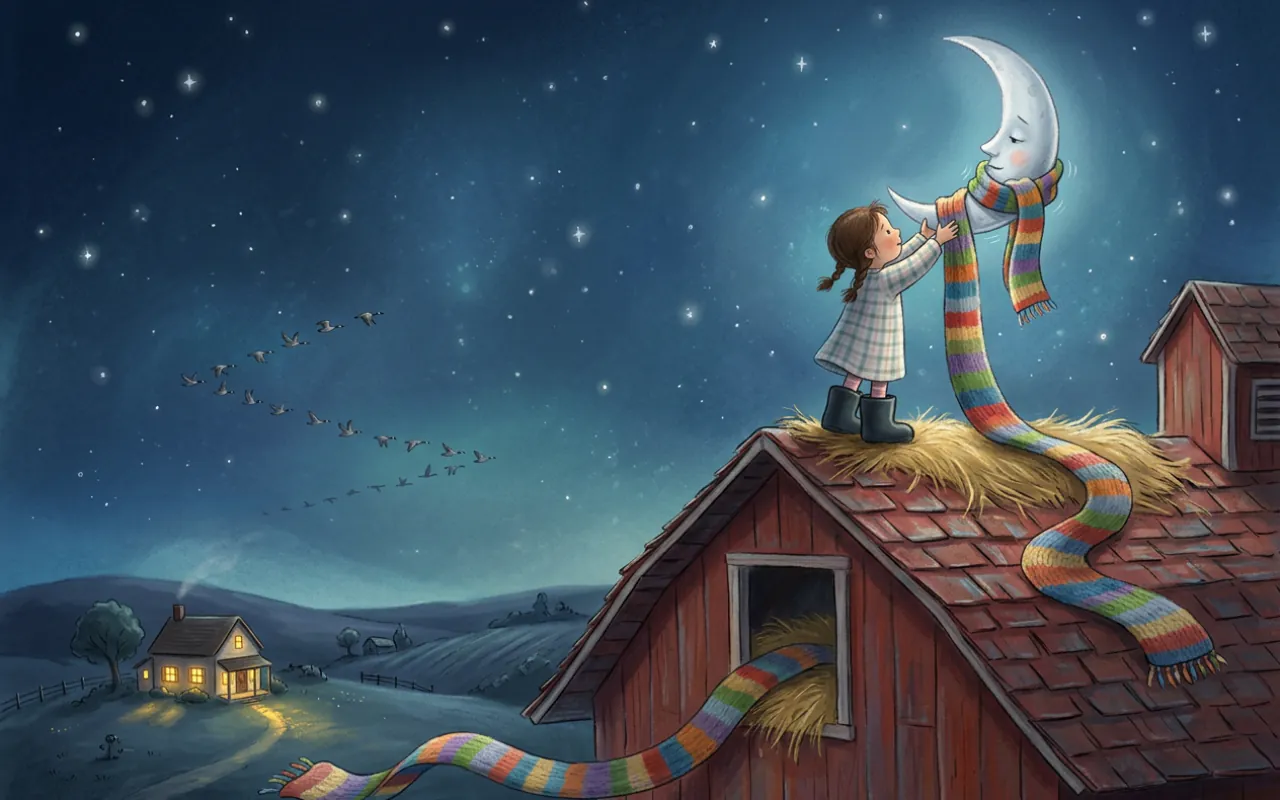
Rosie climbed up into the hay and opened the hayloft door. The barn roof was right above her, white with frost, and the Moon was just over the ridge, closer than any moon has a right to be. Up close, the Moon was as big as a cartwheel and as cold as the pump handle in January.
Rosie unwound the scarf from her neck: once, twice, three times, four, and then all the rest of it. She held it up in both arms.
“You can borrow this,” she said. “It’s too long for me. I think it might be about right for you.”
For a moment nothing happened. Then the Moon came down. Down over the barn roof it came, slowly and carefully, the way Dad gets into a bath that’s too hot. The frosty tip touched the end of the scarf. Then the Moon turned, and turned, and turned again, and the scarf went round and round like thread onto a spool. When it was done there was nothing left in Rosie’s arms, and there was a moon in a red scarf hanging over the barn.
The frost on the tip melted and dripped, once, onto Rosie’s nose. And the Moon stopped shivering.
“There,” said Rosie. “Better.”
At the bottom of the ladder Dad said, “Mind the fourth rung.” That was all.
Rosie went back to her window. Her neck was cold, but the rest of her was warm and pleased. She sat in her chair and waited for the geese. Then the clock downstairs struck nine, and you know what happened next. Dad came up at ten past and carried her to bed. She didn’t even notice. It was the only thing all day she didn’t notice.
At midnight, up high, the geese came over the hill.
They had been flying since teatime, and they were cold all through. The north wind got in under their feathers. The little ones at the back had stopped honking to save their breath.
Then they came to the Moon, who was warm right through by now. The Moon looked at the geese the way Rosie had looked at the Moon. And the Moon began to unwind the scarf.
The goose at the front took the end of it. The next goose took hold a little further along, and the next, and the next, down one side of the V and down the other. Soon every goose in the sky had a piece of scarf to hold and a piece to tuck a cold chin into. Grandma’s scarf was too long to wear. It was long enough for the Moon. And it was just long enough, with nothing to spare, for a hundred geese.
They flew on together, carrying the scarf across the sky like a long red ribbon, and not one goose was cold.
But a borrowed thing goes home, and everybody in the sky knew whose scarf this was. The Moon pointed one warm tip down at the farm on the hill. So the geese turned. They came down low over the barn, lower than geese ever come. They hung the scarf on the weathervane on the farmhouse roof, in a loop, the way you would hang a coat on a peg.
The loose end swung down past Rosie’s window. The wind caught it, and it swung back, and it tapped on the glass.
Tap. Tap. Tap.
Rosie, who had slept through three Novembers of geese, woke at the third tap.
She knelt up at the window in her nightie. And there they were.
The geese were going over. They were so close she could see the white under their chins and their dark feet tucked up neat. They were so close she could hear their wings, a sound like a hundred sheets being shaken out at once. They called to each other, and it sounded to Rosie very much like “Goodnight,” though of course it was only honking. Then they rose up and up, a long V across the stars, and went over the hill and away south. She watched every one of them go. She tried to count them and lost her place somewhere in the sixties, but it was a hundred. She was sure.
Then she opened the window and pulled the end of the scarf, gently. The loop slid off the weathervane, and the whole scarf came down into her arms, all three lengths of it. It was warm. It smelled of frost, and of something else. Rosie had never smelled the Moon before, but she knew it straight away.
She wound the scarf round her neck four times and got back into bed. The rest of it lay over the blanket like a red river. She slept.
In the morning, Dad found her at the kitchen table, wide awake, with a grey feather caught in her scarf.
Dad looked at the feather. He looked at Rosie. And for once in his life, he asked a question.
“Did you see them?”
“I saw them,” said Rosie. “Every one.”
Dad was so glad that he took the goose mug off its hook and made her cocoa. Rosie drank every drop, and kept her face out of it the whole time. When Grandma heard the story, she said she had always known that scarf was exactly the right length. Then she started another one, just in case.
All that November, the Moon glowed a little pink at the edges, the way your cheeks do when you come in from the cold. Nobody else on the hill noticed. Rosie noticed, because Rosie notices everything. She waved to the Moon every night at five to nine, and every night at nine o’clock she fell fast asleep. She didn’t mind one bit. She had seen the geese.