Jem’s Knot on Rope Day
Jem Crosby could tie a miller’s knot with one hand, without looking, while talking about something else. She had closed flour sacks that way for nine years at the mill, four hundred sacks a morning, and by now her fingers did not ask her opinion.
What she could not tie, with both hands and all her attention, was Ansel’s hitch.
She had come to the Travelers’ Camp at the start of the season to help Ansel keep the last tents before the harbor road. She carried pegs. She filled the kettle. She showed travelers the dry patch for their bags. And in between, she practiced the hitch on whatever was nearest. She practiced it on tent pegs and on guy ropes. She practiced it on her own bootlaces, which is why, in her first week, she walked into the kitchen tent and sat down very suddenly on a sack of oats. Once, while Ansel was explaining the morning kettle, she practiced it on Ansel’s sleeve.
Ansel looked down at the sleeve with great interest. “Nearly,” Ansel said. “Leave it on. I want to see where it went wrong.”
She did not mind getting it wrong on a sleeve. What she minded was Rope Day. Once a year the camp held a market, and the big awning went up over it on Ansel’s hitch, in front of everybody. Jem wanted to be the one who tied it. She had not said so to anyone except the oats.
Rope Day began early. Travelers came up from the river and down off the ridge with their tents on their backs and their frayed guy ropes over their shoulders. They made a queue that went twice round the kettle. Ansel mended every rope and taught every traveler a knot to go with it, properly, which is to say slowly. A woman sold secondhand blankets off a handcart. Somebody had brought a fiddle and knew two tunes. Mrs. Hatch set up her griddle on a trestle at the end of the row, and the smell of hot cakes went round the camp a good deal faster than the queue did.
On the highest line of all, the camp’s dry blanket was hung out like a flag, the way it is every Rope Day.
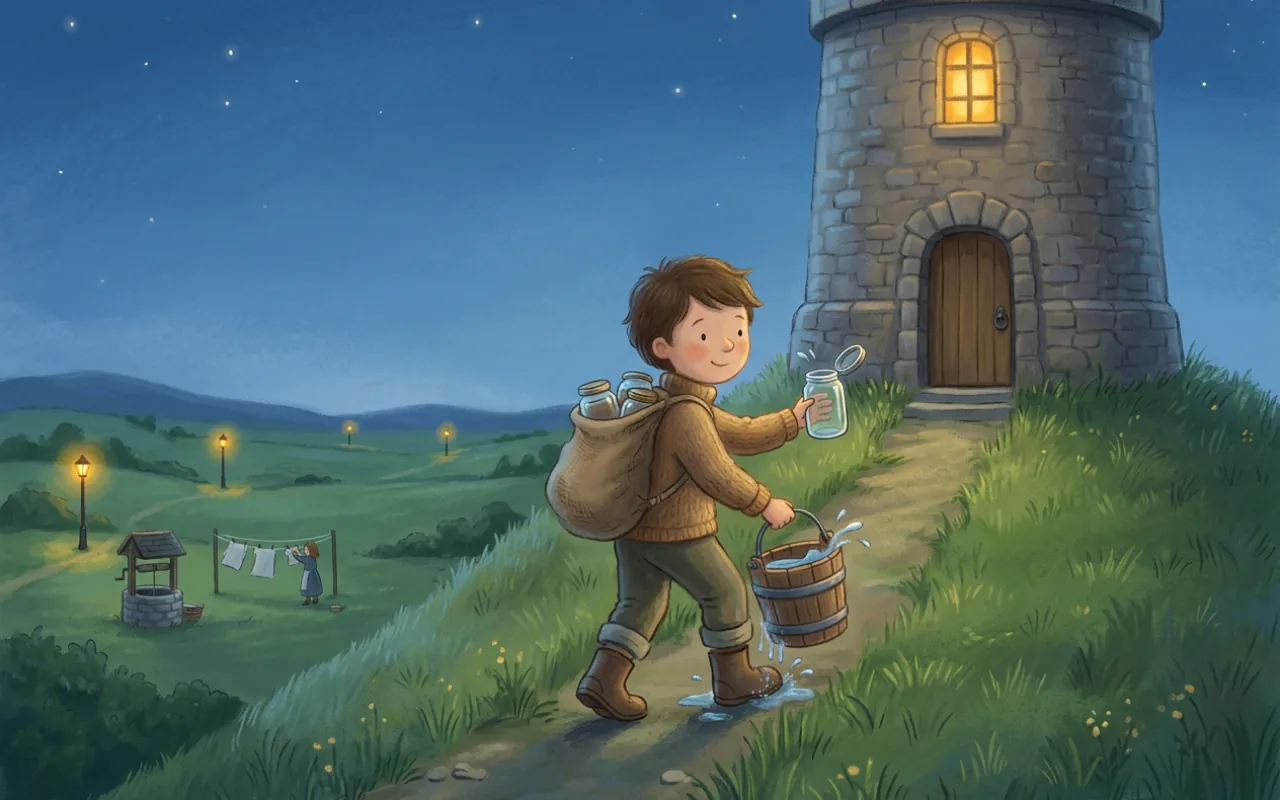
Pip Underweather had come down from Whistling Ridge the night before with a basket of jars, because a market is full of sounds worth keeping: a squeaky peg, a canvas snap, someone sitting down on a kettle lid. That evening Pip Underweather had sat through the whole of Ansel’s hitch lesson, all twelve minutes of it, with an open jar on one knee. Ansel had taken this as the finest compliment ever paid at the camp. The jar now sat in the basket with a label in capital letters: ANSEL, KNOTS, LONG.
The lid did not fit very well.
When the griddle was hot and the queue was settled, Ansel put the awning rope into Jem’s hands. It ran up through a ring at the top of the tall pole and down again to a post, and the knot went on the post.
“Now,” Ansel said. “Over, under, and we take our time. I’ll be just there. Shout if you want me.”
Jem took the rope to the post. She had it over. She had it under. Then her fingers, which had been to the mill and back, gave a little twist of their own, and there on the post was a miller’s knot, neat as a sack.
She picked it out and tried again. This time the hitch came out as a lump. It slid down the post and sat at the bottom, looking pleased with itself.
From the basket at her feet, in Ansel’s warm, unhurried voice, the jar said, “Now. Over, under, and we take our time.”
Half the queue turned round. Over by the kettle, the real Ansel looked up at the sound of Ansel.
“That’s a good lesson, that,” Ansel said, to nobody in particular, and went back to the rope.
Pip Underweather sat on the jar until it stopped. “It does that. Mostly near rope.” Then, without asking: “Do the lump again, Sacks. The sliding bit. Slower.”
Jem did not do the lump again. She went and practiced on something smaller.
By noon a good many things in the camp were tied in slightly wrong hitches. There was one on the handle of the big kettle. There was one on the strap of a traveler’s umbrella, done while he waited for his cake; he thanked her for it, thinking it was a service. And there was still the one on Ansel’s left sleeve, because Ansel would not let her take it off.
Her second try at the awning was very slow. She whispered “over” and “under” to herself, got all the way to the end, and pulled. The whole hitch fell apart in her hands as if it had only been resting there.
“Now,” said the jar, wriggling under Pip Underweather. “Over, under, and we take our time.”
Her third try she did with her eyes shut, on the theory that her fingers might behave if nobody was watching them. They tied a miller’s knot. Of course they did.
“Now,” said the jar, “over, under, and we take our time,” and over by the kettle Ansel said it along with the jar, without noticing.
Ansel came over and looked at the miller’s knot for a long moment.
“That’s a tidy knot,” Ansel said. “It isn’t the one, though. The cakes are ready. Shall I?”
Jem nodded. Ansel tied the hitch. It took some time, because Ansel explained every part of it along the way and could not help it. It was a beautiful hitch. It would have held a house.
“Next year,” Ansel said.
“Next year,” Jem said, and went to fill the kettle, which still had her wrong hitch on the handle.
The ridge had been promising rain all morning. Rain on Whistling Ridge does not fall so much as arrive, sideways, like a neighbor who gave up knocking years ago. It came across the camp in one gray sheet and went straight under the awning, onto the cakes and the blankets and everyone who had been admiring them.
“If these cakes get wet,” said Mrs. Hatch, holding a tray over them, “I’m selling them as soup.”
The awning had to come down. Brought down flat, it would cover the trestle and the blankets like a lid on a pot, and that was the whole idea, if only it came down fast. Ansel was already at the post, picking at the hitch.
“It’s a very good hitch,” Ansel said, working at it. “That’s the trouble. Wet like this, it’ll take me five minutes.”
Beside the post the traveler with the umbrella was trying very hard to open it.
And from the basket, because it was the worst possible moment, the jar said, “Now. Over, under, and we take our time.”
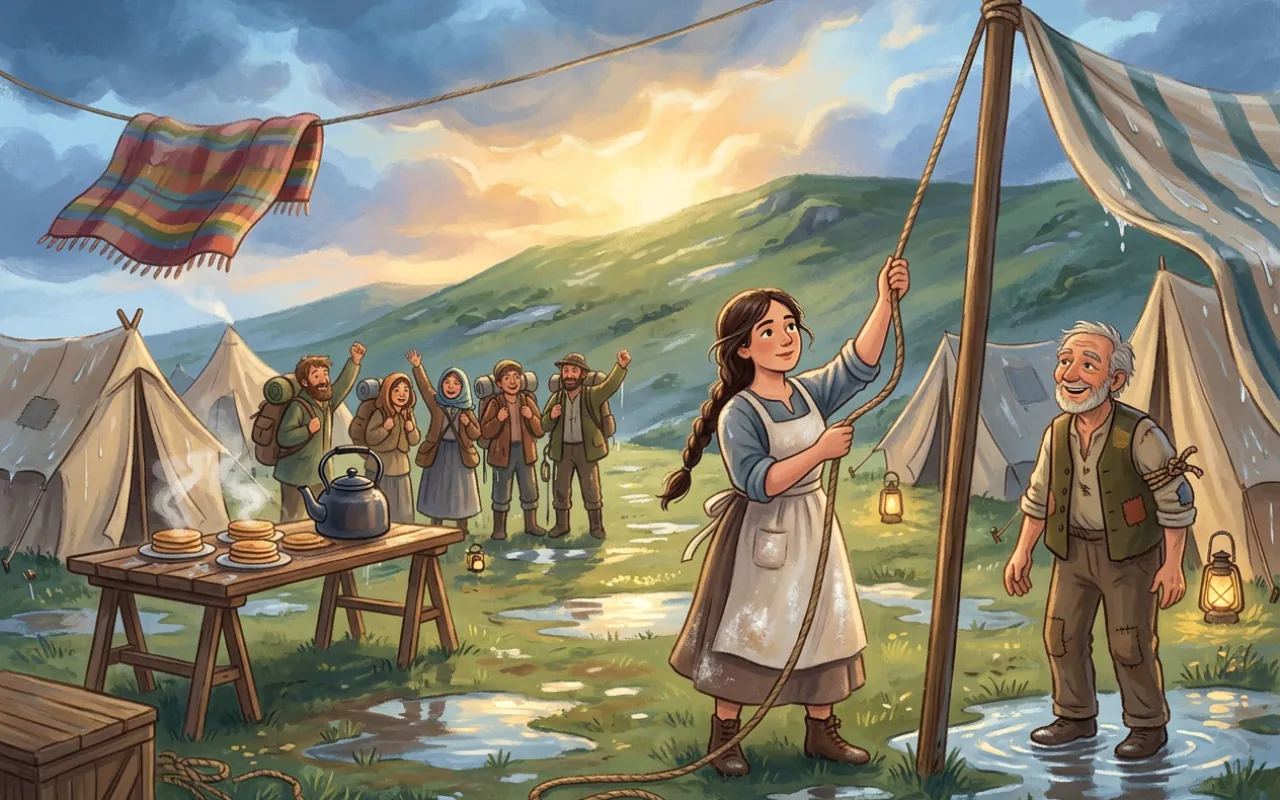
Jem did not take her time. She did the only thing her hands knew. She took the rope just above Ansel’s hitch and threw a miller’s knot round the post, one-handed, without looking, the way she had closed four hundred sacks a morning. Her knot took the weight. Ansel’s hitch went slack, and Ansel had it off the post in a moment.
“Mind your heads,” Jem said, and pulled the loose end.
A miller’s knot comes undone in one pull. That is what it is for. The rope ran up through the ring at the top of the pole with a single long zip, and the whole awning came down over the cake trestle and the blankets as neatly as a lid. The jar got as far as “over, under,” and nobody heard the rest. Pip Underweather had a fresh jar open before the rope stopped running.
The rain went round the ridge and away, the way ridge weather does. Everything in the camp was wet. The tents were wet, the queue was wet, and the traveler with the umbrella was wetter than anyone. Everything was wet except the cakes and the blankets, which were snug under the awning, and the dry blanket on its high line, which was dry, as it always is. Nobody at the camp thought this worth remarking on.
Ansel stood in a puddle, rope in hand and sleeve still tied, looking happier than anyone at the camp had ever seen Ansel look.
“Show me that,” Ansel said.
“It’s only the miller’s knot,” Jem said.
“Show me properly,” Ansel said. “Twice. Here, in front of everyone, so I can’t pretend I’ve got it when I haven’t.”
So there, in front of the whole dripping queue, Jem taught Ansel the miller’s knot. She showed it once, quickly: round, through, tuck. Ansel tried it. Ansel’s fingers went straight back to the old hitch, because they had been tying it for longer than Jem had been alive.
“They do that,” Jem said. “Mine do it the other way round. Again. Round, through, and we don’t take our time.”
The queue laughed. The second time, Ansel got it. One pull, and the knot fell open, and Ansel laughed louder than the queue.
“An awning on this ridge wants to come down faster than it goes up,” Ansel said. “I’ve had it the wrong way round for years. Go on, then. Up it goes.”
And Jem Crosby raised the big market awning on Rope Day, in front of everybody, with one hand, without looking.
Ansel took a rope tag out of a pocket and wrote on it in large careful letters: JEM’S KNOT. Ansel tied it on with the old hitch, properly, taking all the time in the world. All afternoon travelers asked about the tag, and Ansel told every one of them.
“That’s Jem’s knot,” Ansel said. “Jem Crosby. She’s by the kettle. Ask her nicely and she’ll show you, and she won’t take twelve minutes about it.”
At supper, Pip Underweather took a new jar out of the basket and set it on the table. The label said JEM, ZIP, GOOD.
“You know my name,” Jem said.
“Asked Ansel,” said Pip Underweather. “Couldn’t put Sacks on a good one.”
Then the lid came off, and the long zip ran round the supper table exactly as it had run up the pole. Everybody cheered again, Mrs. Hatch loudest. The traveler with the umbrella, who had dried out by then, said it was the best Rope Day he had ever been to.
Ansel poured the tea from the kettle with the wrong hitch on its handle. The sleeve was still tied. Ansel said it was staying that way.
That night Jem undid her bootlaces, which for the first time all season she had tied in miller’s knots, and each one came open in a single pull. She was nearly asleep when she heard Ansel outside by the kettle, telling the very last traveler of the day about the tag on the rope.
“Jem’s knot,” Ansel was saying. “Jem Crosby. She taught me. Twice.”
All season Jem had wanted to tie the right knot in front of everybody. In the end she had, and it turned out to be her own. She slept like a full sack of flour, with her boots by the tent door and, for once, not a single thing tied to anything.