The Door That Needs a Shoulder
Pip Underweather collected sounds in jars. On a shelf on Whistling Ridge there were dozens of them, with the lids screwed down tight. There was a good hinge, and a pan lid dropped on stone, and Sable’s boot on loose shale. There was a laugh that somebody at the camp had tried very hard not to laugh. A sound keeps beautifully in a jar. Now and then one gets out without asking first, and the people on the ridge said that this was also true of Pip.
What the shelf did not have was a door. And every traveler who came over the ridge from the west seemed to say the same thing about one door in particular.
“Maren’s door,” they said, rubbing their shoulders. “It needs a shoulder.”
Pip heard this all summer. In the autumn Pip packed a sack of empty jars and a pencil for the labels, and walked four days west to catch it.
It was a slow four days, because Pip stopped for everything. A cart wheel that ticked. A gate that sang two notes, one going and one coming back. A shepherd who whistled through the gap in his teeth. “Does it always do that?” Pip would say, with a jar already open. “Do it again.” And quite often, after that: “No, the other boot.”
At Kettlebridge the carts queued behind Rook’s rope, and Rook let them over one at a time.
“Next,” said Rook, and a flour cart rolled across.
“Next,” said Rook, and a cart of turnips followed it.
The third cart stopped halfway, because the carter wanted to discuss which wheel had been squeaking before the bridge and which had only started on it.
“Next,” said Rook. It was the crossest word Pip had heard in two days. Pip clapped the lid on it, licked the pencil, and wrote on the label: Rook, saying Next, third time, cross.
That evening Nessa fed everybody on the near bank, as Nessa always did. Rook came in last, took a full bowl to the quiet end of the table, and said, “I am going to eat this. All of it. Nobody needs me until the bottom.”
“Then nobody will,” said Nessa. “Pass the bread round the long way.”
Rook had the first spoonful halfway up when the sack under Pip’s chair said, very clearly, “Next.”
Every head at the table turned to the door. Then every head turned to Rook. Rook looked at the spoon.
“That’s me,” said Rook.
“Third time,” said Pip, sitting firmly on the sack and red to the ears. “Sorry. They’re loudest when they’re new.”
“I was cross,” said Rook.
“You were,” said Pip.
Rook thought about it. “I’m less cross now. Keep the lid on.” And Rook ate the soup to the bottom, while Nessa leaned on the dresser and laughed until the ladle had to be put down.
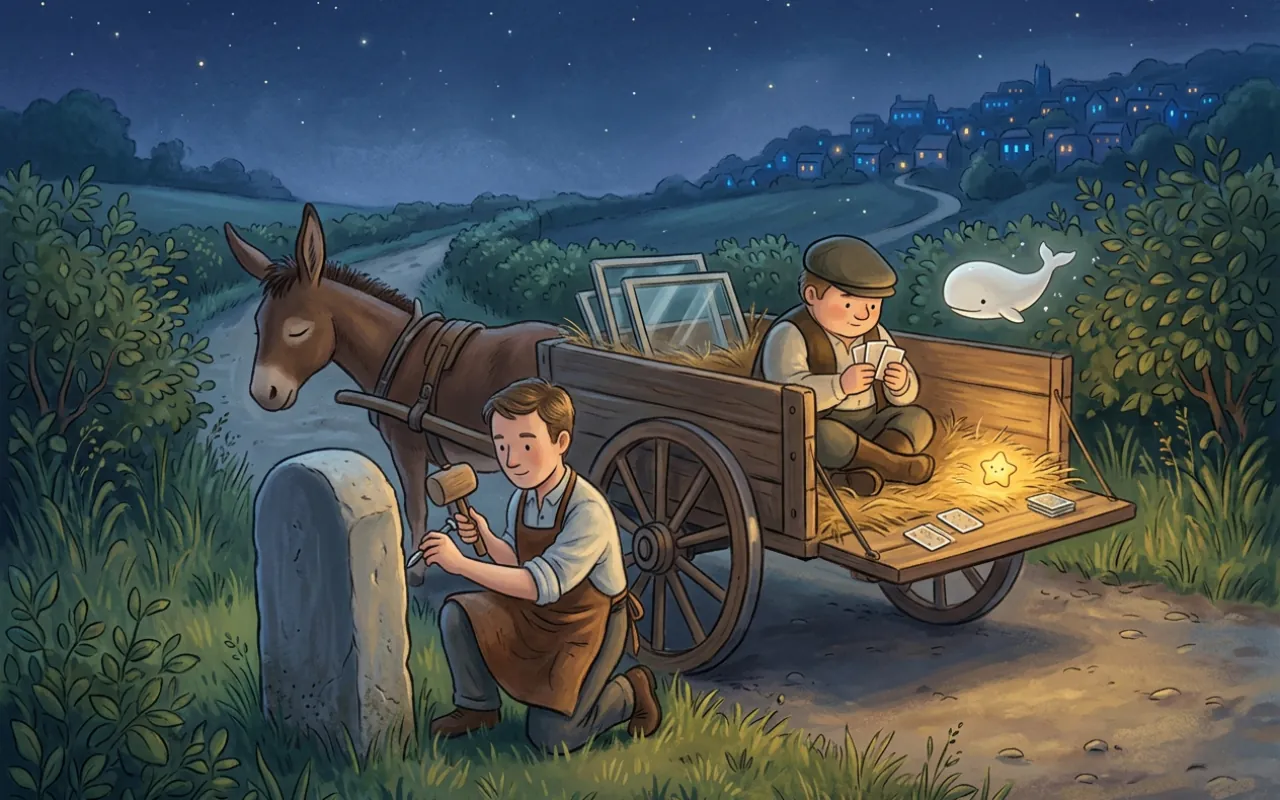
On the fourth morning Pip Underweather came down the east road from Lantern Hollow. At the milestone that says two miles, Ivo was measuring the numeral with a cord and pegs, and Hobb’s glass cart was stopped at the trough. The mule lifted her nose out of the water, looked hard at the milestone, and sneezed.
“Does she always do that?” said Pip, with a jar already open. “Do it again.”
“She does it at that stone every trip,” said Hobb. “It’s the chalk.”
“The numeral is clean,” said Ivo. “I chalk the cord, so I can see it against the stone.”
The mule sneezed again, at both of them, and Pip had it.
Ivo measured the numeral once, twice, three times, and was just settling in to measure it a fourth time, for pleasure, when the jar in Pip’s sack sneezed. The mule sneezed back.
Ivo rolled up the cord. “I’ll do the last one later,” said Ivo. “When it’s quieter.”
Maren’s observatory stands on a knoll above the Sky-Meadow, and Pip went up the path at a run, with an open jar in one hand and the lid in the other.
Now, a door that sticks in wet weather has one great failing, which is that it does not stick in dry weather. It had not rained in the meadow for a fortnight.
Pip knocked. The door swung open at the touch of a knuckle, all the way, without a sound.
Inside, the apprentice was at the stove with a spoon.
“Does it always do that?” said Pip.
“Only when it’s dry,” said the apprentice.
“Do it again.”
The apprentice shut the door and opened it. It moved like a curtain. Pip shut it and opened it, and it moved like a curtain for Pip as well.
“With your shoulder,” said Pip. “The way everyone says.”
So the apprentice stepped outside, pulled the door shut, set a shoulder to it, and pushed as if it were the wettest night of the year. The door gave at once. The apprentice went through the doorway, across the floor, and fetched up against the map table, and the jar in Pip’s hand caught nothing at all.
Pip sat down on the step.
“Four days,” said Pip.
The apprentice looked at Pip on the step for a moment. Then the apprentice dug the bread out from under the maps, where the bread always was in that house, and ladled out a bowl of soup. “Maren’s at the far end of the valley, taking readings,” said the apprentice. “Come and eat.”
When the apprentice put the lid back on the pot, it rocked on the rim, tink-a-tink-a-tink, before it settled.
Pip looked up from the bowl. “Does it always do that?”
“Yes.”
“Do it again.”
The apprentice lifted the lid and set it down, and Pip got it. The label said: Soup lid, Maren’s, rocking. Later, when the apprentice went up to the loft for a blanket for the bench, the third rung of the ladder made a noise like somebody saying “hm” about a hat. Pip got that too, on the third go, after the apprentice had come back down to the second rung and stepped onto the third twice more, very patiently.
By then the meadow lamps were coming on below, post by post in the blue, a little slower than strictly necessary, because Wick checked every cover twice. Pip was walking round the room with an open jar the way other people walk round a room with a candle. Pip held it to the window, and the chimney, and the kettle. Then Pip held it to the shelf where Maren kept the star flecks that had come down and cooled: little dull grey specks in saucers and an old tin, none of them bigger than a seed.
Pip stopped. Pip went perfectly still, which nobody on the ridge would have believed.
The jar was ringing. It was a high, thin note, the note a wet finger makes going round and round the rim of a glass.
“Did you know they did that?” said Pip, very quietly.
The apprentice came and stood by the shelf and listened for a long time. “No,” said the apprentice, and went to fetch the notebook, and wrote down the time, and the shelf, and the note.
Pip wrote a label too. It said: Maren’s shelf. Ringing. Nobody knew.
Then Pip looked at the door, which stood open to the evening as easy as anything.
“I could wait for rain,” said Pip. The sky over the meadow was clear and deep blue, with the first stars out in it, and not a cloud anywhere.
Then Pip looked down at the well at the bottom of the meadow. “Or we could bring it some.”
The apprentice was already fetching the bucket.
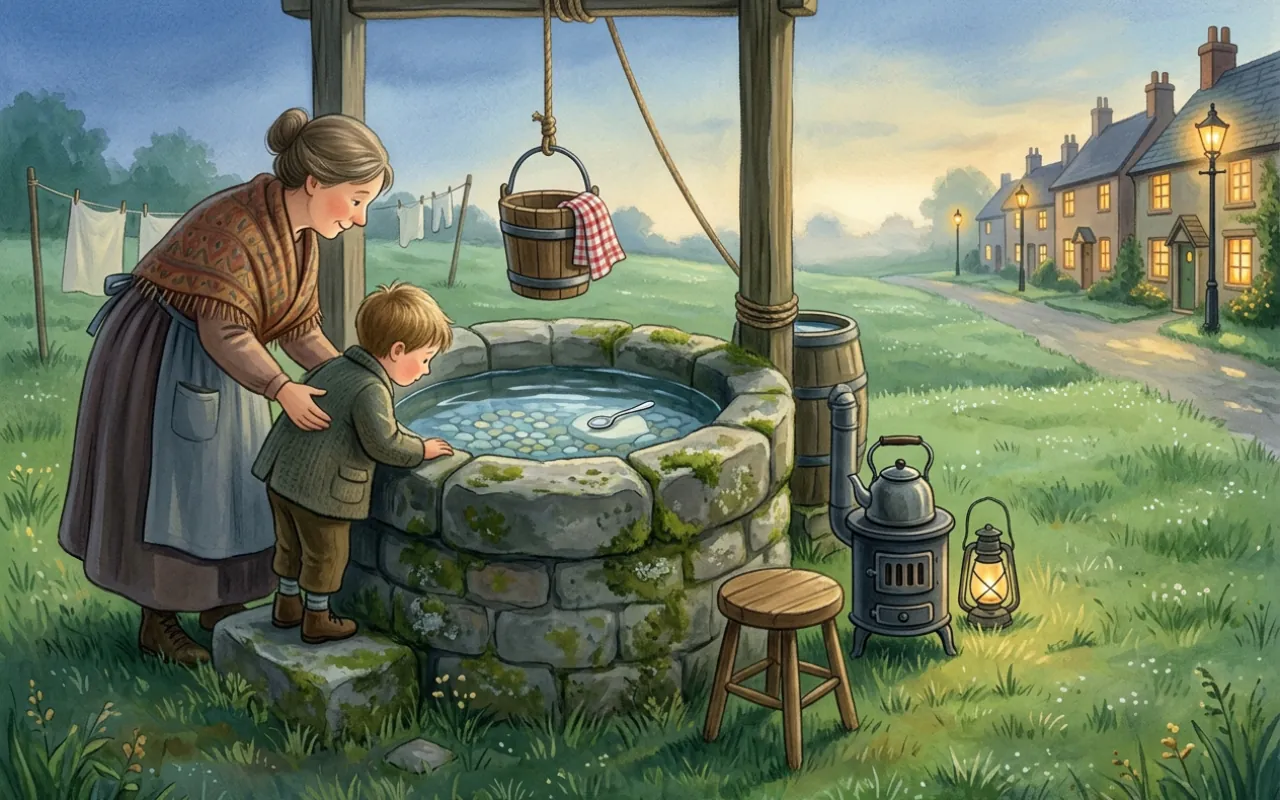
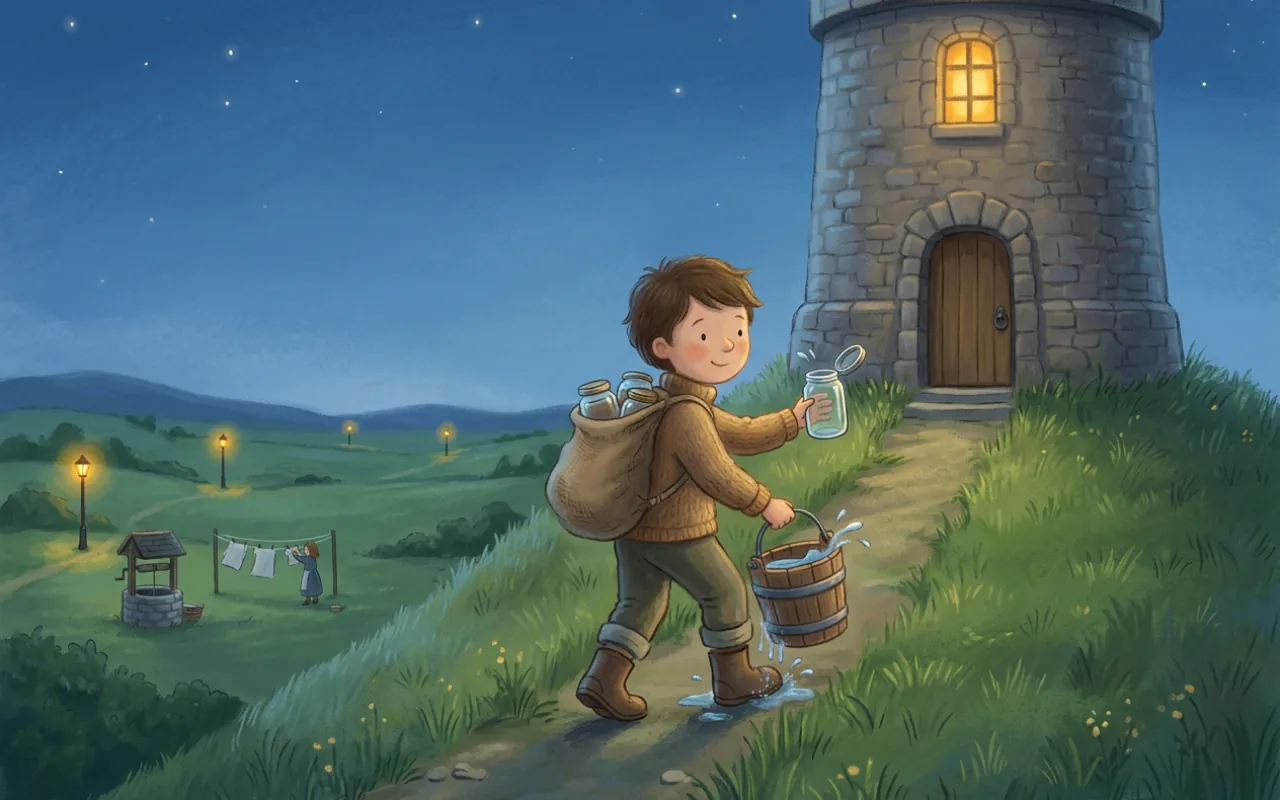
The meadow well is at the bottom of the meadow, and the observatory is at the top of the knoll, and there is a good deal of meadow in between. The apprentice carried the first bucket up and sloshed it along the edge of the door. The apprentice carried the second bucket up and sloshed it over the frame. The well keeper, taking in the washing in the last of the light, watched the second bucket go.
“What’s it for?” she said.
“The door,” said Pip. “We want it to stick.”
The well keeper looked up at the observatory on its knoll. “I’ve heard that door from down here on a wet night,” she said. “I never thought I’d see anybody water it.”
Pip insisted on carrying the third bucket, and spilled half of it on the way up, mostly into Pip’s own boots. Pip stopped on the path. Pip got out a jar. Pip took three steps beside it, squelch, squelch, squelch, screwed the lid down, and carried what was left of the water the rest of the way.
They soaked the door and the frame until the wood went dark and the step ran. Nobody in the Sky-Meadow had ever done such a thing on purpose before. Then they left it.
Maren did not come home that night, which was ordinary when there were readings to take. Pip slept on the bench by the stove under the blanket from the loft, with the sack tucked underneath and the full jars turned label-out, and nothing got out of any of them till morning.
In the morning the door was stuck.
It was stuck properly, swollen tight into its frame, the way every traveler on the ridge had promised. There was no getting out through it, so the apprentice climbed out of the window over the sink and came round to the step, and Pip stood inside with the jar open and the lid ready.
“Now,” said Pip.
The apprentice set a shoulder to the door and leaned. The door groaned. Then it thumped. Then it gave all at once, and the apprentice came through it with an “oof,” and the door banged back against the wall.
Pip clapped the lid on before the sound could get away.
“Does it always do that?” said Pip.
“It does now,” said the apprentice, rubbing a shoulder. “Again?”
Pip held the jar in both hands. “No,” said Pip. “That was the one.”
The label said: Maren’s door. Needed a shoulder. Got one.
Pip went down through the meadow with the sack on one shoulder and that jar not in the sack at all, but held in both hands. At the meadow gate Pip stopped and opened it, just once, just to check.
Out came the groan, and the thump, and the give, and then, small and heartfelt, the apprentice saying “oof.” Pip laughed out loud, all alone on the east road, and screwed the lid down tight, and laughed again on and off all the way to Ivo’s milestone.
Maren came home at noon that day, met the door with her shoulder, said “oof” herself, and wanted to hear all about it. When the apprentice showed her the notebook, she went and put her ear to the saucers, laughed out loud, and asked the apprentice what they had noticed next. The rain came back that week, and the door stayed stuck for the rest of the autumn.
Nobody in the meadow thought of planing that door. Somebody had walked four days to hear it, after all, and now everyone agreed it was a very good noise.