The Fiddler Who Wanted the North Wind to Dance
Once, in a village by a cold sea, there lived a girl called Nell who could play the fiddle better than anyone. She could play anything at all, so long as it was cheerful. She played jigs and reels and hornpipes, and she played them so fast that her bow smoked like a candle just blown out. When Nell came to visit, people in that village kept a cup of water by the door. Just in case.
Above the harbour, in a cave in the cliff, lived the North Wind. He blew all winter long, and he blew the fishing boats home crooked, so that every boat in that village came in sideways and bumped the harbour wall. The old people had a saying about him. “When the North Wind dances,” they said, “tie down your hat.” Nobody had ever seen him dance. They said it anyway, the way old people do.
That autumn the North Wind blew harder than anyone could remember. And that autumn, Nell’s dad was out at sea.
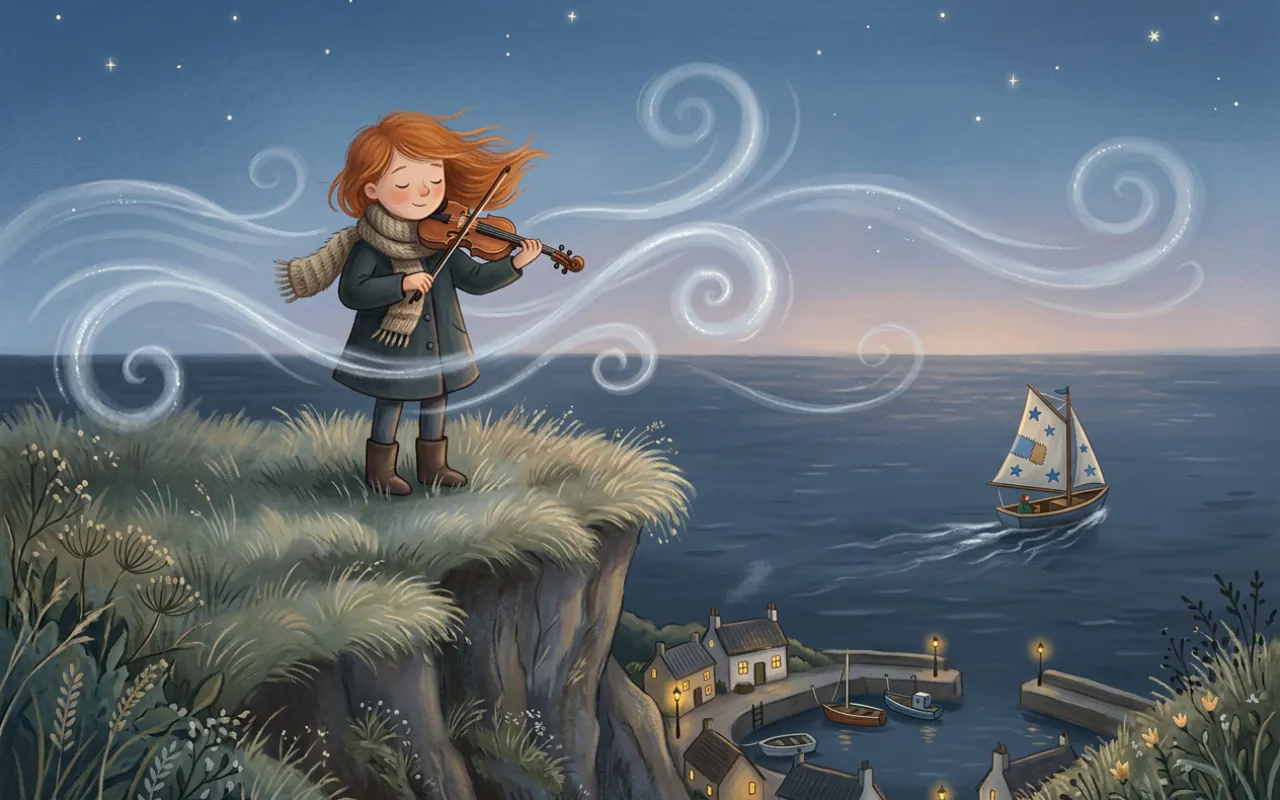
Every evening Nell stood on the harbour wall and looked for his boat. It had a brown sail with a patch on it, and the patch was a square of Nell’s old nightgown with blue stars on it. Every evening she saw the stars, far out. And every evening the North Wind blew them further away. Tomorrow was the first day of winter. After that, the old people said, no boat could get home until spring. Dad would have to spend the whole winter bobbing about out there, with nobody to talk to but the fish.
Nell wanted her dad home. She wanted it more than anything.
So she thought about it, and what she thought was this: nobody can dance and blow at the same time. She tried it in the kitchen to make sure. She was right. You can’t.
Mom said she could go up to the cave, but only as far as the mouth, and only in her thick scarf. So Nell put on her thick scarf, took her fiddle, and climbed the cliff path.
Now, you may think the North Wind is only wind. Nell had thought so too. But when she reached the top, there he was. He was a huge grey old man made of weather. He was so big that he filled the whole cave, from the floor to the roof and from one wall to the other. There were icicles in his beard. He wore a coat made of snow, and the snow kept falling off him in heaps, so he was always shivering. Every time he shivered, a gust went out of the cave and down across the sea.
“Who’s that?” said the North Wind. His voice was like a door banging in the night.
“Nell,” said Nell. “I’ve come to play you something.”
And she played her fastest jig.
The North Wind loved it. His eyes went round. His toes began to tap. He couldn’t move his feet much, because the cave was exactly his size, so he spun round where he stood, bumping his head on the roof, and icicles rained out of his beard. All the breath of his dancing went whirling out of the cave, and down below, the whole sea began to spin like tea when you stir it. The boats went round and round. In the village somebody shouted, “The North Wind is dancing! Tie down your hats!” and everyone ran for string.
Nell’s bow was smoking like a chimney. She stopped. Far out, the little patch of blue stars was spinning the wrong way, further off than ever.
“More!” said the North Wind.
“Not that one,” said Nell.
A jig was too twirly, she decided. What she needed was something steady. So she played the march the band played on the harbour on holidays, the grandest tune she had.
The North Wind liked that too. He stamped. Left foot. Right foot. The whole cliff shook. And down below, the sea stamped with him. The waves went up and came down, bang, bang, bang, all along the harbour wall, until everyone in the village was soaked, and very glad of their tied-down hats. And Dad’s boat was stamped a little further out with every beat.
Nell stopped. Her arm ached. Her bow had smoked itself out. She sat down on a rock at the mouth of the cave and very nearly cried.
“Why have you stopped?” said the North Wind. He was shivering again, and his snow was falling off in heaps.
“Because I only know cheerful tunes,” said Nell, “and they only make you dance.”
Then she remembered that wasn’t quite true. There was one slow tune she knew. It was the song Dad sang when he mended the nets. He sang it badly, too low and wobbly in the middle, but he sang it every single time:
Over and under and over again, the net goes round and the boat comes in.
Nell had never played it. It was much too slow for her. But her arm was tired, and she missed her dad. So she tucked the fiddle under her chin and played it slowly, the way he sang it, only in tune.
The North Wind stopped shivering. Then he sat down. It took a while, because he was very big. He sat on the floor of his cave with his back against the wall, and he listened. His snow stopped falling off and settled on his shoulders like a quilt.
“What’s that one?” he said, quite quietly for him.
“It’s my dad’s,” said Nell.
“Nobody has ever played me a slow one,” said the North Wind. “Nobody has ever played me anything.” And he closed his eyes.
Nell played it again, and again, and a third time. By the third time, the North Wind was asleep. He snored, but his snores came out of the cave as a soft little breeze, the kind that barely moves the washing. Down below, the sea went as flat as a plate. The boats came home on that little breeze, one after another, and every one of them came in straight, which had never happened before in the whole history of the village.
The last boat in had blue stars on its sail.
Up at the mouth of the cave, Nell saw the blue stars come in straight, and she smiled. She played the slow tune one more time, just for Dad.
Dad tied up at the harbour wall. Mom was there, and half the village was there, all still in their tied-down hats. And from high on the cliff, very faint, Dad heard his own net-mending song floating down, played properly.
He laughed out loud. “That’s mine!” he said. “It never sounded like that when I sang it.”
Up on the cliff, Nell came to the end of the tune. Then she fell asleep too, with the fiddle in her lap.
Dad climbed the cliff path, as quietly as a fisherman in big boots can, and carried Nell home. She woke up just enough to say, “You’re back,” and he said, “I heard you.”
After that, Nell went up to the cave every winter night, in her thick scarf, and played the North Wind to sleep. He always asked for the slow one, and she always played it three times. Sometimes Dad came too and sang along, badly, and the North Wind said he didn’t mind one bit.
And that is why, to this day, the boats in that village come home straight on winter nights. And if you listen hard, you can hear a slow tune coming down from the cliff.
The end.