The Jar That Kept the Wind
Sable Windreader kept the night watch on Whistling Ridge, and she kept it in pencil. Each time the wind went round, which on the ridge was every few minutes, she wrote down the time and the new direction. In the morning the carters and walkers who crossed at first light read her log, so they would know which way to lean and which hand to keep on their hats.
She wrote down everything else the same way. To Sable, most things that happened on the ridge were a kind of weather, and ought to be logged like it.
19:40. Wind west, light. Pip Underweather came up for supper with nine jars. Asked for my laugh. Wind unchanged.
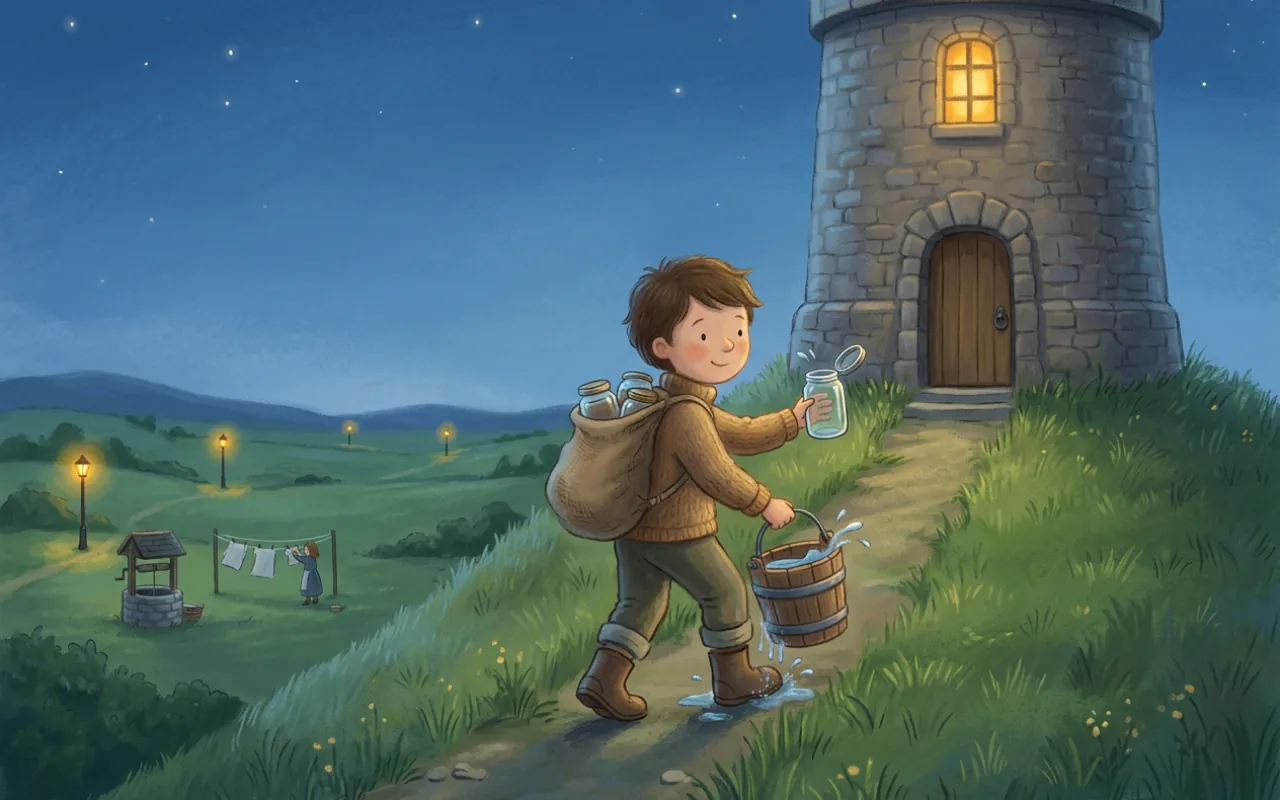
Pip Underweather collected sounds. Every jar in the basket had a label giving the time, who had made the noise, and whether they had said yes. “Nessa, dropping a ladle, 18:20, yes.” “Kettle, boiling, 19:55, didn’t ask.”
Tonight Pip Underweather had come for the sound of the wind going round, which was allowed. Pip Underweather also wanted Sable’s laugh, which was not.
“Only a small one,” said Pip Underweather, holding out a jar. “You wouldn’t have to do it on purpose. I could wait.”
“I know you could,” said Sable. “No.”
What Sable wanted from the night was very little. She wanted the wind to go round, as it always did. She wanted to write it down and hand a clean log to the first carter at dawn. And she did not want to hear herself laughing on somebody’s shelf in a year’s time, between a pan lid and a goat.
So she sat at the low board with a stone on each corner and her deck dealt low out of habit, with another stone on top. The kettle sat in a ring of stones over a little fire. Above her the two pennants flew from their pole. The plain one told her where the wind was. The other, with light in its threads, shone a little in the blue. Pip Underweather sat downwind with a jar held up and the lid ready, watching the plain pennant without blinking.
“How will I know when it goes round?” said Pip Underweather.
“Watch the pennant.”
“What if I miss it?”
“It’ll go round again.”
21:30. Wind north-west. Pip Underweather asked how to tell. Told. Wind went round anyway.
At midnight Pip Underweather caught the wind going round from north-west to north, and was just reaching for the lid, when something small and bright came down out of the blue. It fell as neatly as a dropped button and went straight into the open jar.
“Did you see that?” said Pip Underweather. “Did it make a noise? I didn’t hear it make a noise.”
Sable put down her pencil. A fleck of fallen star is no bigger than a seed, and it makes one thing behave impossibly until somebody lifts it out. Nobody gets to choose which thing.
The jar blew.
It blew out the gust it had just caught, the very same one, out of its mouth and across the ridge. Then it was quiet for a count of four. Then it blew it again. The plain pennant swung round to stream away from the jar, which was the wrong way for the whole of the rest of the ridge. The next gust went across the low board, and Sable’s cards lifted out from under their stone one at a time, as politely as if someone were dealing them, and went off over the heather.
00:02. Wind north. Also a jar.
“Lid,” said Sable.
Pip Underweather handed it over, not quickly. Sable screwed it on tight. The jar whistled one long note, like a kettle that had been working up to it, and began to spin round in circles on the stones. It went slowly at first and then quite fast, with the note going round and round with it.
One corner of Sable’s mouth went crooked.
“Do it again,” said Pip Underweather, who already had an empty jar open.
“No,” said Sable, and took the lid off. The jar stopped spinning and went back to blowing.
She took off her coat next. It was a long, heavy coat that had been on the ridge longer than Pip Underweather had been alive. She wrapped the jar up in it, sleeves round twice and knotted at the front. For a moment there was nothing. Then the coat began to fill. It filled in the back, then the shoulders, then down both arms, and then it stood up on its own on the heather. It stood there with its collar up and its arms a little out from its sides, exactly like a guest at a party who is waiting to be introduced.
“Pip Underweather,” said Pip Underweather to the coat.
The coat strolled off across the heather towards the ridge path, at the easy pace of somebody who has heard there is soup. Pip Underweather ran after it and brought it back by one sleeve.
It should be said, in fairness to the coat, that it had never done anything of the kind before, and never did again.
Sable’s mouth went crooked again.
“Do it again,” said Pip Underweather.
“Get the jar out of my coat,” said Sable.
Once the jar was out, the coat was a good deal colder than it had been. Sable put it on anyway, and a quarter of an hour later she sneezed. Pip Underweather caught it.
“Can I keep that?”
“No.”
Pip Underweather wrote a label, “Sable, sneeze, 01:15, refused”, and put the jar in the basket with the others.
01:15. Wind east. I sneezed. Pip Underweather has it.
The third thing Sable tried was sitting on it. She laid the jar on its side with its mouth in the heather, and sat down on it firmly, the way she would sit on a tent that wanted to go somewhere. She meant to stay there until dawn if that was what it took. The first gust went out under her, came up round her back, and took her hat clean off her head. The hat sailed up and landed on top of the pennant pole, and it stayed there. Underneath it the plain pennant went on pointing the wrong way.
Pip Underweather had a jar open before Sable had even looked up.
“No,” said Sable, before anyone could ask.
02:10. Wind north-west. Pip Underweather asked a question. Wind unchanged.
The question had been whether Pip Underweather could keep the jar for ever. “It would have your shelf off the wall in a week,” Sable had said, which was true.
Now, a sensible person might have given up at this point and gone down the hill. Sable was not especially sensible. She was patient, which lasts longer. She had once watched a ledge of grass for four hours, waiting for it to lie flat, and when it did she had said, “There,” and nothing else.
So she stopped trying to make the jar do anything, and she watched it. She sat with the jar between her boots and the log on her knee, and she watched it blow.
At three Pip Underweather fell asleep against the basket. Sable fetched the blanket out of the board box, tucked it round twice, and put a stone on the corner, because it was the ridge. She moved the kettle nearer the fire so there would be tea.
03:00. Wind north. Pip Underweather asleep. Kettle on.
Then she went on watching. One, two, three, and the gust was gone. Four quiet. One, two, three, gone. Every time, the pennant lifted to the same height. Every time, it pointed at the same tuft of heather. She held her hand out flat in front of the jar, and the gust pushed it exactly as hard as it had the time before, and the time before that.
In all her years on Whistling Ridge the wind had never once done the same thing twice. This little wind had done the same thing two thousand times since midnight.
Sable went very still. Then, quite suddenly, she was on her knees at the board box.
Anything that moves the same way twice can go on a card. Everybody knows that. At the bottom of Sable’s board box, under a small field board she kept for writing down gusts, there was a stack of cards with three or four strokes on each and then nothing. The ridge had never obliged her past the fourth stroke.
“Pip Underweather. Up.”
Pip Underweather came up out of the blanket all at once. “Is it the laugh?”
“It’s the jar. Lid on. When I say, take it off. When I say, put it back.”
She set the field board on the low board and lit the little lamp in its corner, which pays light for every try. Then she counted, and Pip Underweather lifted the lid, and the gust went across the board, and Sable drew one stroke. Then the lid went back on, and the jar whistled and spun until she counted again.
They did it eleven times. The little lamp went down a little each time. Pip Underweather did not ask a single question, and Sable noticed. On the eleventh gust she drew the last stroke, put her mark under it, and named it.
“Steady,” said Pip Underweather, reading upside down. “Is that it?”
“That’s what it does,” said Sable.
04:30. Wind north-east. Pip Underweather asked nothing for eleven counts. Card written.
At dawn Sable took the sugar tongs out of the kettle tin and lifted the fleck out of the jar. It sat bright on the flat stone for a moment, then less bright, and then it was a dull grey speck no bigger than a crumb. The jar was only a jar. The plain pennant swung round to where the real wind was. Sable left her hat on top of the pole for now.
Pip Underweather looked into the empty jar for a while.
“It was a good wind,” said Pip Underweather. “I’m glad it fell in mine.”
“So am I,” said Sable. She tipped the grey speck into the jar and screwed the lid on. “For your shelf. It won’t do anything.”
The low board was wet with dew. Sable laid Steady on its edge, and a little breeze came out of the card, one, two, three, the very same breeze as the jar’s. The dew went off the wood in a single sheet. Then she gathered up her cards, which Pip Underweather had picked out of the heather at first light, and she dealt Pip Underweather a hand. Low, out of habit.
And the ridge wind, which had never once obliged her, dropped to a breath from the south and stayed there for the whole of one hand. Every card stayed exactly where she put it. Not one corner lifted. Pip Underweather’s Rain Cloud sat over the board as calmly as a hen on a nest, and did not drift an inch.
Sable looked at her cards, sitting perfectly still on her own board after the night they had all had, and she laughed out loud. It was not a small one.
Pip Underweather had a jar open, of course.
“Do it again,” said Pip Underweather.
“No,” said Sable. “Keep that one.”
So Pip Underweather wrote the label then and there, “Sable, laugh, 05:40, yes”, and put the jar in the basket very carefully, at the top.
Then Sable picked up her pencil and wrote the last line of the watch, for the carters who would be along any minute.
05:40. Wind south. I laughed. Pip Underweather has it.