The Littlest Wind in the Bears’ Den
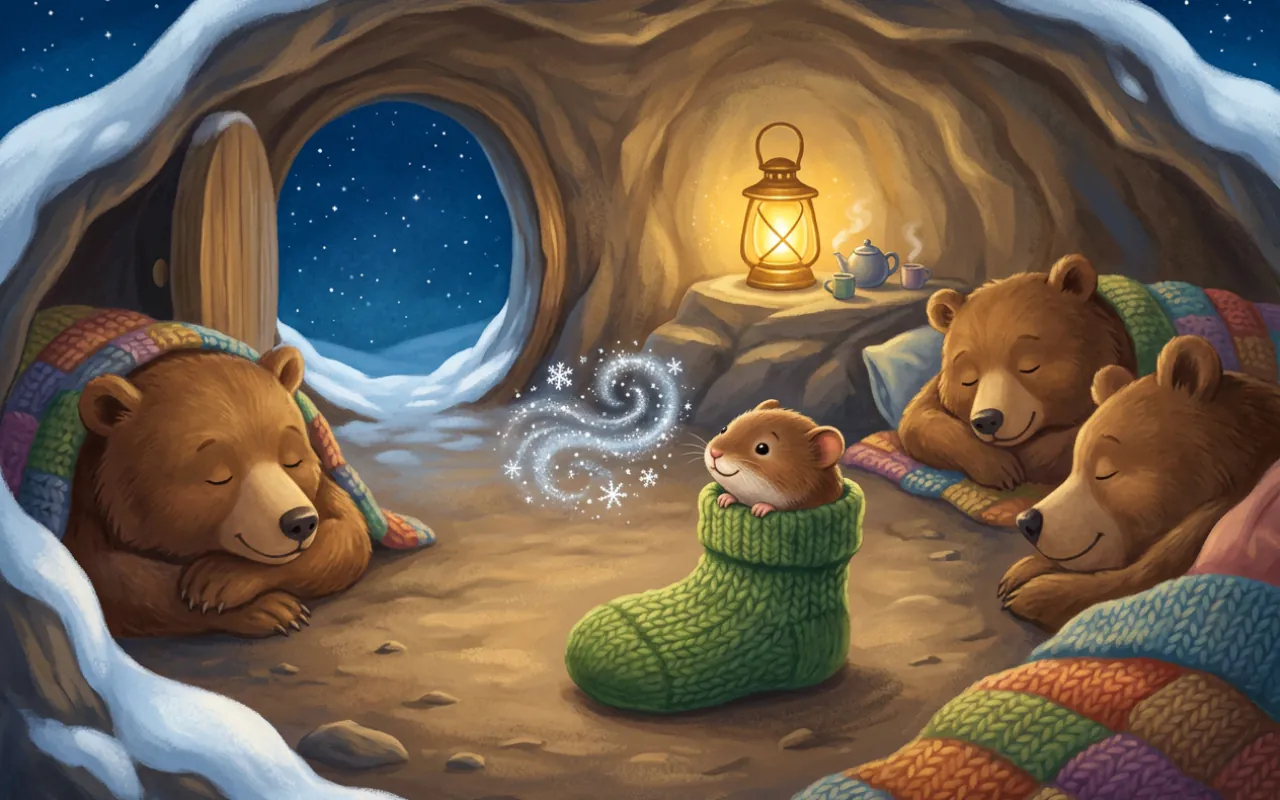
The bears’ den was dug deep into a snowy hill, and on the last night of autumn the snow came up to the door. That was the sign. When the snow is up to a bear’s door, the bear goes to bed and does not get up again until spring.
There were three bears in the den that year, and one vole.
The vole was called Nib. She had come in one wet evening through a crack in the rock at the back of the den, carrying a hazelnut, and said, “Is this anybody’s?” Nobody was sure if she meant the den or the hazelnut. Mrs. Bear went and fetched a sock.
Mrs. Bear knitted all autumn, and her socks were big, because bears have big feet. This one was green. “You can sleep in the toe,” she said. “I’ll knit it double for you, to keep the cold out.” And she did, that very night, while Nib sat on her knee and watched the needles go.
Nib said thank you for that sock every night, and meant it every time.
So, on the last night of autumn, Mr. Bear pushed the door shut against the snow. Mrs. Bear lay down in the straw with the sigh of a bear who has knitted fourteen socks since summer and would very much like to be asleep. Grandfather Bear lay down with his spectacles on. He always wore them to bed, in case he dreamed something he wanted to read.
Nib was so tired her whiskers drooped. All she wanted was the door shut, the bears breathing slow, and the long winter sleep beginning for all of them together.
On her way to her sock she met a snowflake that had slipped in as the door closed.
“Excuse me,” Nib said to it, and waited for it to land.
It did not land. It went back up, and so did the others that had come in with it. They gathered in the middle of the den and spun, round and round, in a little whirl about the size of a teapot.
“That’s a wind,” said Mr. Bear. “A baby one. It’s blown in with the snow.”
The little wind went on a tour of the den. It left a tiny drift of snow on the end of Mr. Bear’s nose, and another on Mrs. Bear’s. It breathed on Grandfather Bear’s spectacles and drew a frost pattern on each lens, a curly one on the left and a starry one on the right.
“Who’s that?” said Grandfather Bear, who could now see nothing but frost.
Then the little wind whistled three notes. The first went up, the second went up a little more, and the third came halfway down, as if it were about to land somewhere nice. Then there was no fourth note. There were only three bears and a vole, lying very still, waiting for it.
It never came. The little wind just started again from the beginning.
Anybody can sleep through a noise. Nobody can sleep through a tune with its last note missing.
“It goes down,” said Grandfather Bear, from behind his frost. “The fourth note. Down.”
“Up,” said Mr. Bear.
“I don’t mind which way it goes,” said Mrs. Bear, “as long as it goes.”
Nib lay in the double toe of the green sock and wanted everybody in the den asleep so much that her whiskers ached. Herself too, but mostly the bears, who had been so kind to her.
Mr. Bear tried first.
“I’ll blow it out,” he said. He opened the door a crack at the top, took the biggest breath a bear can take, and blew.
Now, a bear’s breath is a wind of its own, so all Mr. Bear had done was make more wind. The little one thought this was a game. It spun twice as fast and whistled twice as loud, and it did not go out of the door at all. Mr. Bear shut the door and sat down with snow in his fur.
Then Grandfather Bear tried.
Grandfather Bear believed a hat would fix anything. He had once put a hat on a pie that would not cool, and he said it had come right in the end. He felt his way across the den, because of the frost, and put his woolly hat down over the little wind.
The den went quiet. Grandfather Bear smiled.
Then the hat lifted off the floor by itself and went round the den. It went round for a whole hour, bobble first, whistling three notes from the inside. Grandfather Bear followed it twice, saying, “Steady, now,” and then sat down. At the end of the hour the hat flopped over in a corner, and the little wind came out as lively as ever.
Then Mrs. Bear tried.
“If I can’t hear it,” she said, “I can sleep through it.” She took two pawfuls of snow from beside the door and packed them into her ears.
All she got was cold ears. She could still hear the whistling, only now it came through the snow, very faint and thin.
“It sounds so small,” said Mrs. Bear.
Nib listened, and thought Mrs. Bear was right. It did not sound like a wind playing a game. It sounded like a wind that had blown in by mistake and could not remember the way out.
So Nib got up.
“Excuse me,” she said to the sock, because she had to tread on its heel to get out.
She pattered across the floor and stood in front of the little wind. It was about the size of a teapot. Nib was about the size of the teapot’s lid.
“Excuse me,” Nib said to the little wind. “Are you lost?”
Nobody had asked it anything all night. It had been blown at, and sat on with a hat, and shut out with snow. Now the little wind stopped spinning, and its snowflakes hung still in the air. Then it whistled once, the first note only, which was as near to yes as a wind can get.
“I thought so,” said Nib. “Come with me. I know another way.”
She led it to the crack at the back of the den, the one she had come in by with her hazelnut. A bear could not have got a claw into it. Even a vole had to breathe in.
“You’ll have to make yourself thin,” said Nib.
The little wind made itself thin, like a thread of snow pulled through a needle, and up they went through the rock together.
The crack came out on the top of the hill, under a big moon. Along the hilltop the other winds were going by, big winter winds carrying snow from one valley to the next, and as they went they whistled a tune. It went up, and up a little more, and halfway down. And then it had a fourth note.
The little wind listened. It whistled its three notes, the way it always did. And then, for the first time, it whistled the fourth.
It went down, as it happens. Far below, the bears heard it faintly through the rock. Grandfather Bear said, “Told you.” Mr. Bear said, “Down, then,” and was asleep before he had finished saying it.
“Will you do something for us?” Nib said to the little wind. “In the spring, when the snow goes down from the door, come back and wake us. Gently, mind.”
The little wind went round her once, very lightly, which Nib took for a yes. Then it went off over the hill with the big winds, whistling all four notes, until it was too far away to hear.
Nib went back down through the crack.
The den was quiet. Mr. Bear was asleep with his paws over Mrs. Bear’s ears, to warm them. Grandfather Bear had felt his way to his hat and put it back on. “There,” he said, without opening his eyes. “A hat fixes anything.” Then he was asleep too, with the frost still on his spectacles, which gave him something to read all winter.
Mrs. Bear was not asleep. Mrs. Bear, who wanted to sleep more than anybody, had waited up. When Nib climbed into the green sock, a big paw came down and tucked the double toe in round her.
“There you are,” said Mrs. Bear. “I wasn’t going to sleep with you out on the hill. I’m glad you’re back.”
“Thank you,” said Nib.
Then Mrs. Bear slept, and Nib slept, and nobody whistled anything at all. Every bear and one vole slept the whole winter through, while the snow came up over the door and over the top of the hill.
In the spring, when the snow had gone down from the door, the little wind came back, just as it had been asked. It came in through the crack and went round the den as softly as a wind can go. It blew on three bear noses and took the frost off Grandfather Bear’s spectacles. And at the toe of a green sock it whistled all four notes of its tune, very quietly.
Nib opened one eye. “Thank you,” she said to the little wind. Then, because it was still very early, and the toe of her sock was knitted double, she shut her eye again and slept a little longer.