Mags Brings the Clouds Home
On Hill Farm the clouds were let out in the morning to wander the sky, and every evening they were brought home to sleep in the big stone fold, the way other farms bring in their sheep. Each cloud wore a little bell on a ribbon. On a windy day the whole valley could hear them, very high and very small.
Mags was the cloud-herder in training. There were forty clouds, and she had named every one, and she had an opinion about each. Bertha was bossy. Pillow was the best cloud on the farm, and knew it. Gray Ned sulked but always came when he was called. Lumpy was the oldest and the slowest, and he would only go into the fold if somebody hummed to him. Little Puff was the smallest, and in Mags’s opinion a nuisance, because every evening without fail Little Puff wandered off to look at the sea.
“Tonight I want to bring them in by myself,” Mags said at supper. “All forty. You only do the winch.”
Mom looked at her over the teapot. “All forty?”
“Even Little Puff,” Mags said.
Mom thought about it for as long as it took to butter a crust. “All right,” she said. “I’ll do the winch. And I’ll do the count, because somebody has to shout it.”
Under the table, Honk the goose woke up and said, “Honk,” which meant Honk was coming too. Honk was the farm’s cloud-dog. Nobody had ever told Honk that a cloud-dog is usually a dog, and nobody was going to be the one to say so.
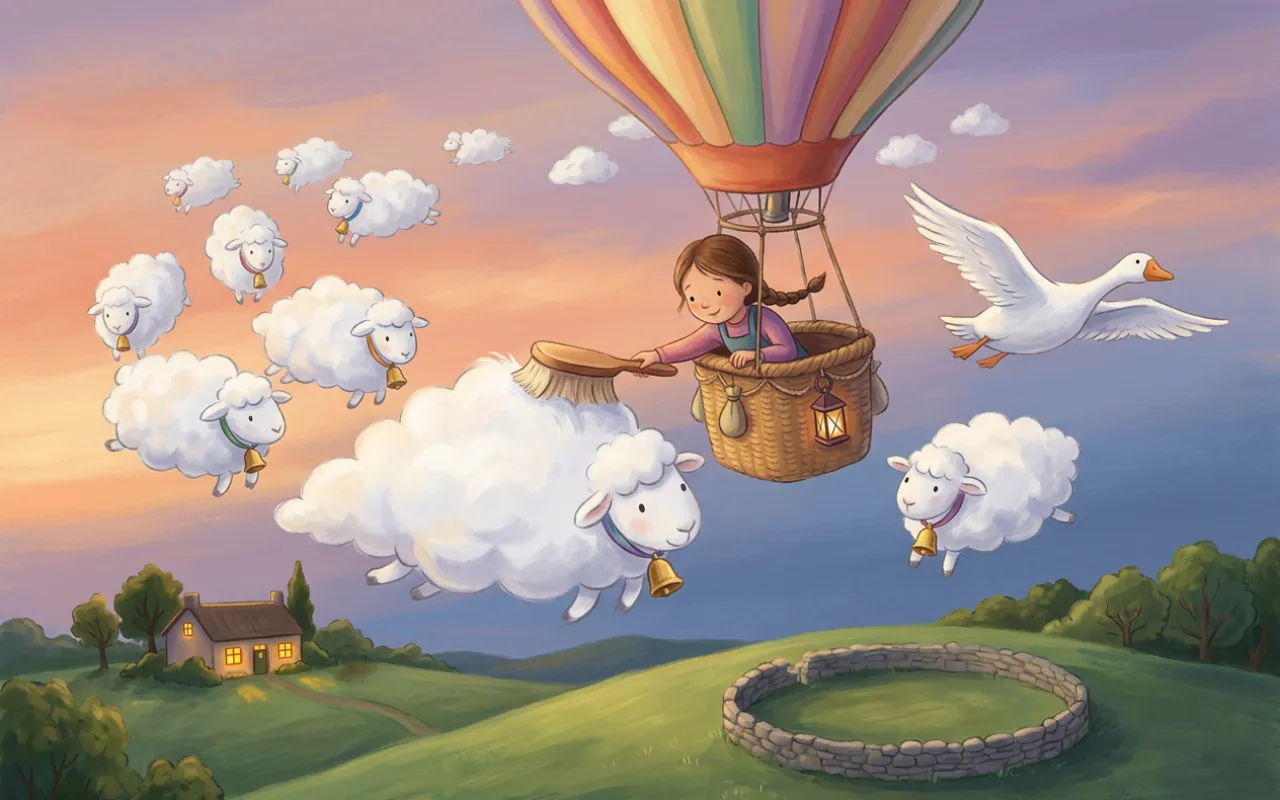
The basket was round and brown and just big enough for a girl. It hung under a little striped balloon, it had a square sail for steering, and a long rope ran from the bottom of it down to the winch by the fold gate. In the basket Mags had her bell, her brush and a knitting needle.
The knitting needle was for counting. A cloud cannot be counted on fingers, because fingers go straight through. But a knitting needle goes in just a little way, and the cloud gives a small surprised tink, and then it has been counted.
Mom lit her lantern and let off the brake, and the winch began to turn. The basket went up past the chimney. It went up past the top of the hill, and up past the rooks going home to bed, and up into the evening, until Mom and her lantern were the size of a button. Mags leaned right over the side to wave. She liked it best up here, where everything was in front of her.
The sky is very large when you are in the middle of it. That is the main difficulty of cloud-herding. The other difficulty is the breeze. Tonight it was a light one, and it kept nudging the basket out toward the sea. Mags turned her sail and nudged it back.
Then she rang her bell.
It was a bigger bell than the clouds’ bells, with a deeper note. All over the sky the clouds heard it and turned round, slowly, the way cows turn when someone rattles a bucket. Honk flew out round the back of them, honking. Honk did not need to be as loud as that, but Honk felt it helped.
Here they came, in ones and twos, big and white and gold at the edges, all their bells going. As each cloud passed the basket, Mags brushed it.
Clouds get very tangled after a whole day in the wind, and nobody likes to go to bed in a tangle. Mags brushed long and slow, front to back. The combings came off soft and gray and fell away below as a fine rain. It fell on the bean rows in the valley, and on the cabbages, and on the lettuces in their neat lines. Down in the gardens, people who had been about to fill their watering cans looked up, and smiled, and put them away again.
Then Mags gave the cloud a poke with the knitting needle and called its name.
“Bertha!”
“One!” Mom’s voice came up from a long way down.
And so it went, all the way round the sky. Bertha went in bossily. Gray Ned went in sulking, but he went. Mom’s count came up through the evening air, and Mags called back the names, and the fold below filled up with soft white, like a bowl filling with milk.
“Spoon!”
“Thirty-one!”
“Pillow!”
“Thirty-two!”
“The Twins!”
“Thirty-three!”
The Twins were really one cloud, but it had never made up its mind. Then came Dumpling and Mrs. Wobble and Toast and the others, all the way up to thirty-eight. And then there was Lumpy, half a sky behind.
Lumpy was the oldest cloud on the farm and the biggest, and he did not hurry for anybody. He did not hurry for the bell. He did not hurry for Honk, who flew three times round him, honking. He just hung there, large and gray and comfortable, looking at nothing in particular.
So Mags hummed.
Lumpy’s tune was “The Wheelbarrow Song.” It had eleven verses, all of them about a wheelbarrow, and in Mags’s opinion it was the worst song ever made. But it was Lumpy’s favorite, and it was his bedtime, so she hummed every verse. She even hummed the ninth, where the wheelbarrow loses a wheel and nothing else happens.
By the third verse Lumpy had started to move. By the seventh he was beside the basket, and Mags brushed him all over. That took a long time, and it rained gently on half the valley. By the eleventh verse he was settling down into the fold like a very old dog onto a rug.
“Lumpy!” Mags called, and poked him.
“Thirty-nine!” came Mom’s voice. Then: “And?”
“I know,” Mags said. She already knew where to look.
Little Puff was out over the sea.
Mom let out the very last of the rope. All evening the breeze had been nudging Mags toward the water, and now she let it. It carried the basket past the edge of the hill and over the cliffs and over the harbor, and Honk came too, quieter now.
And there was Little Puff, small and white, hanging over the water with its bell perfectly still.
Mags had a speech ready. It began, “Every single night,” and went on from there. But then she saw what Little Puff was looking at, and she kept the speech to herself.
The boats were coming home. There were six of them, each with a lamp at the front. They came round the point one after another and slid into the harbor, and their lamps went along the water and stopped, one by one, at the quay. Somebody on the quay was waving with both arms.
Little Puff, Mags saw, was doing exactly what Mags did every evening. It was waiting until everybody was in.
Mags watched with Little Puff for a minute. It was a very good minute. When the last boat came in and its lamp stopped beside the others, Mags changed her opinion of Little Puff, which was not a thing she did often.
“They’re all home now,” she said. “Come on. Our turn.”
She did not ring the bell. She did not need to. Little Puff came along beside the basket the whole way back, close enough to touch. At the fold Mags brushed it very gently, so that only a handful of rain fell, on one lettuce, in one garden.
“Little Puff!”
“Forty!” Mom’s voice came up, and it sounded very pleased.
Down below, Mom swung the fold gate shut and dropped the latch. Up above Mags, the sky over Hill Farm was clear from one side to the other, and full of stars.
She sat down in the bottom of the basket to rest her eyes for one moment, and that was the end of being awake.
Mom wound the winch very slowly, so as not to wake her. When the basket touched the grass, Honk was already asleep on the fold wall, with Honk’s head tucked under one wing. Mom set the lantern down and stroked Honk’s back.
“Forty-one,” she said quietly.
Then she lifted Mags out of the basket, knitting needle and all, and carried her across the yard and up to bed, and tucked the blanket round her.
“Forty-two,” Mom said. “All in, and you did it by yourself. I’m proud of you.”
“Little Puff’s all right, actually,” Mags said, without opening her eyes.
“Yes,” Mom said. “I’ve always thought so.”
And that was everybody: forty clouds asleep in the fold with their bells gone quiet, one goose on the wall, and one cloud-herder in her bed, every one of them counted and home. The end.