Gus Gives Away His Cave
Up above the frozen stream there is a pine wood, and in that pine wood there lived a large brown bear called Gus. Gus wore a scarf. It was a fine scarf, gray and warm, and it was far too long for him, so that a full bear’s length of it dragged behind him through the pine needles wherever he went. He had never noticed. Squirrels sometimes rode on the end of it for a while and got off again, and he never noticed that either.
What Gus had noticed, and what he wanted everyone else to notice, was his cave.
He had been getting it ready for six weeks. He had swept it. He had carried out four stones he did not care for. And he had laid the moss on the floor in stripes: a stripe of pale green, then a stripe of dark green, then pale, then dark, all the way to the back wall. Gus thought this was simply how moss went. When anybody passed on the path he came out and said, “Would you like to see the stripes?” and they always did, because he was so pleased about them.
What Gus wished for was this. He wanted to sleep all winter in his own beautiful cave, on his own striped moss, warm and quiet and unbothered, until the stream came unfrozen and it was spring.
Now, I should tell you the rule of that wood, because everybody in it knows the rule and you ought to know it too.
In the pine wood, the animals talk, and the wood keeps count. Whatever a bear gives away in autumn, the wood gives back in spring, and it always gives back more. Nobody knows who set that rule. Nobody remembers it being set. The wood simply does it, the way the stream simply freezes, and in all the winters anyone could count it had never once forgotten.
The first snow came sideways, because the winter in that wood is long and the wind has strong opinions. Gus went into his cave, turned around three times, lay down on the stripes, and shut his eyes.
Somebody knocked.
Gus opened one eye. Then he sighed, the enormous slow sigh of a bear who has just got comfortable, and he said, “Well. Come in, then.”
In came Mrs. Pin, and behind her came her hedgehogs, in a line, all snowy.
“Our hollow filled up with water,” said Mrs. Pin. “I have eleven. Let me count. One, two, three, four, five, six, seven, eight, nine, ten.” She frowned. “Ten.”
I counted them too, and I got ten, and there were eleven, and there is no explaining it.
They shuffled to the back of the cave and settled in a heap that gently rustled. Gus lay down along the front like a doorstep and shut his eyes again.
Somebody knocked.
Gus opened one eye. He sighed. And he said, “Well. Come in, then.”
It was an owl, blown so sideways she had arrived walking. “I cannot fly in that wind,” she said. “It keeps putting me back where I started.”
So the owl came in. She hooked herself onto a knob of rock near the roof and slept upside down. Nobody mentioned it then or afterward. I am only mentioning it because you would want to know.
Gus lay down again. He was still, for a bit, on the very edge of the pale green stripe.
Somebody knocked.
Gus opened one eye. He sighed, longer than before. And he said, “Well. Come in, then.”
In came Digby, a badger, apologizing before he was through the door. “Sorry. So sorry. My sett collapsed, and I’m sorry about that, and I’m sorry about the mud, and I’m sorry about being sorry, I know it’s a lot.”
“Come in,” said Gus.
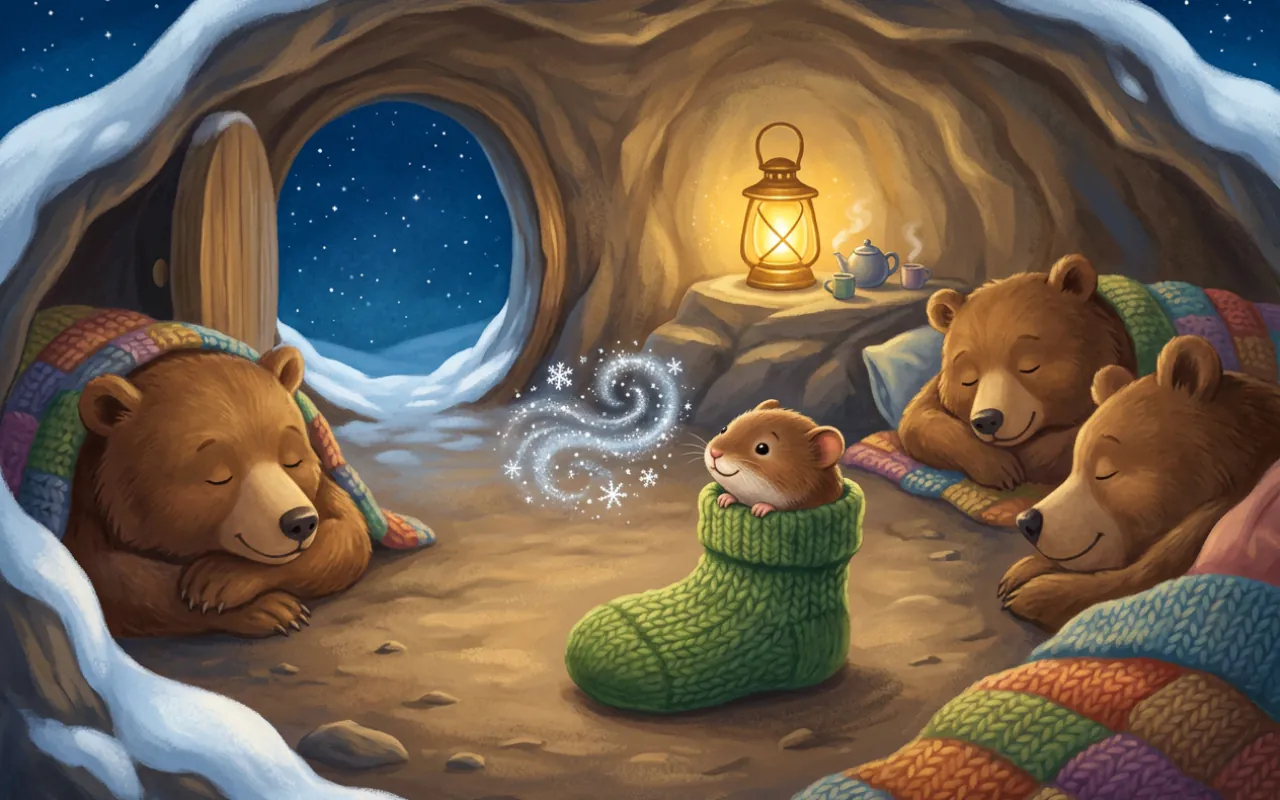
And that was the cave full. Eleven hedgehogs at the back, an owl upside down at the top, a badger apologizing in the middle, and no room at all for a large brown bear.
So Gus took his scarf and went out and found a hollow log.
It was, and I want to be honest with you, a bad log. It was a log for a smaller bear, or possibly for a fox with ambitions. Gus got his head in and his shoulders in and most of his middle in, and his feet stuck out the end and stayed there all winter, with snow on them.
He slept badly. He complained beautifully. All through the deep of the winter, anyone going past heard a voice come out of the log. It said, “My feet are outside.” It said, “There is a bump under me shaped like a hedgehog, and there is no hedgehog.” And once it said, “I have been thinking about the stripes.”
But not once, not one single time, did Gus ask for his cave back. Mrs. Pin came to say sorry about it. He told her the hedgehogs were to stay where they were warm. Then he said, “How many have you got?”
“Ten,” said Mrs. Pin.
They both agreed that was a good number.
Then the wind wore itself out, and the stream came unfrozen, and it was spring.
Gus woke up.
He knew at once that something was wrong, because his feet were warm. His feet had not been warm since autumn. He opened both eyes.
He was not in the log. He was lying in a cave. It was not his cave. His cave had been a good ordinary bear-sized cave, and this one went back and back into the hill, twice as big, with a proper high roof.
Eleven hedgehogs had dug it, all winter, working nights, because hedgehogs dig beautifully and Mrs. Pin will not have idleness. Digby had roofed it with fitted stones and packed earth, apologizing to each stone as he set it. And on the floor, all the way to the back wall, the moss was laid in stripes. Pale green, dark green, pale, dark. The owl had remembered the stripes. She had watched them for a whole winter, upside down, and she had got them exactly right.
That is how the wood keeps its promise. It does not do the digging itself. It sends friends.
Gus walked to his doorway. His scarf came along behind him, a full bear’s length of it, as it always did.
He looked back in at the moss for a long moment.
“The stripes,” said Gus, “are exactly right.”
Then he went in, turned around three times, lay down, and slept for another two weeks.
And that is the whole of it, and here is the moral, said once: a bear who shares his cave gets a bigger cave.
The end.